WordPress two-factor authentication (2FA) adds a second verification step to your login process. Even if someone gets hold of your password, they still cannot access your site without the second factor.
This guide covers what 2FA is, why it matters for WordPress sites, the best plugins to use, and how to set it up step by step.
To add two-factor authentication in WordPress, install a 2FA plugin like WP 2FA or miniOrange Google Authenticator, activate it, and follow the setup wizard to choose your authentication method — such as TOTP app, SMS, or email code. Then enforce 2FA for all user roles from the plugin settings. The entire process takes under ten minutes and works on any WordPress site without coding.
What is Two-Factor Authentication?
Two-factor authentication (2FA) is a login security method that requires users to verify their identity in two separate ways before gaining access to an account.

Two-factor authentication requires you to verify your identity twice before logging in: your password plus a one-time code, fingerprint, or hardware key.
Even if someone steals your password, they cannot get in without your second factor. The code expires in seconds and cannot be reused.
This also protects you from phishing attacks. A fake login page can steal your password but cannot generate your second factor.
Want an Extra Layer of Protection for Your Website?
Our 24/7 WordPress support services can help you secure your site and implement two-factor authentication for added protection.
Reasons Why Two-Factor Authentication is Important for WordPress Websites
Two-factor authentication (2FA) is crucial for WordPress websites due to several compelling reasons:
Enhanced Security
Passwords alone can be vulnerable to various threats, such as brute-force attacks, in which automated tools repeatedly try different combinations to crack them.
By requiring an additional authentication factor, like a code sent to a mobile device, 2FA significantly strengthens the security of WordPress websites.
Mitigation of Password-related Risks
Many users use weak or easily guessable passwords, or reuse them across multiple accounts.
This is a significant security risk, as a compromised password can lead to unauthorized access to the WordPress site.
With 2FA, even if a password is compromised, an attacker would still need access to the second authentication factor, adding a critical layer of protection.
Protection Against Credential Stuffing
Credential stuffing occurs when attackers use stolen username/password combinations from one website to gain unauthorized access to other websites.
With 2FA in place, even if attackers have obtained login credentials from elsewhere, they would still need the additional authentication factor to successfully access the WordPress site.
Defenses Against Phishing Attacks
Phishing involves tricking users into providing their login credentials through fake websites or emails.
2FA can thwart such attacks because even if users unwittingly provide their passwords to phishing sites, the attackers would still need the second factor to gain access.
Compliance Requirements
In certain industries or jurisdictions, regulatory standards or compliance requirements mandate the use of additional security measures like 2FA to protect sensitive data.
Implementing 2FA ensures compliance with these standards and helps mitigate the risk of non-compliance penalties.
Protecting Valuable Content and Data
Many WordPress sites contain valuable content, sensitive information, or customer data. Implementing 2FA helps safeguard this valuable digital asset, preventing unauthorized access and potential data breaches.
Reputation Management
A security breach can tarnish the reputation of a WordPress site owner or organization, leading to a loss of trust among users or customers.
By implementing 2FA and demonstrating a commitment to robust security measures, WordPress site owners can enhance their reputation and build trust with their target audience.
Best WordPress Two-Factor Authentication Plugins
When it comes to securing your website, WordPress two-factor authentication plugins can play a crucial role. Here are some of the best WordPress 2FA plugins to fortify your site’s defenses.
WP 2FA: Two-factor Authentication for WordPress
WP 2FA is a popular two-factor authentication plugin for WordPress, boasting over 100,000 active installs.
It swiftly enhances website authentication, enabling users to set up 2FA within minutes through intuitive, customizable wizards.
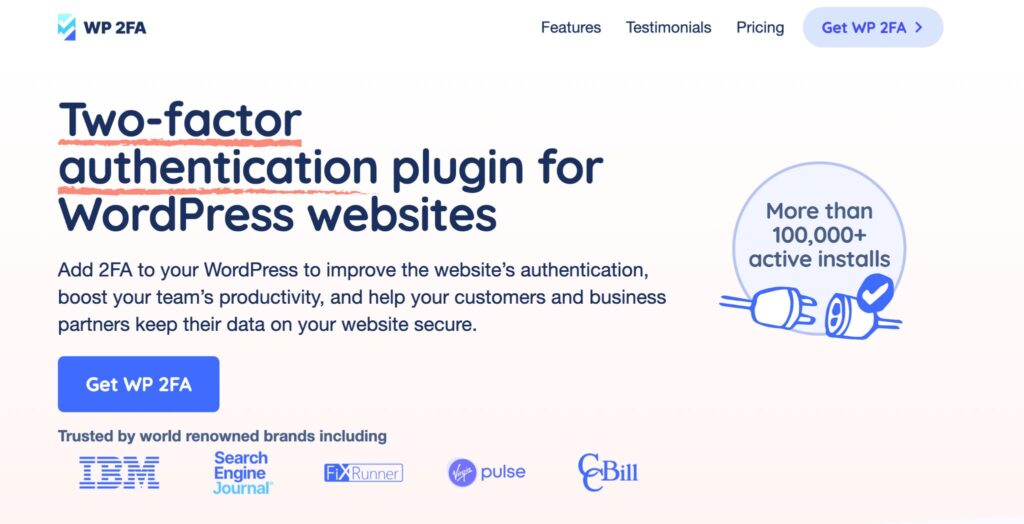
With WP 2FA, users can securely log in from anywhere, ensuring robust login security.
Features:
- Easy to use and simple to set up
- Choose from multiple 2FA methods
- Fully configurable 2FA policies
- Universal 2FA app support
- Third-party services integrations
- Support for custom login pages
Pricing: WP 2FA offers a free basic version for easy two-factor authentication setup on WordPress sites. The PRO option includes:
- Premium at $79/per year: 2FA solution for any type of WordPress website.
- Enterprise at $89/per year: Offers white-labeling and priority support for comprehensive solutions.
miniOrange’s Google Authenticator: WordPress 2FA Authentication
miniOrange’s Google Authenticator is a user-friendly WordPress two-factor authentication plugin that swiftly implements 2FA with an intuitive setup wizard.
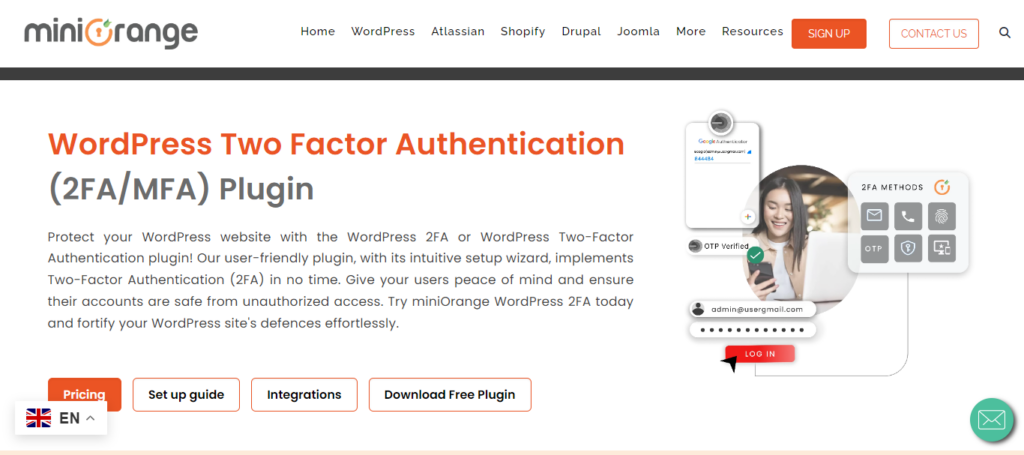
Compatible with 80+ login forms, themes, and LMSs, it ensures account security and offers seamless integration with LearnDash, LifterLMS, and more.
Features
- Password-less authentication
- Custom SMS gateway
- Back-up login methods
- Risk-based access
- Customizable login UI popup
- Multiple WordPress website support
Pricing: miniOrange’s Google Authenticator offers a free lifetime plan. For broader coverage, there are the:
- Starter plan at $69/year/1 site for unlimited users
- Enterprise plan at $99/year/1 site for unlimited users
- All-Inclusive plan at $149/year /1 site for unlimited users
Two-factor Authentication WordPress Plugin
This two-factor authentication WordPress plugin, from the creators of UpdraftPlus, secures logins with one-time codes.
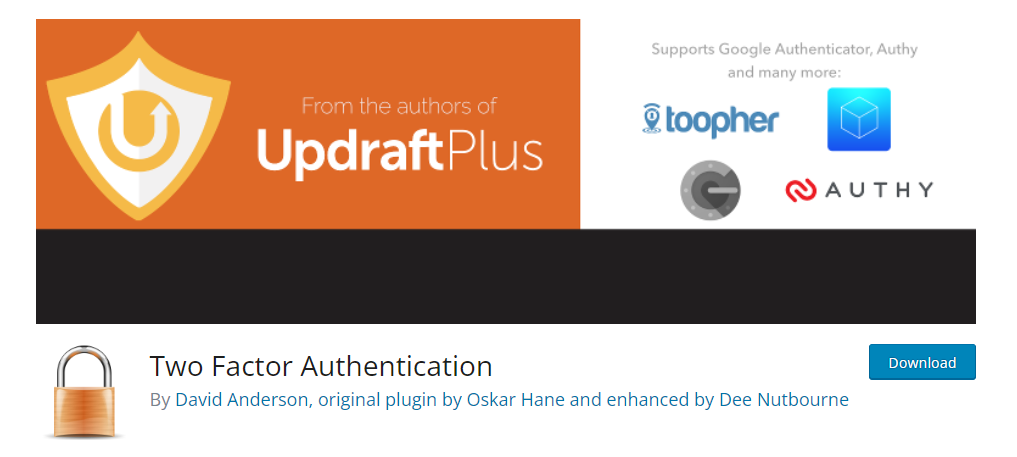
With over 20,000 installations, it encrypts TFA secret keys for added security. Attackers would need to breach both the database and files, plus passwords, to bypass TFA with this robust plugin.
Features
- Supports standard TOTP + HOTP protocols
- Displays graphical QR codes for easy scanning
- TFA can be made available on a per-role basis
- WP Multisite compatible
- Support for the WooCommerce and Affiliates WP login forms
Pricing: This 2FA WordPress plugin is priced at $70.00/per site annually.
Rublon Multi-Factor Authentication
Rublon multi-factor authentication (MFA) safeguards organizational data and network access across various platforms.
Offering versatile authentication methods like Mobile Push and WebAuthn, this 2FA plugin is user-friendly, cost-effective, and scalable.

Rublon MFA also enhances compliance and user experience, making it an ideal website security solution.
Features
- Scalable and flexible
- Phishing-resistant FIDO keys and OTP tokens
- Integrates with business technologies like Windows, Active Directory, Remote Desktop, and more.
- It helps meet compliance and regulatory requirements for cybersecurity, such as GDPR, NIS2 Directive, HIPPA, and more.
Pricing: Rublon offers a 30-day free trial. Its other two plans are:
- Business Plan: $2/per user/month with email support (minimum 15 licenses).
- Enterprise Plan: $4/per user/month with custom contracts and email support (minimum 300 licenses).
Shield Security Pro
Shield Security Pro can integrate the 2FA & MFA user interface directly into your frontend site or customer area using a simple WordPress shortcode.
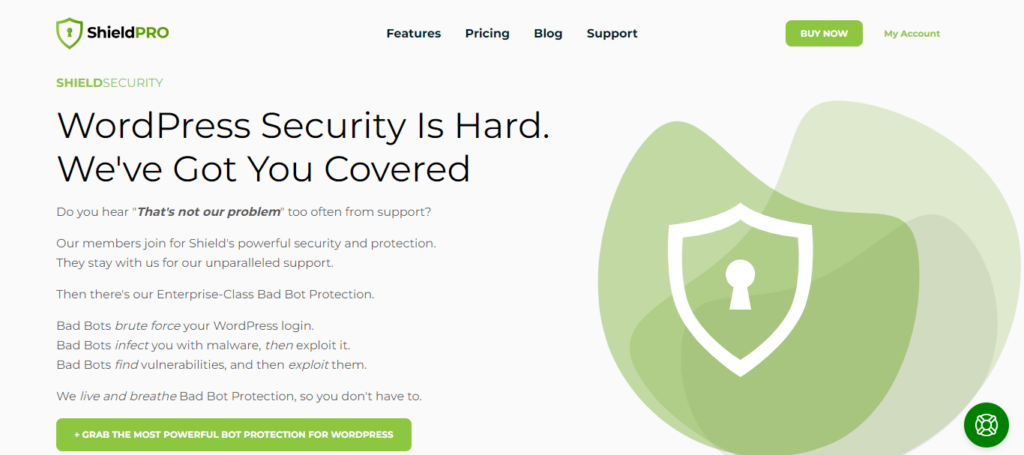
This ensures a consistent user experience, whether accessing from the backend or frontend, with automatic theme styling and optional customization.
Features
- Two-factor/multi-factor authentication
- Custom 2FA & MFA pages
- Advanced 2FA & MFA login protection
- 2FA login backup codes
- 2FA Remember Me/Device
Pricing: Shield Security Pro offers three pricing tiers:
- Basic at $129/year/per site for non-business-critical projects
- Plus, at $149/year/per site for businesses seeking best-in-class protection
- Enterprise at $199/year/per site for comprehensive portfolio security.
How to Add Two-Factor Authentication in WordPress?
Adding two-factor authentication (2FA) to your WordPress website involves several steps but is relatively straightforward.
Note: Before deploying 2FA site-wide, conduct thorough testing to ensure the authentication process works smoothly. Additionally, provide clear instructions and educational resources to help users set up and use 2FA effectively.
Here’s a detailed guide on how to implement 2FA:
Step 1: Choose a 2FA Plugin
Start by selecting a reliable 2FA plugin from the WordPress plugin repository. Some popular options include Google Authenticator or Two-factor Authentication.
Step 2: Install and Activate the Plugin
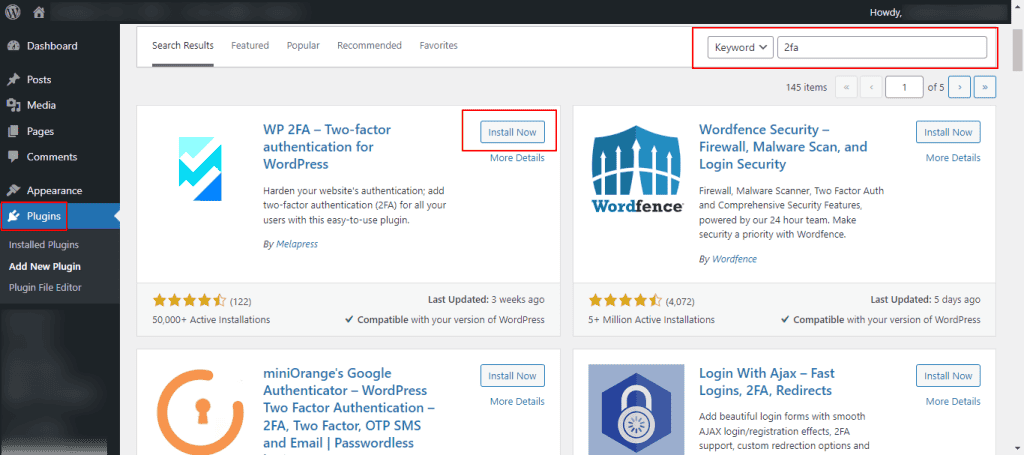
Once you’ve chosen a plugin, install and activate it. You can do this by navigating to the “Plugins” in your WordPress dashboard, Add New → Install Now → Activate.
Step 3: Configure Plugin Settings
After activation, go to the plugin’s settings page. The configuration options may vary slightly depending on the plugin you’ve chosen.
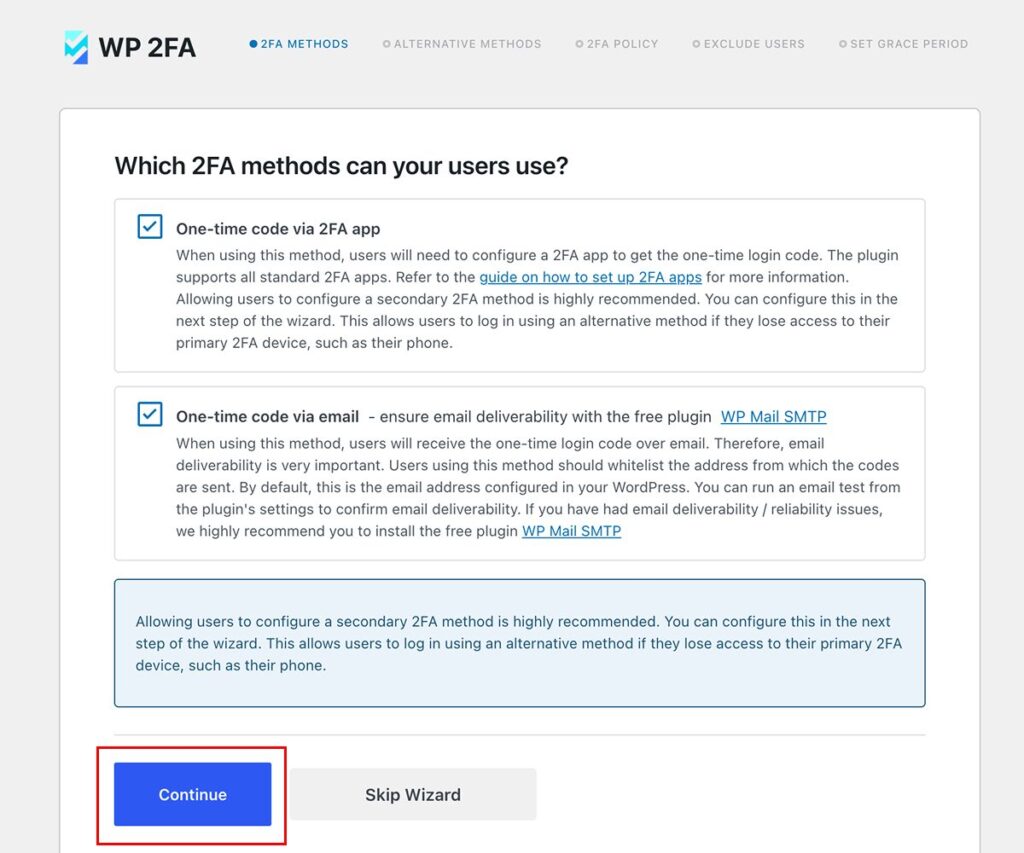
Typically, you’ll find options to enable 2FA for specific user roles, set up default authentication methods, and customize the user experience.
Step 4: Choose Authentication Methods
Most 2FA plugins offer multiple authentication methods, such as Time-based One-Time Passwords (TOTP), SMS codes, or email verification.
Decide which methods you want to make available to your users and configure them accordingly.
Step 5: Enforce 2FA
For maximum security, consider enforcing 2FA for all user accounts, especially those with administrative privileges.
This ensures that even if an attacker obtains a user’s password, they still need the second authentication factor to gain access.
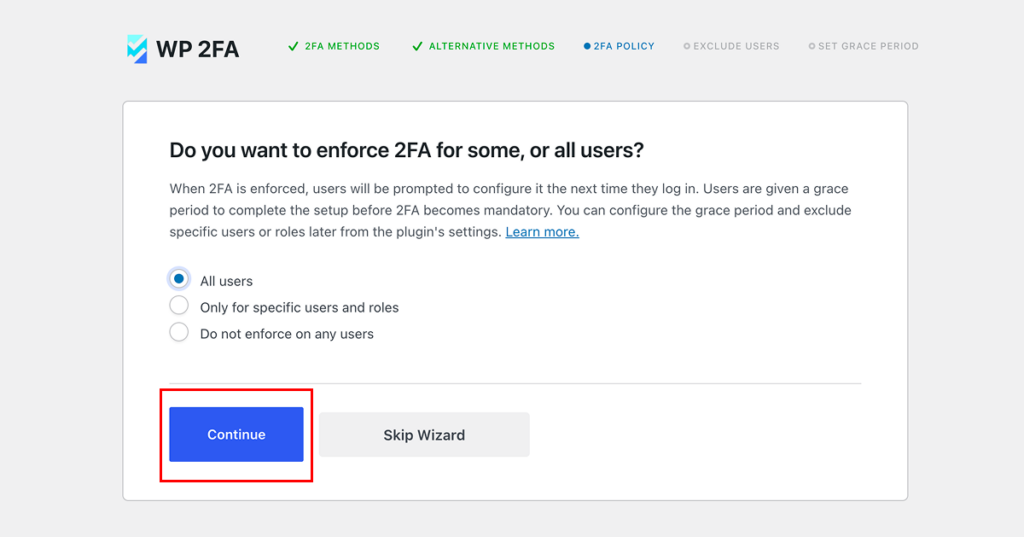
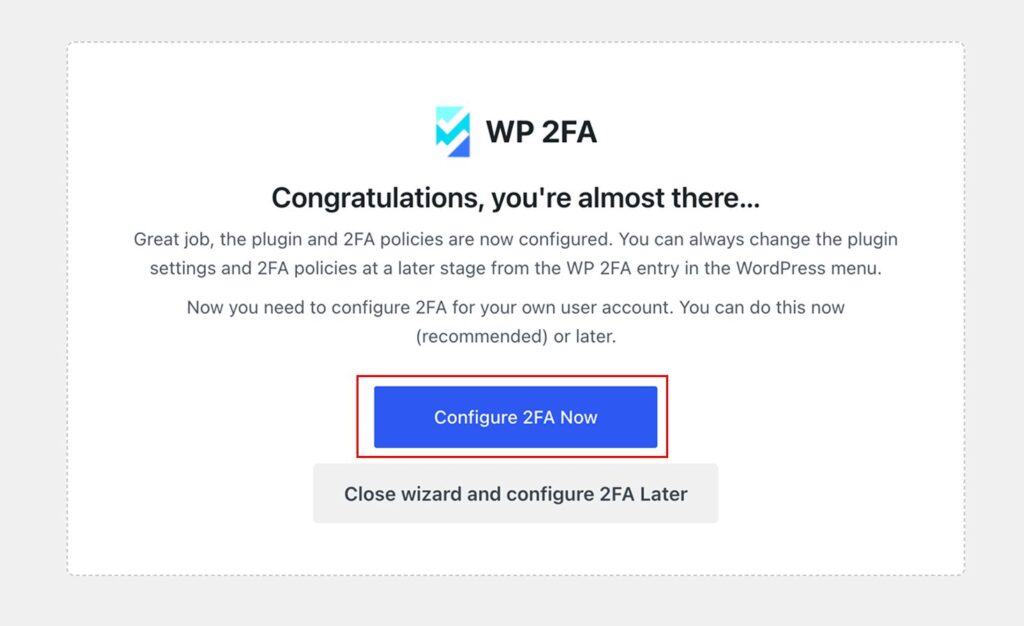
Lastly, you will receive a notification to ‘Configure 2FA Now’ to complete two-factor authentication for your WordPress website.
Further, regularly monitor your site’s security logs to detect suspicious activity and promptly address security concerns.
Stay informed about security trends & best practices, and updates for your chosen 2FA plugin. Also, keep your WordPress site and plugins up to date to mitigate potential vulnerabilities.
Best Practices When Enabling Two-Factor Authentication
Enabling two-step authentication (2FA) significantly enhances the security of online accounts by requiring both a password and an additional verification code.
This method ensures an extra layer of protection during the login process, safeguarding your data against unauthorized access.
Here’s a brief overview of best practices for enabling 2FA.
Choosing the Right Method
First, it is crucial to select an appropriate authentication method. Options include using an authentication app, such as Microsoft Authenticator, or a plugin that generates a time-sensitive code.
Alternatively, you might use a text message, hardware tokens, or even push notifications. Remember to scan the QR code provided during setup.
Backup Codes
It’s important to store backup codes in a secure location. These are essential if you lose access to your primary 2FA method, such as when your phone is lost or stolen.
WordPress Security
For WordPress users, installing security plugins or choosing hosting providers with built-in WordPress security features can be beneficial.
These often include options to enable two-factor authentication on the admin login page, safeguarding against both automated attacks and failed login attempts.
Managing User Roles and Access
Define user roles carefully to control who can access the admin login.
Monitor for automated bots and keep track of login attempts to detect suspicious activity swiftly. Additionally, ensure regulatory compliance, which can often mandate such security measures.
Recovery and Support
Always have recovery codes or shared secret keys on hand and check if there’s a grace period for new users to enable 2FA.
Ensure your security measures are consistent and regularly updated to protect against evolving threats.
Conclusion
Implementing two-factor (2FA) authentication on your WordPress website is crucial to enhancing its security.
Whether you’re a small business or a large enterprise, prioritizing website security through 2FA not only protects your data and user accounts but also helps maintain trust and build credibility with your audience.
From free WordPress 2FA options to premium 2FA plugins with advanced features and support, there’s a solution for every budget and requirement.
So, choose a reliable plugin and bolster your site’s defenses against cyber threats right away!
FAQs WordPress Two-Factor Authentication
Do you need two-factor authentication for WordPress?
2FA is not mandatory but it is strongly recommended for any WordPress site that has user logins, handles customer data, or processes payments. WordPress admin accounts are a common target for brute-force and credential stuffing attacks. A password alone is not sufficient protection for high-value accounts.
How can two-factor authentication help improve your online security?
2FA protects your accounts by requiring a second verification step that an attacker cannot obtain just by stealing your password. Even if your credentials are exposed in a data breach or phishing attack, your account stays protected because the attacker does not have the second factor.
Why is a security key the most secure 2FA method?
Security keys use public-key cryptography and are bound to the domain they are registered on. A fake login page cannot authenticate your key even if it captures your password. SMS codes and TOTP apps do not have this protection since a phishing site can relay them in real time. Your physical key is required for every login.
Why is two-factor authentication useful for preventing information attacks?
Phishing, credential stuffing, and brute-force attacks all depend on a stolen password being enough to get in. 2FA makes that assumption wrong. Without your second factor, a stolen password gets an attacker nowhere.