TYPO3 vs WordPress comes down to complexity, flexibility, and team needs. WordPress is the better choice for most businesses because it is easier to use, more affordable, and supported by a huge plugin ecosystem.
TYPO3 is a stronger fit for large, complex, and multilingual websites that need more structured content management and enterprise-level control.
This guide compares TYPO3 and WordPress across SEO, usability, scalability, pricing, and integrations, so you can choose the right CMS for your business needs.
TL;DR: Choosing the Right CMS for Your Website Needs
- WordPress is best for most websites due to ease of use, lower cost, and a large plugin ecosystem.
- TYPO3 is better suited for enterprise projects that need multilingual support and structured content management.
- WordPress wins on speed, flexibility, and faster content publishing.
- TYPO3 offers stronger control for complex, large-scale, and highly customized websites.
- Both support SEO and scalability, but WordPress is easier to optimize and manage.
- Choose based on complexity: WordPress for simplicity and growth, TYPO3 for enterprise-level control.
TYPO3 vs WordPress: Key Differences at a Glance
TYPO3 and WordPress serve different website needs. WordPress is easier to use, more flexible, and ideal for most businesses, while TYPO3 is built for complex, large-scale, and multilingual websites that require structured content management and deeper customization.
| Feature | WordPress | TYPO3 |
|---|---|---|
| Best for | Small to mid-sized websites, blogs, business sites | Enterprise, multilingual, and complex websites |
| Ease of use | Easier for beginners | More technical and complex |
| SEO | Strong with plugins | Strong with custom configuration |
| Security | Strong with proper setup | Strong built-in enterprise controls |
| Scalability | Good with the right hosting and setup | Built for structured large-scale projects |
| Pricing | Lower and more flexible | Free core, but higher implementation cost |
What is the TYPO3 CMS?
TYPO3 is an open-source enterprise CMS built for large, complex websites with advanced content management needs. It is commonly used by organizations that require multilingual support, structured workflows, and high levels of customization.
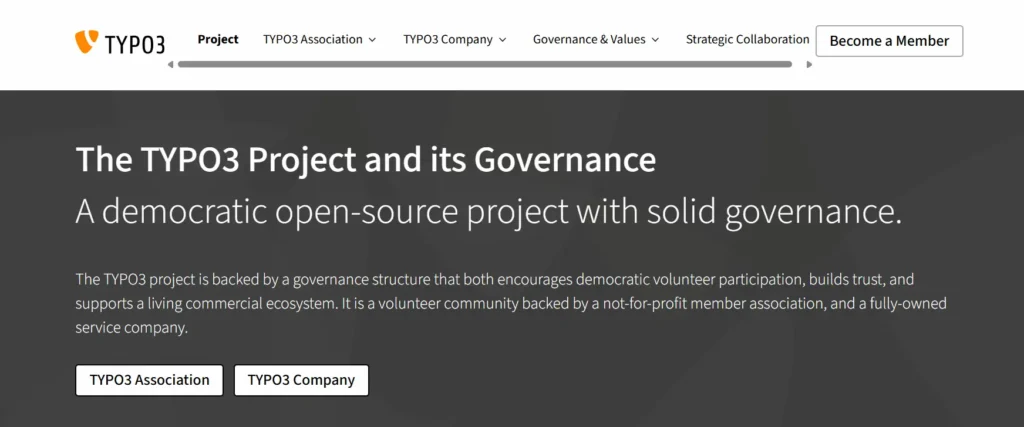
Its strengths lie in scalability, content governance, and developer flexibility. However, it requires more technical expertise and is better suited for teams that can manage complex implementations.
When to Choose TYPO3?
Choose TYPO3 if your project requires a structured, enterprise-level CMS with advanced customization, multilingual capabilities, and strong content governance.
You should choose TYPO3 if you need:
- Built-in multilingual support for managing multiple languages across large or global websites.
- Advanced content workflows and structured content management for complex publishing environments.
- High customization and flexibility for enterprise-level websites with unique requirements.
- Strong security and access control for managing large teams and sensitive content.
- A scalable platform designed for large, complex websites with multiple domains and integrations.
TYPO3 is best suited for enterprises, government organizations, and businesses managing large, multilingual, and highly structured digital platforms.
What is WordPress and Why Do So Many Businesses Use it?
WordPress is an open-source CMS known for its ease of use, fast setup, and extensive plugin ecosystem. It is widely used for blogs, business websites, ecommerce stores, and scalable content platforms.
Its main advantage is simplicity. Non-technical users can easily manage content, while developers can extend functionality using plugins, themes, and custom code. This makes WordPress a practical choice for both beginners and growing businesses.
Ready to Build a Powerful Website?
Choose WordPress! It’s simple, powerful, and trusted by millions. And we’re here to help you create a professional and functional site.
When to Choose WordPress?
Choose WordPress if you want a CMS that is easy to use, cost-effective, and flexible enough to support your website as it grows. It works well for businesses that need speed, simplicity, and full control over content without heavy technical complexity.
You should choose WordPress if you need:
- Lower total cost of ownership without licensing fees and flexible control over hosting, plugins, and development costs.
- Easy content management for non-technical teams, allowing faster publishing and updates without developer support.
- Strong SEO capabilities with plugins and full control over on-page, technical, and content optimization.
- Faster website launches and quick updates without long development cycles or complex implementation.
- A flexible ecosystem with plugins, themes, and integrations for blogs, ecommerce, and scalable business websites.
WordPress is ideal for startups, small to mid-sized businesses, content-driven websites, and companies that want speed and flexibility without enterprise-level complexity.
TYPO3 vs WordPress: Feature-by-Feature Comparison
The sections below compare TYPO3 and WordPress across the most important decision factors, including usability, SEO, security, integrations, and scalability.
Ease of Use
Ease of use matters because it determines how quickly your team can create, edit, and manage content. A user-friendly dashboard in a CMS also enhances productivity and encourages wider adoption. Thus, enabling individuals with varying technical expertise to contribute effectively to website management.
TYPO3 Ease of Use: TYPO3 offers deep control and flexibility, but it has a steeper learning curve and usually requires more technical expertise than WordPress.
While its power lies in handling intricate websites, the learning curve might be steeper for beginners. However, once accustomed, TYPO3 offers a flexible environment for managing diverse content, making it user-friendly for those seeking advanced customization and scalability.
WordPress Ease of Use: WordPress is easier for beginners and content teams because its dashboard, editor, and plugin ecosystem make website management faster and simpler.
Additionally, WordPress seamlessly integrates with various page builders. This adaptability contributes to WordPress’s reputation as an exceptionally user-friendly CMS.
Verdict: WordPress wins here as TYPO3 has a steeper learning curve.
Learn: TinaCMS vs Headless WordPress
Design Capabilities
Design flexibility matters because it affects how easily you can create a website that matches your brand, content needs, and development workflow.

This flexibility not only enhances user experience but also facilitates brand representation. This makes the website visually engaging and aligns with specific aesthetic preferences.
Design Capabilities of TYPO3: TYPO3 provides extensive design capabilities, allowing users to create highly customized websites. Its templating system enables developers to craft unique designs, and it supports responsive design principles.
With a focus on enterprise-level projects, TYPO3 empowers designers and developers with the tools needed for complex layouts, ensuring high design flexibility.
Design Capabilities of WordPress: WordPress offers impressive design capabilities, with a wide range of themes and plugins. The introduction of the Gutenberg editor has further streamlined the web design process.
WordPress is also renowned for its adaptability, supporting a wide range of design styles and catering to both beginners and advanced users.
Verdict: It’s a tie as both offer an array of design options, including custom design.
Learn: Fastest WordPress Themes (With PageSpeed Scores)
Website Security
Security matters because both CMS platforms require proper setup to protect content, user data, and long-term website stability.

Thus, fostering a safe online environment and mitigating potential risks and vulnerabilities. Let’s check out the security measures offered by TYPO3 and WordPress.
TYPO3 Security: TYPO3 strongly emphasizes security through features such as user authentication, access control, and regular updates. The system follows best practices for secure coding. Plus, its active community and dedicated security team work to promptly address and patch any vulnerabilities.
WordPress Security: WordPress prioritizes security through regular updates, dedicated security plugins, and an engaged community. While its popularity can make it a target, the core software is continually improved to address vulnerabilities.
Users can further enhance security by following best WordPress security practices, using secure WordPress hosting, and vigilantly monitoring their websites.
Verdict: Both offer robust security through built-in options and plugins.
Read: WordPress Security Mistakes to Avoid
Third-Party Tools Integration
Third-party integrations matter because they enable your CMS to connect with tools like CRMs, analytics, and ecommerce platforms. It enables seamless integration of diverse services, providing users with a comprehensive, integrated digital environment. So, what do TYPO3 and WordPress offer in terms of 3rd party integration? Let’s find out!
TYPO3 Third-Party Tools Integration: TYPO3 supports integrations with CRMs, ecommerce systems, APIs, and enterprise tools for more complex digital setups. Whether it’s eCommerce solutions, CRM systems, or various APIs, TYPO3’s modular architecture facilitates seamless integration.
WordPress Third-Party Tools Integration: WordPress makes integrations easier through plugins for SEO, analytics, ecommerce, social media, and security.
From SEO and social media to eCommerce, analytics, and security tools, WordPress’s extensive ecosystem accommodates diverse needs. Its user-friendly plugin architecture allows users to easily enhance website functionality.
Verdict: With it comes to the sheer number of third-party tools, WordPress wins this round.
Also read: Best Free WordPress Plugins To Use
Search Engine Optimization (SEO) Features
SEO features matter because they affect how easily you can manage metadata, URLs, content structure, and technical optimization at scale.

This is critical for businesses and individuals aiming to maximize their site’s visibility and reach their target audience.
TYPO3 SEO Features: TYPO3 supports SEO through structured content and custom configuration, but requires more technical setup. Its flexibility enables developers to implement SEO best practices, making TYPO3 suitable for enhancing a website’s search engine performance.
WordPress SEO Features: WordPress is widely used for SEO because it offers easier optimization through plugins and faster content publishing.
Users can easily optimize content, meta tags, and other elements to improve search engine rankings. The user-friendly interface and SEO plugins make WordPress popular for businesses seeking strong SEO integration.
In most cases, WordPress is the easier CMS for SEO execution, while TYPO3 is better suited to teams that need more structured enterprise workflows.
Verdict: WordPress is a more SEO-friendly CMS than TYPO3.
Know more: SEO Trends To Follow
ECommerce Capabilities
eCommerce features are essential for businesses looking to leverage their digital presence to drive sales and revenue.

The eCommerce integration in CMS can streamline product listings, payment processing, and inventory management, providing a seamless online shopping experience.
TYPO3 eCommerce Capabilities: While TYPO3 doesn’t have built-in eCommerce features, it supports eCommerce extensions like TYPO3 Commerce. This extension integrates seamlessly with TYPO3, providing powerful eCommerce capabilities for managing product catalogs, transactions, and other essential aspects of eCommerce stores.
WordPress eCommerce Capabilities: WordPress features an eCommerce plugin called WooCommerce. WooCommerce offers extensive features for product management, payment gateways, and order processing.
With a user-friendly interface and a vast selection of WooCommerce plugins, WordPress is a versatile CMS for small to medium-sized and large businesses looking to create an online store.
Verdict: For eCommerce, WordPress wins here with its seamless WooCommerce integration.
Related: WooCommerce vs Shopify: Who Wins
Support and Resources
A strong support system, including documentation, forums, and responsive customer support, ensures users can navigate the CMS platform efficiently.

Here’s what both TYPO3 and WordPress offer:
TYPO3 Support and Resources: TYPO3 has extensive documentation and official guides, providing users with valuable resources for troubleshooting and learning. TYPO3 also has a dedicated community that actively engages in discussions and problem-solving, contributing to a collaborative environment.
WordPress Support and Resources: WordPress has an active, extensive community, forums, and extensive online documentation.
With plenty of tutorials and user-contributed content, users can find solutions to common WordPress errors and issues. Furthermore, WordPress help and professional support services are widely available, offering assistance to users seeking expert guidance.
Verdict: Both offer support through documentation, forums, and guides. WordPress also has a large community.
Related: Best WordPress Support Services
Scalability and Performance Optimization
When selecting the right content management system, scalability and performance optimization are crucial, especially for complex sites and enterprises undergoing growth.
Both TYPO3 and WordPress offer distinct approaches to handling large-scale projects, with their methods differing significantly.
TYPO3: As an enterprise-level CMS, TYPO3 is designed to manage complex sites with multilingual support and extensive coding capabilities.
Its built-in features, such as caching mechanisms, multi-domain management, and strong enterprise-level security, allow developers and dedicated IT teams to create tailored solutions for large organizations.
TYPO3’s admin interface and extensive technical resources make it ideal for more experienced users working on projects that require customization options and new features.
WordPress: With its vast plugin library and extensive ecosystem, it can scale effectively with the right hosting providers and caching plugins. A WordPress site relies on paid plugins and security patches to enhance performance and security.
Its very active community, extensive library of themes, and user-friendly admin interface provide flexibility for enterprise growth, but may require additional technical resources and coding knowledge for complex projects.
Verdict: Both CMS are equally scalable. However, WordPress has an edge as it is also flexible.
Further reading: WordPress vs. Showit: Detailed Comparison
Pricing
Pricing matters because the real cost of a CMS includes hosting, development, plugins or extensions, maintenance, and long-term support. The real pricing difference lies not in the software itself, but in the total cost of setup, maintenance, development, and long-term support.
TYPO3 Pricing: TYPO3 is an open-source CMS, meaning the core software is free to use. However, users may incur costs for services like professional support, extensions, and custom development. The overall cost is based on individual needs and requirements.
WordPress Pricing: WordPress is also open-source. Users, however, may incur expenses for hosting, premium themes, plugins, and professional WordPress services. WordPress’s flexible pricing model allows users to tailor their expenses based on their website needs.
Verdict: Both CMS are open-source and free to use.
Learn: Cost of WordPress Website
Conclusion
WordPress is the better choice for most businesses because it is easier to use, more affordable, and supported by a massive plugin ecosystem. It works especially well for content-driven websites, ecommerce stores, and businesses that need speed and flexibility.
TYPO3 is better suited for enterprises and organizations managing large, multilingual, and highly structured websites. It offers stronger governance and enterprise control, but it also introduces greater technical complexity.
If your priority is usability, lower cost, and fast growth, choose WordPress. If your priority is multilingual content management, structured workflows, and enterprise-grade website control, choose TYPO3.
FAQs About TYPO3 vs WordPress
What is the main difference between TYPO3 and WordPress?
TYPO3 is an enterprise-focused CMS built for complex, multilingual, and structured websites, while WordPress is a flexible, user-friendly CMS designed for ease of use, faster publishing, and lower setup costs.
Which is better for SEO: TYPO3 or WordPress?
WordPress is generally better for SEO because it offers easier optimization through plugins, faster content updates, and simpler technical setup. TYPO3 also supports strong SEO but requires more technical configuration.
Is TYPO3 better than WordPress for enterprise websites?
TYPO3 can be a better choice for enterprise websites that require multilingual support, structured workflows, and complex content management. WordPress can also support enterprise use, but may need additional tools and customization.
Which CMS is easier to use for beginners?
WordPress is much easier for beginners due to its intuitive dashboard, large plugin ecosystem, and minimal technical requirements. TYPO3 has a steeper learning curve and requires more technical expertise.
Can WordPress handle large and complex websites?
Yes, WordPress can handle large and complex websites with the right hosting, plugins, and development setup. Many enterprise-level sites use WordPress successfully at scale.
When should you choose TYPO3 over WordPress?
You should choose TYPO3 when you need advanced multilingual capabilities, structured content management, and a CMS designed for large, complex, and enterprise-level digital projects.