Enterprises today can’t afford slow, rigid digital systems. As customer expectations rise, traditional WordPress architectures often struggle to keep up with omnichannel delivery, performance demands, and security requirements. That’s where enterprise headless WordPress development changes the equation.
By decoupling the frontend from the backend, businesses gain flexibility, faster load times, and the freedom to use modern frameworks without abandoning WordPress as a powerful content engine.
But technology alone isn’t the goal; scalable growth is. With an API-first architecture, enterprises can deliver seamless experiences across web, mobile, and beyond.
If future-ready digital transformation is the priority, headless WordPress is no longer optional; it’s strategic.
TL;DR: Quick Summary
- Enterprise headless WordPress separates backend content management from frontend presentation.
- It improves scalability, performance, and security through API-first architecture.
- It is ideal for high-traffic websites and multi-channel digital ecosystems.
- Supports global brands with multi-site and multi-language capabilities.
- It requires advanced development expertise and a higher initial investment.
- SEO must be carefully configured (SSR, metadata, structured data).
- It is best suited for enterprises seeking flexibility, integration, and long-term digital scalability.
What is Headless WordPress?
Headless WordPress is a decoupled CMS architecture in which WordPress serves solely as the content management backend, while the frontend presentation layer is built with a separate technology stack.
In a traditional setup, WordPress tightly integrates content management, theme rendering, and frontend delivery within a single monolithic system. In contrast, a headless approach separates these concerns, allowing each layer to operate independently.
Plus, in traditional WordPress, PHP-based themes control how content is displayed. However, in a headless configuration, WordPress no longer renders the frontend.
Instead, content is delivered via APIs to external applications such as websites, mobile apps, or even IoT interfaces.
The primary enablers of this architecture are the WordPress REST API and WPGraphQL. The REST API exposes content endpoints using standard HTTP requests, while WPGraphQL provides a more flexible query-based data-fetching model, enabling precise data retrieval and performance optimization.
Architecturally, headless WordPress consists of three layers:
- Backend (WordPress CMS): Manages content, users, and workflows.
- API Layer: Exposes content via REST or GraphQL endpoints.
- Frontend Application: Built with modern frameworks, consuming data from the API to render user experiences.
This separation enhances scalability, site security, and development flexibility for enterprise environments.
Power Your Enterprise with Headless WordPress
Build faster, scale smarter, and deliver seamless digital experiences across every channel. Partner with experts now.
Enterprise Headless WordPress Architecture Explained
Enterprise headless WordPress architecture is built on a decoupled model where content management, data delivery, and presentation operate as independent layers.
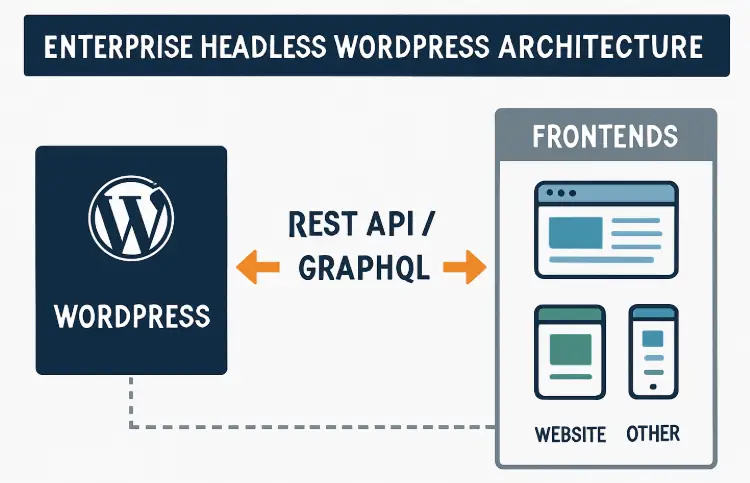
This separation enhances scalability, performance optimization, and system resilience. To better understand how it functions, let’s break down the three core layers.
Backend Layer
At the foundation lies the backend layer, powered by WordPress as a content repository. Here, editors manage pages, custom post types, taxonomies, media assets, and user roles.
Moreover, enterprise workflows, including approvals, revisions, and role-based access control, are handled within the CMS. Importantly, WordPress no longer controls how content is displayed. Instead, it focuses purely on structured content management and data storage.
API Layer
Next comes the API layer, which acts as the communication bridge between the backend and frontend. Through the WordPress REST API or WPGraphQL, content is exposed as structured data endpoints.
While REST delivers predefined endpoints via HTTP requests, GraphQL enables precise data queries, reducing over-fetching and improving performance.
Additionally, enterprises can implement authentication mechanisms such as JWT or OAuth to secure API access.
Frontend Layer
Finally, the frontend layer handles presentation and user interaction. Built with modern frameworks such as React, Next.js, or Vue, this layer consumes data from the API and renders dynamic user experiences.
As a result, enterprises gain complete design flexibility, improved performance through SSR or SSG, and the ability to deploy across multiple digital channels, all without impacting the WordPress backend.
When Should Enterprises Choose Headless WordPress?
Enterprises should consider headless WordPress when their digital requirements extend beyond the capabilities of a traditional monolithic setup.
While it offers advanced scalability and architectural flexibility, it is most valuable in environments where performance, omnichannel delivery, and global operations are business-critical.
For high-traffic enterprise websites, headless architecture enables independent scaling of the frontend and backend.
This separation supports CDN distribution, server-side rendering, and optimized caching strategies, ensuring consistent performance during traffic spikes, product launches, or global campaigns.
Similarly, organizations operating within multi-channel digital ecosystems benefit significantly.
If content needs to be delivered across websites, mobile apps, progressive web apps, digital kiosks, or third-party platforms, a decoupled CMS allows centralized content management with API-driven distribution.
As a result, marketing and product teams can maintain consistency while accelerating deployment cycles.
For global brands with localization needs, headless WordPress supports multi-language implementations, region-specific content, and flexible frontend frameworks tailored to different markets. This ensures both brand uniformity and localized user experiences.
However, traditional WordPress may still be sufficient for small to mid-sized websites, content-focused blogs, or businesses without complex integration requirements.
If omnichannel distribution, heavy customization, or extreme scalability are not priorities, the traditional architecture remains cost-effective and easier to manage.
Enterprise Headless WordPress vs Traditional WordPress
Here is a quick comparison between traditional and enterprise headless WordPress:
| Criteria | Enterprise Headless WordPress | Traditional WordPress |
|---|---|---|
| Architecture | Decoupled architecture separating backend and frontend via APIs | Monolithic architecture combining backend, themes, and frontend rendering |
| Performance | Optimized with CDN, SSG, SSR, and modern frontend frameworks for high-speed delivery | Dependent on PHP rendering, hosting quality, and caching plugins |
| Scalability | Frontend and backend scale independently, ideal for enterprise traffic volumes | Vertical scaling primarily; may face limitations under heavy load |
| Omnichannel Delivery | API-driven content distribution across web, mobile, apps, and IoT | Primarily website-focused with limited cross-platform flexibility |
| Security | Reduced attack surface due to separated frontend layer | Public-facing WordPress installation increases exposure risk |
| Development Flexibility | Freedom to use React, Vue, Next.js, and microservices architecture | Restricted to WordPress theme and plugin ecosystem |
| Plugin Compatibility | Some plugins require custom integration in headless setup | Full compatibility with WordPress plugin ecosystem |
| Cost & Complexity | Higher initial investment and technical expertise required | Lower setup cost and simpler implementation |
| Best For | Large enterprises, global brands, multi-platform ecosystems | Blogs, SMEs, content-driven marketing sites |
Why Enterprises Choose Headless WordPress CMS?
As digital ecosystems become more complex, enterprises require platforms that deliver speed, scalability, and seamless cross-channel experiences.

Traditional CMS architectures often limit performance and flexibility. Therefore, organizations increasingly adopt headless WordPress to future-proof their infrastructure while maintaining content management efficiency.
Scalability and Performance
First and foremost, scalability is a critical driver. Headless WordPress allows the frontend and backend to scale independently, which optimizes resource allocation during traffic spikes.
Moreover, enterprises can leverage static site generation (SSG), server-side rendering (SSR), and global CDN distribution to significantly reduce load times.
Because content is delivered via APIs rather than rendered through PHP templates, performance bottlenecks are minimized. As a result, businesses achieve improved Core Web Vitals and better user engagement metrics.
Omnichannel Content Delivery
In addition, modern enterprises rarely operate on a single digital touchpoint. Headless WordPress enables content distribution across websites, mobile applications, kiosks, wearables, and other digital interfaces through API-driven delivery.
Consequently, content teams can manage information centrally while deploying it consistently across multiple platforms. This unified content strategy enhances brand coherence and accelerates time-to-market.
Improved Security
Security is another decisive advantage. Since the frontend is decoupled from the WordPress backend, the public-facing layer does not directly expose the CMS database.
Therefore, the attack surface is reduced. Enterprises can further implement API authentication, firewalls, and isolated hosting environments to strengthen overall system resilience.
Development Flexibility
Finally, development flexibility empowers innovation. Teams can use modern frameworks such as React, Vue, or Next.js without being restricted by WordPress theming limitations.
Thus, enterprises benefit from faster iteration cycles, composable architecture, and seamless integration with microservices, CRM systems, and enterprise applications.
Key Features of Enterprise-Grade Headless WordPress Solutions
Enterprise-grade headless WordPress solutions go beyond basic decoupling. They are engineered to support large-scale digital ecosystems, complex organizational structures, and mission-critical performance requirements.
Therefore, the architecture must include features that ensure governance, speed, resilience, and seamless integration across business systems.
Multi-Site and Multi-Language Capabilities
First, enterprise environments often operate across regions and brands. Headless WordPress supports multi-site configurations, enabling centralized content governance while maintaining brand-level flexibility.
Additionally, multi-language capabilities allow global organizations to manage localized content efficiently. This ensures consistent messaging while adapting to regional regulations, cultural nuances, and SEO requirements.
Role-Based Access Control (RBAC)
Equally important is robust access management. Role-Based Access Control (RBAC) allows administrators to define granular permissions for editors, marketers, developers, and stakeholders.
As a result, enterprises can streamline editorial workflows, maintain compliance, and reduce the risk of unauthorized content modifications.
Advanced Caching Strategies
Performance is mission-critical at scale. Enterprise headless setups implement advanced caching strategies at multiple layers, including object caching, API response caching, and frontend static generation. Consequently, content is delivered faster while reducing server load and infrastructure costs.
CDN and Edge Deployment
Moreover, integrating a Content Delivery Network (CDN) ensures global content distribution with minimal latency. Edge deployment further enhances this by processing requests closer to the user’s geographic location. This significantly improves page load times and supports high-traffic scenarios.
API Rate Limiting and Monitoring
To maintain system stability, API rate limiting prevents excessive or malicious requests. In parallel, real-time monitoring tools provide visibility into API performance, traffic patterns, and potential bottlenecks.
Integration with CRM, ERP, and Marketing Automation Tools
Finally, enterprise headless WordPress integrates seamlessly with CRM, ERP, and marketing automation platforms. This connectivity enables unified data flows, personalized experiences, and data-driven decision-making across the organization.
SEO Considerations in Headless WordPress
While headless WordPress offers architectural flexibility, SEO must be strategically configured to maintain search visibility. Because the frontend and backend are decoupled, essential optimization elements must be handled explicitly rather than relying solely on traditional WordPress plugins.

- Managing Metadata via API: Metadata such as title tags, meta descriptions, canonical URLs, and Open Graph tags must be exposed through APIs. Using the WordPress REST API or WPGraphQL, SEO fields can be fetched and rendered dynamically on the frontend. This ensures search engines receive complete and accurate page signals.
- Structured Data Implementation: Structured data (Schema.org markup) must be implemented directly within the frontend application. JSON-LD scripts can be dynamically injected based on API-driven content, improving eligibility for rich results.
- SSR vs CSR Impact on SEO: Rendering strategy significantly affects crawlability. Server-Side Rendering (SSR) or Static Site Generation (SSG) is generally preferred over Client-Side Rendering (CSR), as pre-rendered HTML enables faster indexing and better performance signals.
- Sitemap Generation: XML sitemaps should be dynamically generated via the backend or frontend build process to reflect real-time content updates.
- Redirect Management: Proper 301 and 302 redirect handling must be configured at the server or application layer to preserve link equity.
- Core Web Vitals Optimization: Finally, optimizing Core Web Vitals, through image compression, code splitting, caching, and CDN usage, ensures a strong user experience and improved rankings.
Common Challenges in Enterprise Headless WordPress Development & How to Overcome Them
Although enterprise headless WordPress offers scalability and flexibility, it introduces technical and operational complexities. Hence, organizations must anticipate these challenges and implement structured solutions to ensure long-term success.
Increased Development Complexity
First, a decoupled architecture demands expertise in both backend and modern frontend frameworks. Unlike traditional setups, teams must manage APIs, deployment pipelines, and rendering strategies.
To overcome this, enterprises should adopt standardized development workflows, invest in DevOps automation, and engage cross-functional teams with proficiency in CMS and JavaScript frameworks.
Preview Functionality
Secondly, real-time content preview becomes more complex in a headless environment. Since the frontend is separate, default WordPress preview features do not function automatically.
This challenge can be resolved by implementing secure preview APIs and token-based authentication to generate dynamic preview builds within the frontend application.
Plugin Compatibility
Not all WordPress plugins are optimized for headless use. Plugins that rely heavily on PHP-rendered themes may not function as expected.
The solution lies in selecting API-compatible plugins or custom-developing integrations using the WordPress REST API or WPGraphQL.
Cost Considerations
Lastly, headless implementations often involve higher upfront investment due to infrastructure, frontend development, and ongoing maintenance.
However, with proper architectural planning and scalable cloud hosting, enterprises can achieve long-term ROI through improved performance, security, and operational efficiency.
Final Thoughts
Enterprise headless WordPress development represents a strategic shift from traditional, theme-driven architectures to API-first digital ecosystems.
By decoupling the frontend and backend, organizations gain scalability, performance optimization, enhanced security, and omnichannel content delivery. However, success depends on careful planning, technical expertise, and alignment with business objectives.
While not every organization requires a headless setup, enterprises managing high traffic, global audiences, and complex integrations can unlock significant long-term value.
Ultimately, headless WordPress is not just a technical upgrade; it is a foundation for future-ready, composable digital transformation.
FAQs About Enterprise Headless WordPress
What does enterprise headless WordPress development mean?
Enterprise headless WordPress development separates the WordPress backend from the frontend presentation layer and delivers content through APIs to multiple digital platforms.
Why do enterprises choose headless WordPress over traditional WordPress?
Enterprises choose headless WordPress because it improves scalability, enhances security, and enables omnichannel content delivery across web, mobile, and other digital interfaces.
Does headless WordPress affect SEO performance?
Headless WordPress can improve SEO performance when developers implement server-side rendering, structured data, optimized metadata, and strong Core Web Vitals practices.
Is headless WordPress more secure than traditional WordPress?
Headless WordPress increases security by decoupling the frontend from the backend, which reduces direct exposure of the CMS to public-facing threats.
When should a business avoid using headless WordPress?
A business should avoid using headless WordPress if it runs a simple website, has limited technical resources, or does not require multi-channel content distribution.