
WordPress is the better choice for most websites because it offers more flexibility, plugins, and control, while Ghost is built for fast, clean publishing with a focus on writing and memberships. In the WordPress vs Ghost comparison, the right platform depends on whether you want full control or a simple, distraction-free blogging experience.
If you are starting a blog, building a content business, or planning to scale your website, this choice matters. WordPress gives you freedom to grow in any direction, while Ghost keeps things simple and focused on content and monetization. This guide will help you decide which platform fits your goals without confusion.
TL;DR:
- WordPress is the better choice for most users because it offers flexibility, scalability, and strong SEO tools.
- Ghost is designed for fast, clean publishing and works best for writers and content-focused websites.
- WordPress supports thousands of plugins, themes, and integrations for building any type of website.
- Ghost offers built-in memberships and newsletters, making monetization simple without additional tools.
- WordPress requires optimization for speed, while Ghost delivers fast performance by default.
- Choose WordPress for long-term growth and control, and choose Ghost for simplicity and focused publishing.
What is the Difference Between WordPress and Ghost?
The core difference between WordPress and Ghost is how they approach website building and growth. WordPress is a complete CMS platform designed to handle any type of website, while Ghost is built specifically for publishing content with speed and simplicity.
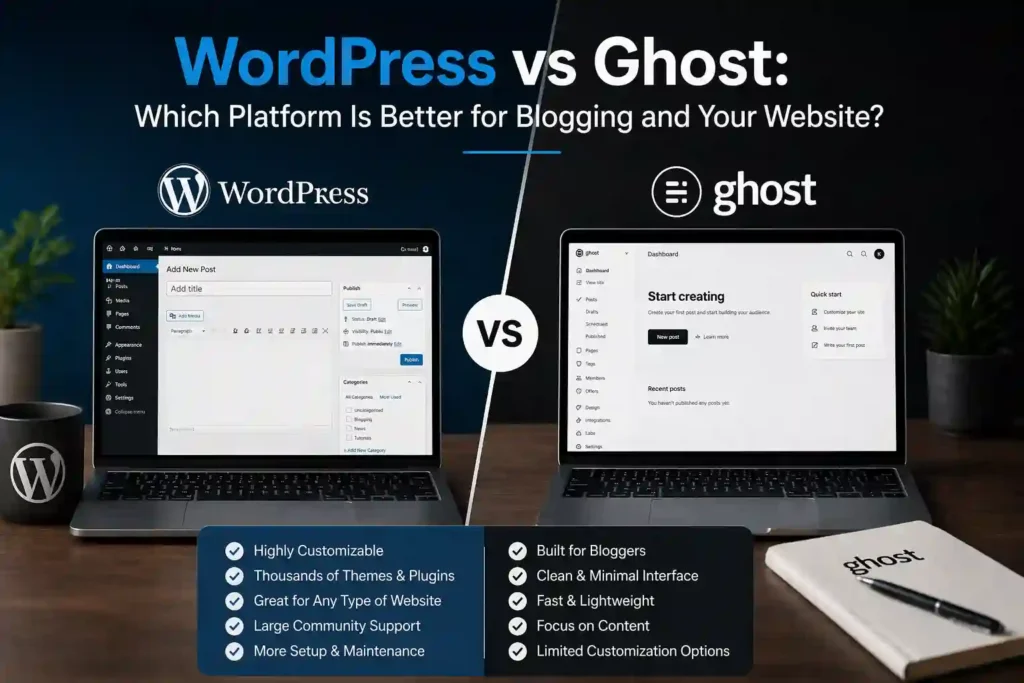
WordPress gives you full control over design, features, and scalability. You can build anything from a blog to a full business or eCommerce site. Ghost keeps things focused on writing, newsletters, and memberships, which makes it faster but more limited in scope.
What is WordPress?
WordPress is an open-source CMS platform that lets you create blogs, business websites, online stores, and more with themes and plugins, without coding.
The biggest advantage of WordPress is flexibility. You can start with a simple blog and expand into advanced features like eCommerce, SEO optimization, or membership systems. This ability to scale without switching platforms makes it the most widely used website builder today.
Who Should Use WordPress?
WordPress is the best choice if you want a flexible CMS platform that can grow with your website. It is designed for users who need control, scalability, and the ability to build more than just a blog. Whether you are starting small or planning long-term growth, WordPress adapts to your needs.
It works as a complete website builder that supports blogging, business websites, eCommerce stores, portfolios, and membership platforms. This makes it the most versatile option in the WordPress vs Ghost comparison.
- You want to build more than just a blog and may expand into services, eCommerce, or lead generation.
- You need advanced SEO tools to optimize content, structure, and rankings.
- You want access to a large ecosystem of plugins for features like security, speed, forms, and analytics.
- You want full control over design using themes, page builders, and custom layouts.
- You plan to scale your website over time without switching platforms
WordPress is ideal for bloggers, businesses, startups, agencies, and creators who want long-term flexibility. It gives you complete ownership of your website and the freedom to customize every part of it as your goals evolve.
Build a Powerful Website with WordPress Experts
Create a fast, scalable, and SEO-friendly website. Get expert WordPress development tailored to your goals.
What is Ghost?
Ghost is a modern publishing platform designed for writers, bloggers, and content creators. It focuses on speed, clean design, and built-in tools for memberships and newsletters.
It removes unnecessary features and distractions, which makes writing faster and smoother. However, this focus also limits its flexibility. Ghost works best for content-driven websites but is not ideal for building complex or multi-purpose websites.
Who Should Use Ghost?
Ghost is the better choice if your main focus is writing, publishing, and monetizing content without distractions. It is built specifically for content creators who want a fast, clean, and focused platform for blogging and newsletters.
Unlike traditional CMS platforms, Ghost removes unnecessary features and keeps everything centered around content creation. This makes it highly efficient for writers who care more about publishing and audience growth than customization.
- You want a clean, distraction-free writing environment that helps you focus on your content.
- You focus on blogging, newsletters, or building a content-driven brand.
- You want built-in tools for memberships, subscriptions, and email newsletters without plugins.
- You prefer fast performance and simple architecture without heavy optimization.
- You are comfortable with managed hosting or basic technical setup.
- You do not need complex features like eCommerce, advanced design, or custom functionality.
Ghost is ideal for writers, journalists, publishers, and independent creators who want to build a content business. It works best when your priority is speed, simplicity, and direct monetization through your audience.
Quick Comparison Between WordPress and Ghost
Choosing between WordPress and Ghost becomes easier when you compare them side by side.
| Feature | WordPress | Ghost |
|---|---|---|
| Ease of Use | Beginner-friendly | Simple but limited |
| SEO | Advanced with plugins | Built-in but basic |
| Speed | Depends on setup | Fast by default |
| Flexibility | Extremely high | Limited |
| Best For | Websites, businesses, blogs | Writers, publishers |
WordPress wins for most users because it adapts to any type of website. Ghost wins only when your goal is pure publishing with minimal distractions.
WordPress vs Ghost: Key Features Comparison
This quick breakdown highlights the key differences in features, performance, SEO, and usability so you can decide faster.
Ease of Use and Setup Experience
Ease of use affects how quickly you can launch your website and how easily you can manage it over time. For most users, a platform that reduces confusion and speeds up workflow is the better choice.
WordPress emphasizes accessibility and usability, while Ghost prioritizes simplicity in content creation. The difference becomes clear when you start setting up and managing your site.
Which Platform is Easier for Beginners?
WordPress is easier for beginners because it offers guided setup, one-click installations, and thousands of tutorials. You can install themes, add plugins, and publish content without needing technical knowledge.
Ghost looks simple on the surface, but setup can be more complex. You may need to understand hosting, deployment, or managed platforms before getting started. This creates friction for beginners who want a quick launch.
Dashboard and Daily Workflow
WordPress provides a flexible dashboard that lets you manage content, design, plugins, and settings from one place. It may feel feature-heavy at first, but it becomes easy once you get familiar with it.
Ghost offers a clean, minimal dashboard focused solely on writing and publishing. This makes it fast and distraction-free, but it lacks advanced tools for managing larger or more complex websites.
Verdict: WordPress is easier to start and manage long term, while Ghost is simpler but limited to content-focused workflows.
SEO, Performance, and Speed
SEO and performance decide how easily your website gets traffic and how well it performs for users. A good platform should make optimization simple without limiting your growth.
WordPress gives you full SEO control, while Ghost focuses on built-in performance and clean structure. Both approaches work, but they serve different needs.
Which Platform is Better for SEO?
WordPress is better for SEO because it supports advanced plugins like RankMath. This tool helps you optimize titles, meta descriptions, schema, internal links, and content readability step by step.
Ghost includes basic SEO features such as clean URLs, XML sitemaps, and fast-loading pages. While this is enough for simple blogs, it lacks the advanced customization options needed for competitive SEO strategies.
Speed and Performance Comparison
Ghost is faster by default because it is lightweight and built only for publishing. It delivers clean code and fast loading times without requiring additional setup.
WordPress performance depends on hosting, themes, and plugins. With proper optimization using caching tools, CDNs, and performance plugins, WordPress can match or even outpace Ghost in terms of speed.
Verdict: Ghost wins in default speed, but WordPress offers better long-term SEO and performance control.
Features, Plugins, and Flexibility
Features determine what your website can do today and how it can grow in the future. Flexibility is critical if your goals change over time.

WordPress is built for expansion, while Ghost is built for focus. This creates a clear difference in how each platform supports growth.
WordPress Plugins vs Ghost Integrations
WordPress offers over 50,000 plugins that allow you to add almost any feature. You can build eCommerce stores, membership sites, learning platforms, and more without coding.
Ghost uses integrations instead of plugins, but the ecosystem is smaller. It works well for publishing tools, analytics, and email, but lacks support for advanced features.
Customization and Design Options
WordPress provides thousands of themes and page builders that give full control over design. You can create landing pages, custom layouts, and interactive designs without technical knowledge.
Ghost offers clean and modern themes focused on content. However, customization is limited, and advanced changes often require coding skills.
Verdict: WordPress offers unmatched flexibility and customization, while Ghost is limited to a simple publishing-focused design.
Blogging Experience and Content Publishing
This is where Ghost stands out. It is designed specifically for writing and publishing, which gives it an advantage for content creators. WordPress offers more features, while Ghost offers a cleaner writing experience. The choice depends on what you value more.
Writing and Editor Experience
Ghost provides a distraction-free editor that feels fast and modern. It lets you focus entirely on writing without having to deal with unnecessary tools. WordPress uses a block editor that gives more control over layout and media. While it is powerful, it may feel heavier compared to Ghost’s minimal approach.
Memberships, Newsletters, and Monetization
Ghost includes built-in tools for memberships, subscriptions, and newsletters. You can monetize your content directly without adding plugins. WordPress requires plugins for these features, but it offers more flexibility in how you design and scale monetization strategies.
Verdict: Ghost is better for pure writing and built-in monetization, while WordPress offers more control and long-term scalability.
Pricing and Total Cost
Both platforms are open source, but real costs depend on hosting, tools, and maintenance. Understanding long-term cost is important before choosing a platform. WordPress offers greater control over the budget, while Ghost may require a higher upfront investment, depending on the setup.
Hosting and Setup Costs
WordPress offers flexible hosting options, from low-cost shared hosting to premium managed hosting. You can start small and upgrade as your website grows. Ghost often requires managed hosting or technical setup. This can increase initial costs, especially for beginners who need a simple setup.
Long-Term Expenses
WordPress costs depend on plugins, themes, and services. You can control spending, but premium tools can increase costs as your website grows. Ghost may have fewer add-on costs, but hosting and infrastructure can be more expensive over time, especially for scaling content platforms.
Verdict: WordPress is more budget-friendly and flexible, while Ghost can become costly depending on hosting and setup needs.
Conclusion
If you want a clear answer, WordPress is the better platform for most websites. It gives you full control, stronger SEO capabilities, and the ability to scale your site as your needs grow. You can start with a simple blog and expand into a full business without changing platforms.
Ghost is a strong choice only if your focus is pure content creation, blogging, and monetization through memberships or newsletters. It offers speed and simplicity, but limits flexibility. For most users, WordPress provides a more complete and future-proof solution.
FAQs
Which is better for beginners: WordPress or Ghost?
WordPress is better for beginners because it offers guided setup, more tutorials, and a larger support community. Ghost is simple to write but requires more technical setup.
Is Ghost better than WordPress for blogging?
Ghost is better for pure blogging and writing experience because it offers a clean editor and built-in publishing tools. WordPress is better if you want to grow beyond blogging.
Which platform is better for SEO?
WordPress is better for SEO because it offers advanced tools like Yoast SEO and RankMath. Ghost includes basic SEO features but lacks deeper customization.
Is Ghost faster than WordPress?
Yes, Ghost is faster by default because it is lightweight and optimized for publishing. WordPress can match speed with proper hosting and performance optimization.
Can I switch from Ghost to WordPress later?
Yes, you can migrate content from Ghost to WordPress using tools or manual methods. However, design and functionality usually need to be rebuilt.


