WordPress is the better choice for most websites because it is easier to manage, more flexible, and comes with stronger built-in SEO support. Joomla suits more complex setups, but it requires technical knowledge, which is why most users lean toward WordPress in the Joomla vs WordPress comparison.
The right platform depends on how you plan to build and scale your site. WordPress helps you launch faster with plugins, themes, and simple controls, while Joomla gives you more structured content control if you already understand how CMS platforms work.
TL;DR:
- WordPress is the better choice for most websites because it is easier to use, faster to set up, and offers stronger SEO support.
- Joomla provides more structured control, but it requires technical knowledge and a steeper learning curve.
- WordPress works best for beginners, bloggers, and businesses that want to grow without complexity.
- Joomla is more suitable for developers and users building complex websites with advanced content structures.
- WordPress offers a larger ecosystem of plugins, themes, and support, making customization easier.
- Most users should choose WordPress unless they specifically need Joomla’s advanced control features.
What is the Difference Between Joomla and WordPress?
The main difference between Joomla and WordPress is how easy they are to use and how much control they offer. WordPress focuses on simplicity, speed, and flexibility, making it ideal for beginners and content-driven websites. Joomla offers more built-in structure and control, but it requires more technical knowledge to manage.

In short, WordPress helps you build and run a website quickly, while Joomla gives you deeper control if you understand how CMS platforms work.
What is WordPress, and Why Do Most Websites Use it?
WordPress is a beginner-friendly CMS platform that lets you create and manage websites without coding. It uses plugins and themes to handle design, features, and SEO so that you can build almost any type of site with ease.
It powers blogs, business websites, eCommerce stores, and portfolios. Its simple dashboard, strong SEO tools, and massive plugin ecosystem make it the most popular website platform in the world.
What is Joomla, and When Should You Use it?
Joomla is a flexible CMS platform designed for users who need more control over website structure and user management. It includes advanced features out of the box, but it takes more time to learn and manage.
It works best for complex websites that need structured content, custom user roles, or advanced functionality without relying heavily on plugins.
Need Expert Help Building a Website?
If WordPress feels like the better fit for your goals, our team can help you build a fast, scalable, and SEO-friendly site with expert WordPress development support.
Joomla vs WordPress: Key Features Comparison
Here is a quick overview of both platforms to help you make an informed decision:
Ease of Use and Learning Curve
Ease of use plays a major role when choosing a CMS platform. Most users want a website builder that feels simple, fast, and easy to manage without technical confusion.
Which Platform is Easier for Beginners?
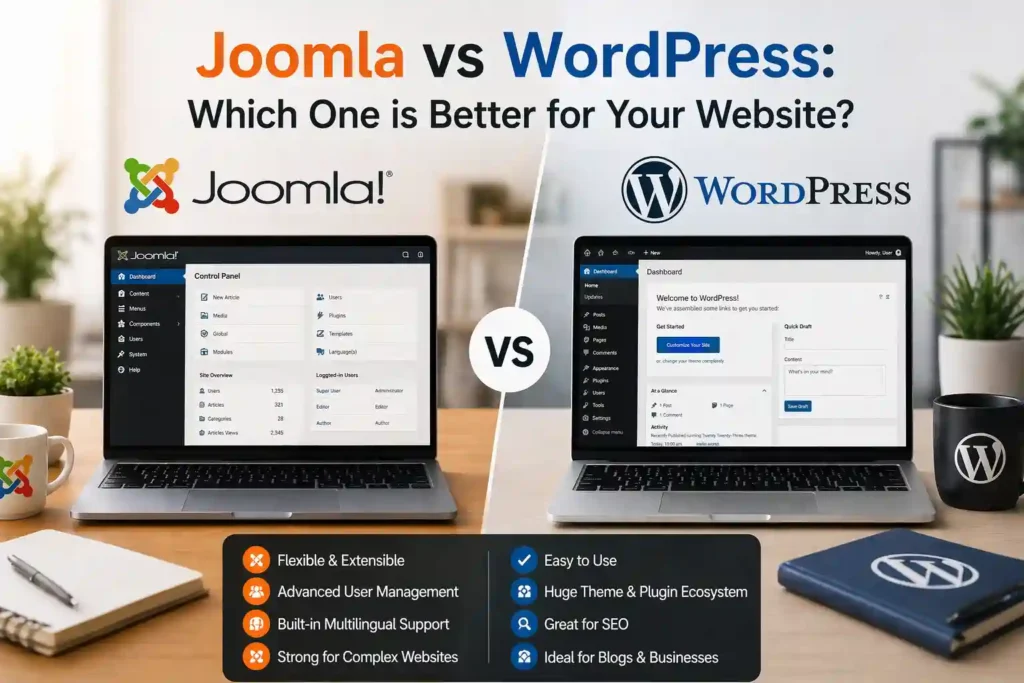
WordPress is easier for beginners because it offers a simple interface, guided setup, and ready-to-use themes. You can create pages, add content, and install plugins without writing code. This makes it ideal for first-time users who want to launch quickly.
Joomla feels more complex from the start. It requires understanding menus, modules, and content structure before you begin. In the Joomla vs WordPress comparison, this learning curve often slows beginners and creates unnecessary friction early on.
Dashboard, Setup, and Daily Use Experience
WordPress provides a clean, user-friendly dashboard that lets you manage pages, posts, plugins, and settings with a few clicks. The setup process is quick, and most actions feel intuitive even if you have no technical background.
Joomla uses a more structured backend with components and modules that take time to understand. Even small updates require extra steps, which can feel overwhelming. This makes WordPress easier for daily website management and ongoing use.
Verdict: WordPress is easier to learn, faster to use, and better suited for beginners and non-technical users.
SEO, Performance, and Speed
SEO and performance directly affect how your website ranks and how users experience it. A strong CMS platform should make optimization simple and accessible without technical complexity.
Which Platform is Better for SEO?
WordPress is better for SEO because it offers powerful tools like Yoast SEO and Rank Math that guide you step by step. You can easily optimize titles, meta descriptions, keywords, and content structure without advanced knowledge.
Joomla supports SEO features, but most settings require manual configuration. This makes it harder for beginners to manage optimization properly. In the Joomla vs WordPress comparison, WordPress stands out for its simplified SEO for both beginners and businesses.
Speed, Optimization, and Plugins
Both platforms can deliver fast websites when optimized correctly. WordPress makes this process easier with plugins for caching, image compression, and performance improvements. You can boost speed without touching code.
Joomla can also perform well, but optimization often requires more manual setup and technical understanding. WordPress gives you more ready-to-use tools, which help improve loading speed, user experience, and search rankings with less effort.
Verdict: WordPress makes SEO and performance optimization easier, especially for beginners and growing websites.
Features, Plugins, and Customization
Features and customization define how much control you have over your website. You need a CMS platform that can grow with your needs without becoming difficult to manage.
Plugins vs Extensions
WordPress uses plugins, while Joomla uses extensions, but the difference lies in ease and availability. WordPress offers a massive plugin library that covers almost every feature, from SEO and security to eCommerce and design.
Joomla extensions are powerful but fewer in number and often harder to configure. In most Joomla vs WordPress comparisons, WordPress stands out because it lets users add features quickly without technical complexity.
Themes, Design, and Flexibility
WordPress offers thousands of themes, making it easy to design your website without coding. You can customize layouts, colors, and features using simple tools or page builders, which speeds up the design process.
Joomla also supports templates, but customization usually requires more technical steps. WordPress provides greater flexibility for modern design and scalability, making it easier to build and grow your website over time.
Verdict: WordPress offers more flexibility, easier customization, and a larger ecosystem of tools.
Security and Maintenance
Security and maintenance depend more on how you manage your website than the platform itself. Both Joomla and WordPress are secure, but they require regular updates and proper setup.
Which Platform is More Secure
WordPress is secure when you use trusted plugins, strong passwords, and regular updates. It has a large community, so security issues get fixed quickly. However, its popularity also makes it a common target for attacks, especially when users install poor-quality plugins.
Joomla also offers strong built-in security features and better control over user permissions. It is less targeted because fewer websites use it. In the Joomla or WordPress comparison, both platforms are safe if managed properly, but WordPress requires more attention to plugin quality.
Updates, Maintenance, and Support
WordPress makes updates simple with one-click upgrades for themes, plugins, and the core system. Many hosting providers also offer automatic updates, reducing manual effort and keeping your site secure.
Joomla updates are reliable but less beginner-friendly. You may need to handle extensions and compatibility more carefully. WordPress has a larger support community, more tutorials, and better plugin support, which makes ongoing maintenance easier for most users.
Verdict: Both platforms are secure, but WordPress is easier to maintain and manage for most users.
Pricing and Total Cost
Both Joomla and WordPress are free, open-source CMS platforms, but building and running a website still costs money. The total cost depends on your hosting, design, and feature requirements.
Hosting, Themes, and Plugin Costs
WordPress offers flexible pricing, letting you start with affordable hosting and free themes or plugins. Premium plugins and themes add cost, but they also improve functionality and design. You can scale your spending based on your needs.
Joomla also requires hosting and may involve costs for templates and extensions. While some options are free, advanced features often require paid tools. In most Joomla vs WordPress setups, the base cost is similar, but WordPress offers greater budget flexibility.
Hidden Costs and Long-Term Expenses
WordPress can become expensive if you rely on many premium plugins, paid themes, or advanced tools. Maintenance services, backups, and security tools can also add to long-term costs, especially for growing websites.
Joomla may cost less in plugins, but it may require developer support for customization and maintenance. This can increase expenses over time. Overall, WordPress offers greater control over spending, while Joomla may entail higher long-term technical costs.
Verdict: WordPress offers greater pricing flexibility, while Joomla may entail higher technical costs over time.
Who Should Use Joomla or WordPress: Best Use Cases
Most people don’t need a long feature comparison. They need a clear decision they can trust.
In the comparison, the real difference comes down to simplicity vs. control, and that determines which platform best fits your website goals.
Choose WordPress If You Want Speed, Simplicity, and Growth
WordPress is the best choice for most users because it removes friction at every step. You can build, manage, and grow your website without technical knowledge, which makes it the most widely used CMS platform today.
- You want to launch fast and go live in hours using ready-made themes and plugins without coding.
- You don’t want technical complexity and prefer a simple dashboard with easy controls.
- You care about SEO and traffic and want tools like Yoast SEO and RankMath to guide optimization.
- You want flexibility as your website grows with options like eCommerce, blogs, and memberships.
WordPress works best for bloggers, startups, small businesses, and anyone who wants a scalable website builder that balances ease of use with powerful features.
Choose Joomla If You Need Control and Know What You’re Doing
Joomla is designed for users who need more structured control and are comfortable working with a more advanced CMS platform. It offers deeper customization options but also requires more time and technical understanding.
- You need complex content structures with multiple categories and advanced user roles.
- You want deeper backend control without relying heavily on plugins.
- You have technical knowledge and can manage modules, extensions, and configurations.
- You are building advanced websites, such as portals, directories, or custom systems.
Joomla suits developers, agencies, and advanced users who need greater control over how their websites are structured and managed.
Conclusion
If you want a clear answer, WordPress is the better choice for most websites. It is easier to use, faster to set up, and offers stronger SEO tools and greater flexibility. You can build, manage, and scale your website without technical complexity.
Joomla still works well for advanced users who need structured control and have the skills to manage it. But for beginners, businesses, and content-focused websites, WordPress gives you a smoother path with fewer obstacles.
FAQs About Joomla vs WordPress
Which is better, Joomla or WordPress?
WordPress is better for most users because it is easier to use, more flexible, and offers better SEO tools. Joomla is better for advanced users who need structured control and have technical experience.
Is Joomla better than WordPress for SEO?
No, WordPress is generally better for SEO because it offers plugins like Yoast SEO and RankMath that simplify optimization. Joomla supports SEO, but it requires more manual setup.
Is WordPress easier than Joomla?
Yes, WordPress is much easier than Joomla. It has a simple dashboard, a faster setup, and requires less technical knowledge, making it ideal for beginners.
Why is WordPress more popular than Joomla?
WordPress is more popular because it is beginner-friendly, highly flexible, and supported by a large community. It also offers thousands of plugins and themes that make website building easier.
Can I switch from Joomla to WordPress?
Yes, you can switch from Joomla to WordPress using migration tools or manual methods. Content can be moved, but design and layout usually need to be rebuilt.
Which CMS is best for beginners?
WordPress is the best CMS for beginners because it is easy to learn, quick to set up, and offers built-in tools for design, content, and SEO without technical complexity.