Choosing the right eCommerce platform can shape how your online store grows. If you’re comparing SureCart vs WooCommerce, you’re likely looking for flexibility, performance, pricing clarity, and long-term scalability.
WooCommerce has powered millions of WordPress stores for years. It’s powerful, customizable, and backed by a massive ecosystem of plugins and themes.
SureCart, on the other hand, takes a modern approach with a lightweight, hosted checkout system designed to reduce bloat and simplify payments.
TL;DR
- SureCart is built for speed, subscriptions, and low-maintenance selling inside WordPress.
- WooCommerce offers deeper customization and works better for large or complex stores.
- Both platforms provide key features and core features for online selling, but differ in how these are delivered and accessed.
- SureCart suits digital products and recurring billing with a streamlined checkout.
- WooCommerce handles physical products, shipping, and advanced store logic better.
What is SureCart?
SureCart is a cloud-powered WordPress plugin built for modern eCommerce. It uses a SaaS checkout system, which means payments and subscription billing run through external infrastructure instead of overloading your WordPress database.

It focuses on digital products, subscription billing, and recurring payments. SureCart is Stripe-native, offering direct Stripe integration as its primary payment gateway. This simplifies setup and reduces the need for multiple extensions.
Because of its lightweight database structure, SureCart improves performance and reduces server strain.
It also supports features like cart abandonment recovery and flexible pricing models, making it ideal for creators, SaaS businesses, and membership sites selling digital products.
SureCart Pros and Cons
SureCart is built for modern WordPress businesses that prioritize speed, subscriptions, and a clean checkout experience. It reduces technical overhead while keeping payment flows optimized.
SureCart Pros
- Fast Checkout Experience: SureCart uses a SaaS-based checkout system powered by Stripe-native processing. This reduces checkout friction, improves payment success rates, and helps lower cart abandonment.
- Subscription-First Architecture: The platform is designed specifically for subscription billing and recurring payments. This makes it ideal for memberships, SaaS products, online courses, and digital subscriptions.
- Lightweight Performance: Most processing happens outside your WordPress site. This keeps your database clean, improves load times, and reduces server strain as traffic grows.
- Built-In Payment Optimization: Native Stripe integration includes smart retries, optimized payment flows, and secure handling of customer data without extra plugins.
- Lower Maintenance Requirements: Fewer dependencies mean fewer updates, reduced plugin conflicts, and less ongoing technical maintenance.
- Simplified Store Management: SureCart focuses on selling rather than complex store operations, making it easier for non-technical teams to manage.
SureCart Cons
- Smaller Plugin Ecosystem: Compared to WooCommerce, SureCart has fewer third-party extensions, which may limit advanced customization options.
- Limited Store Customization: Design and checkout customization are more structured, which can be restrictive for highly customized stores.
- Less Suitable For Physical Products: Complex shipping rules, inventory tracking, and fulfillment workflows are not its core strength.
- Platform Dependency: Relies on cloud infrastructure, which offers performance benefits but reduces full self-hosted control.
Who Should Choose SureCart?
SureCart is ideal for creators, SaaS founders, coaches, and agencies that primarily sell digital products or subscription-based services.
If your business model relies on recurring billing and you want a Stripe-native checkout without managing complex store infrastructure, SureCart is a strong fit.
It works best for teams that value speed, low maintenance, and predictable performance. If you prefer a streamlined system with fewer plugins and less technical overhead, SureCart simplifies eCommerce inside WordPress.
What is WooCommerce?
WooCommerce is an open source WordPress eCommerce platform that turns any WordPress site into a fully customizable online store. It supports physical products, digital products, and hybrid stores.
As an open source solution, WooCommerce offers full control over checkout, store design, and functionality.
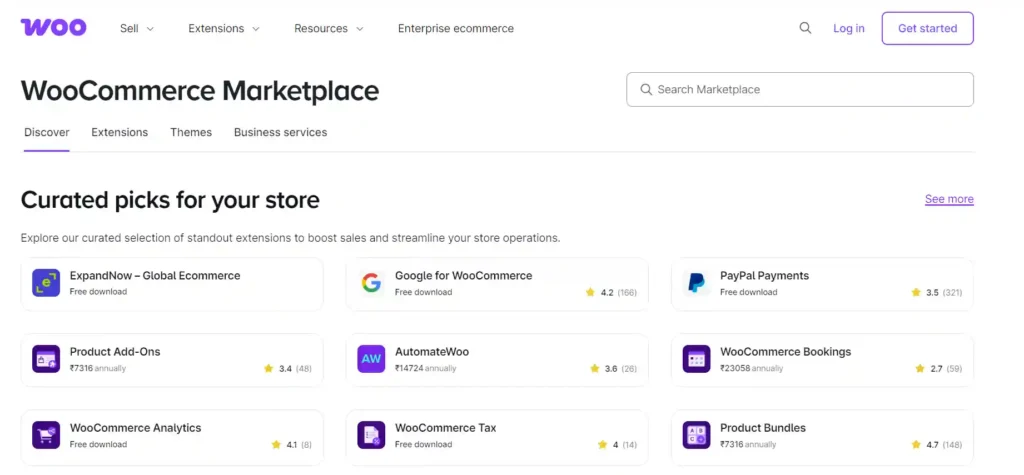
It includes access to a massive extensions marketplace for payment gateways, shipping zones, product variations, tax settings, and inventory management.
WooCommerce runs entirely within your WordPress environment. This gives you maximum flexibility, but it requires hosting resources, plugin management, and ongoing optimization to maintain performance.
Keep Your WooCommerce Store Running Smoothly
Get expert ecommerce website care that keeps your store secure, fast, and optimized for sales.
WooCommerce Pros and Cons
WooCommerce is a powerful open source WordPress eCommerce platform designed for flexibility and full control. It suits businesses that need advanced customization and complex store functionality.
WooCommerce Pros
- Extensive Plugin Ecosystem: Thousands of extensions are available for payment gateways, shipping zones, tax rules, marketing tools, and inventory management.
- Deep Customization Options: Open source access allows developers to customize themes, checkout flows, and store logic at a granular level.
- Supports All Store Types: WooCommerce works well for physical products, digital downloads, subscriptions, and hybrid stores.
- Multiple Payment Gateways: Supports global and regional payment gateways, giving flexibility across different markets.
- Large Community and Resources: Backed by a massive WordPress community, detailed documentation, and developer support.
- Full Data Ownership: Store data, hosting, and infrastructure remain fully under your control.
WooCommerce Cons
- Performance can Degrade Over Time: A database-heavy structure combined with multiple plugins can slow down stores without optimization.
- Higher Ongoing Maintenance: Requires regular updates, backups, security monitoring, and performance tuning.
- Costs Increase with Scale: While the core is free, essential features often require paid extensions and higher hosting plans.
- Technical Complexity: Advanced customization usually requires development expertise, which can increase time and costs.
Who Should Choose WooCommerce?
WooCommerce is better suited for larger eCommerce stores selling physical products or managing complex catalogs.
If you need advanced shipping rules, tax configurations, product variations, and full design control, WooCommerce offers deeper flexibility.
It fits businesses prepared to invest in hosting, extensions, and ongoing optimization. For stores that require enterprise-level customization and long-term scalability, WooCommerce provides the control needed to grow.
SureCart vs WooCommerce: Key Differences
SureCart and WooCommerce approach WordPress eCommerce in very different ways.
One prioritizes speed, performance, and subscriptions, while the other focuses on flexibility and full store control. Understanding these differences helps you choose the right platform for your business goals.

Ease of Setup
Ease of setup affects how fast you can launch and how much technical effort your team needs upfront. A simpler setup often means fewer errors and lower maintenance later.
- SureCart: Offers a minimal setup process with Stripe-first onboarding. You can connect your payment gateway quickly and start selling digital products or subscriptions without complex configuration.
- WooCommerce: Requires more initial setup, including store settings, product configurations, taxes, shipping zones, and additional plugins. This gives flexibility but increases setup time.
Pricing Structure
Pricing models directly impact long-term costs and profitability. The difference between predictable pricing and variable expenses becomes clear as your store grows.
- SureCart: Follows a subscription-based pricing model with clear monthly costs. This makes budgeting easier and avoids surprise expenses from multiple add-ons.
- WooCommerce: The core plugin is free, but most advanced features require paid extensions, premium themes, and higher hosting resources, which can increase costs over time.
Payment Processing
Payment processing plays a major role in checkout speed, security, and conversions. Platform design determines how smoothly payments are handled.
- SureCart: Supports a smooth payment process with major gateways like Stripe, PayPal, Apple Pay, and Google Pay, ensuring reliable transactions and modern checkout options that enhance customer convenience and boost conversion rates.
- WooCommerce: Integrates with hundreds of payment gateways, including Apple Pay and Google Pay, providing flexibility but requiring ongoing management of updates and fees for each gateway.
Overall, SureCart offers a streamlined payment process with built-in support for popular gateways, while WooCommerce provides broader gateway integration but with more management overhead.
Performance and Speed
Performance affects both user experience and search rankings. As stores scale, infrastructure choices become more important.
- SureCart: Runs on cloud infrastructure with a lightweight database footprint. Most checkout processing occurs outside WordPress, keeping sites fast and stable.
- WooCommerce: Operates fully inside WordPress using a database-heavy architecture. Performance can decline as products, extensions, and traffic increase without optimization.
Customization and Flexibility
Customization determines how much control you have over store design and functionality. This is where the platforms differ the most.
- SureCart: Focuses on streamlined simplicity. SureCart offers structured customization for checkout forms and product pages, making it easy to personalize the shopping experience while limiting complexity to deliver a clean checkout experience, especially for digital products and subscriptions.
- WooCommerce: Provides deep customization through open source code and a large extensions ecosystem. WooCommerce integrates with popular page builders, allowing users to adjust layouts and extensively customize product pages and checkout forms. This flexibility suits businesses that need advanced workflows and custom store logic.
When comparing, WooCommerce offers greater flexibility for adjusting layouts and using page builders, while SureCart prioritizes simplicity and ease of use.
Subscription and Recurring Payments
Recurring revenue models require reliable subscription management. Native support reduces dependency on third-party tools.
- SureCart: Built specifically for subscription billing and recurring payments. These features work out of the box without extra extensions.
- WooCommerce: Supports subscriptions through paid add-ons. This adds flexibility but increases cost and maintenance effort.
SureCart works best for speed, subscriptions, and performance. WooCommerce suits businesses that need full control and deep customization at scale.
Performance Comparison: Which is Faster?
SureCart is generally faster because it uses cloud-based infrastructure and a SaaS checkout model. WooCommerce runs fully inside WordPress, which increases database load as your store grows.
SureCart offloads transaction processing outside your site. This reduces database strain, improves checkout speed, and lowers hosting pressure.
WooCommerce stores orders, product variations, and metadata inside your WordPress database. As traffic and plugins increase, performance depends heavily on hosting quality and optimization.
If speed and low maintenance are priorities, SureCart has the advantage. If you want full hosting control and are ready to manage optimization, WooCommerce remains flexible.
SEO Capabilities: WooCommerce or SureCart
Both platforms can rank well in search engines, but WooCommerce offers deeper SEO customization.
WooCommerce allows full control over product URLs, categories, structured data, and schema markup.
It integrates seamlessly with WordPress SEO plugins and supports advanced product-level optimization. SureCart works well with major SEO plugins, but checkout runs separately, limiting some structural customization.
SureCart benefits from lightweight performance, which can improve page speed and indirectly support SEO. WooCommerce offers more direct control, but requires optimization to maintain strong Core Web Vitals.
If SEO control is your priority, WooCommerce gives more flexibility. If performance simplicity matters more, SureCart delivers efficiency.
Security Comparison
SureCart uses Stripe-native processing and cloud infrastructure, which supports PCI-compliant payment handling and reduces exposure to plugin vulnerabilities.
Because fewer plugins are required, there is lower risk of WordPress security gaps and malware issues.
WooCommerce provides full control but increases responsibility. Store owners must manage updates, monitor vulnerabilities, maintain secure checkout configurations, and regularly patch extensions to reduce malware risks.
SureCart reduces technical security overhead. WooCommerce offers control but requires ongoing security management.
SureCart vs WooCommerce: Different Use Cases
SureCart and WooCommerce serve different types of businesses. Choosing the right platform depends on what you sell, how you charge customers, and how much control you need.

Best for Digital Products
SureCart works best for selling digital products like courses, software, licenses, and downloads. Its SaaS checkout, Stripe-native payments, and lightweight setup reduce friction and improve conversions.
WooCommerce can handle digital products, but it often requires additional plugins and setup to match the same simplicity.
Best for Physical Products
WooCommerce is better suited for physical products. It offers built-in support for shipping zones, inventory management, tax rules, and product variations. SureCart is not designed for complex shipping workflows or physical inventory tracking.
Best for Subscription Businesses
SureCart is the stronger choice for subscription-based businesses. It is built specifically for recurring billing, memberships, and subscription management without add-ons.
WooCommerce supports subscriptions, but only through paid extensions that increase complexity and cost.
Best for Large eCommerce Stores
WooCommerce performs better for large eCommerce stores that need advanced customization, complex catalogs, and multiple integrations.
With the right hosting and optimization, it can scale to support high traffic and large inventories. SureCart is more focused on streamlined selling rather than enterprise-level store management.
Best for Beginners
SureCart is ideal for beginners who want to launch quickly without dealing with technical setup. Its simplified onboarding and reduced maintenance make it easier to manage. WooCommerce has a steeper learning curve but offers more flexibility once mastered.
Conclusion
Choosing between these two WordPress eCommerce platforms comes down to how you sell and how much control you need.
If your business focuses on digital products or recurring revenue, SureCart offers a lightweight, performance-driven approach.
It simplifies checkout, reduces technical overhead, and makes subscription billing easy to manage.
For stores with physical inventory, large catalogs, and advanced workflows, WooCommerce remains the more flexible option.
It requires more setup and ongoing optimization, but it gives full control over design, data, and functionality.
FAQs About WordPress eCommerce Platforms
Is SureCart a better option for subscription businesses?
Yes. SureCart is built specifically for recurring billing and subscription management. It handles these features natively without relying on additional extensions.
Can WooCommerce handle digital products effectively?
WooCommerce supports digital products, but it often requires extra plugins and configuration to achieve the same streamlined experience offered by SureCart.
Which platform is easier to manage over time?
SureCart is easier to manage because it relies on fewer plugins and offloads processing to cloud infrastructure. WooCommerce demands more hands-on maintenance as stores grow.
Which option offers better SEO flexibility?
WooCommerce provides more control over product URLs, schema, and site structure. SureCart benefits from strong performance and compatibility with WordPress SEO plugins.
Which platform offers stronger security?
SureCart reduces risk by using a secure, Stripe-native checkout and fewer plugins. WooCommerce security depends on hosting quality, plugin updates, and ongoing monitoring.