
AEO vs SEO is now one of the biggest discussions about search visibility for businesses in 2026, as search behavior is rapidly changing with AI-powered search engines and zero-click search experiences.
Traditional SEO helps websites rank in Google search results. AEO focuses on helping AI systems display direct answers in AI Overviews, featured snippets, ChatGPT, Gemini, and voice search.
Businesses can no longer rely solely on rankings, as AI-driven search now influences how users discover information online. This guide explains the difference between AEO and SEO, how both strategies work together, and which approach your website actually needs for long-term visibility, traffic, and growth.
SEO helps your website rank in traditional search results so users find and click your pages. AEO helps your content be extracted as a direct answer by AI tools like Google AI Overviews, ChatGPT, and voice assistants, without the user having to click anything. SEO gets you indexed. AEO gets you cited. In 2026, your website needs both.
Understanding SEO and AEO
In 2026, SEO, AEO, GEO, NLP, and featured snippets all shape how content gets discovered across traditional and AI-powered search surfaces. Every piece of content now needs to satisfy technical authority, conversational search intent, and structured answer extraction simultaneously.
UX and readability sit at the center of both strategies. Search engines and AI systems favor content that is clearly formatted, easy to scan, and built to deliver direct answers fast, making clean structure a core ranking and citation signal.
What is SEO and How Does it Work?
SEO stands for Search Engine Optimization. It is the process of improving your website so it ranks higher in search engine results pages (SERPs) and attracts more organic traffic from Google and other search engines. SEO focuses on helping search engines understand your content, website structure, authority, and relevance so users can discover your pages more easily.
SEO works by combining technical SEO, on-page optimization, and off-page authority signals. The goal is to improve organic rankings, increase visibility, and generate more clicks from search results.
- Technical SEO: Improves crawlability, site speed, mobile optimization, indexing, XML sitemaps, and website structure.
- On-Page SEO: Focuses on title tags, headings, keywords, internal links, content quality, and search intent optimization.
- Off-Page SEO: Builds backlinks, brand mentions, authority signals, and trust across the web.
- Main Goal: Rank higher in Google Search results and increase organic website traffic and clicks.
What is AEO, and How is it Different?
AEO stands for Answer Engine Optimization. It focuses on structuring content so AI-powered search systems can extract and display direct answers inside Google AI Overviews, featured snippets, People Also Ask boxes, voice search, ChatGPT, Gemini, Bing Copilot, Perplexity, and other AI-driven search experiences.

Unlike traditional SEO, which focuses on ranking higher in search results, AEO focuses on becoming the answer itself. The goal is not only visibility but also helping AI systems understand, trust, and quote your content accurately during zero-click searches and AI-generated responses.
AEO and SEO: A Side-by-Side Comparison
Both SEO and AEO help your website get found, but they work in completely different ways and measure success differently. Here is how they compare side by side.
| SEO | AEO | |
|---|---|---|
| Goal | Rank on results page | Be extracted as the answer |
| Measures Success By | Rankings and organic clicks | Citations and AI inclusions |
| Content Format | Long-form, keyword-rich pages | Direct answers, structured data |
| User Behaviour | User clicks a link | User gets answer without clicking |
| Where It Appears | Google SERP blue links | AI Overviews, voice, chatbots |
| Foundation | Technical authority | Content clarity and structure |
Want Better Visibility Across Google and AI Search?
Improve your technical SEO foundation, strengthen search visibility, and prepare your website for modern search experiences.
AEO vs SEO: Key Differences Every Website Needs to Understand in 2026
Search visibility in 2026 is no longer determined solely by rankings. Understanding how SEO and AEO differ in their goals, formats, and measurements is the first step toward building a strategy that performs across every modern search surface.
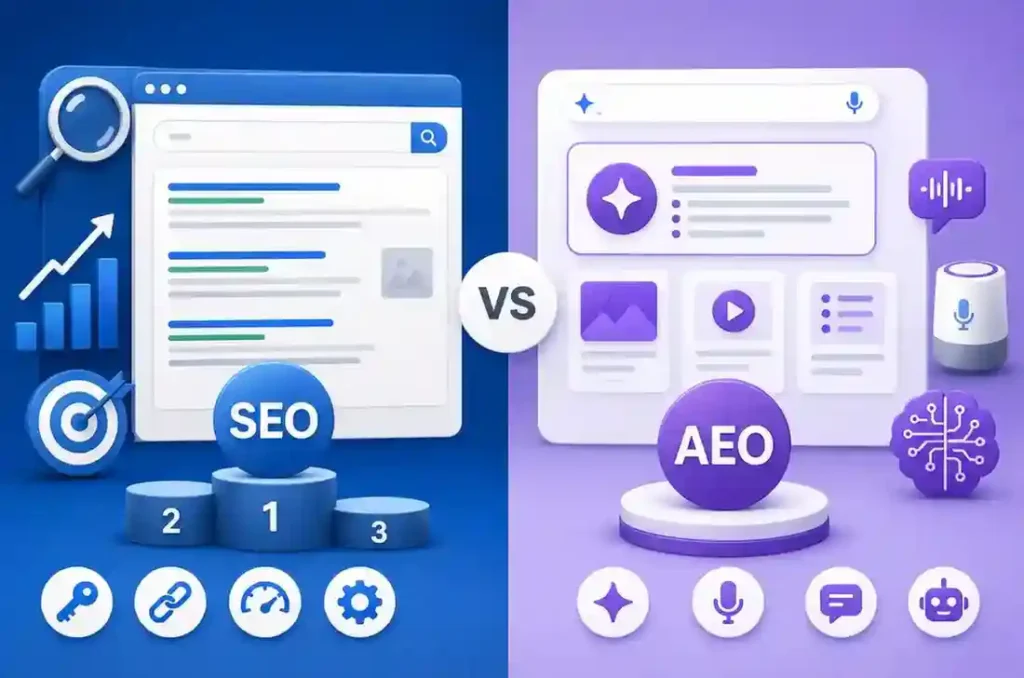
Goal: Rankings vs Direct Answers
SEO aims to rank your website on search engine results pages so users find, click, and visit through organic search. It builds discoverability by signaling relevance and authority through technical structure, content depth, and off-page signals.
AEO extracts your content and presents it as a direct answer in Google AI Overviews, ChatGPT, voice assistants, and featured snippets, without the user having to click anything.
Verdict: In 2026, your website needs both SEO and AEO working together.
How Success is Measured: Traffic vs Citations vs Visibility
SEO measures success through keyword rankings, organic click-through rates, domain authority growth, and traffic volume. Metrics like impressions, average position, and pages per session reveal how content performs across the full search funnel.
AEO measures success through AI citations, featured snippet inclusions, and the frequency with which content surfaces in responses across ChatGPT, Gemini, and Perplexity. Brand visibility inside zero-click results becomes a key indicator even when no direct traffic is generated.
Verdict: Tracking only rankings means missing how most users find information in 2026.
Content Format: Depth vs Structure vs Clarity
SEO relies on long-form, keyword-rich pages that demonstrate topical depth and comprehensive coverage built around search intent. NLP is playing an increasingly important role as Google evaluates whether content reads naturally and satisfies real user intent rather than just matching keywords.
AEO relies on direct answers, structured data, FAQ sections, and NLP-friendly language that AI systems can extract cleanly. Good readability and UX ensure both human visitors and AI tools can navigate content without friction.
Verdict: The best content satisfies SEO depth, AEO structure, NLP clarity, and UX readability together.
User Behavior: Clicks vs Zero-Click Answers
SEO drives users to click a link and visit your website to find what they searched for. A strong title tag, compelling meta description, and clear intent all contribute to higher click-through rates and better on-page engagement.
AEO delivers answers directly within search results or AI tools through featured snippets, voice responses, and AI Overviews. Content structured for AEO builds brand authority and trust even when no visit occurs.
Verdict: Ignoring AEO means losing visibility even when SEO rankings are strong.
Where It Appears: SERPs vs AI Surfaces
SEO gets your pages into organic results, local packs, image listings, video carousels, and news sections across all devices. Appearing across multiple SERP features increases total visibility well beyond a single blue link position.
AEO gets your content into AI Overviews, voice search results, chatbot responses, and answer panels inside ChatGPT, Gemini, Bing Copilot, and Perplexity. NLP optimization and schema markup help AI systems accurately interpret and surface the content of each section of your page.
Verdict: Appearing only in blue links while competitors dominate AI panels means losing visibility every month.
Foundation: Authority vs Clarity vs Experience
SEO is built on technical authority, including crawlability, backlinks, site structure, Core Web Vitals, and mobile performance. Strong backlinks signal trust, and Core Web Vitals, including LCP, INP, and CLS, directly affect rankings by measuring real user experience.
AEO is built on content clarity, including answer-first formatting, schema markup, FAQ optimization, and NLP-aligned conversational language. UX and readability are tied together, since pages that load quickly and scan easily perform better across SEO rankings and AEO citations.
Verdict: NLP, UX, and readability are the connective tissue that make SEO and AEO work together.
Common SEO and AEO Mistakes Businesses Make
Many businesses still optimize only for traditional rankings while ignoring how AI systems now influence search visibility. Weak content structure, poor technical SEO, and outdated optimization strategies can reduce both organic rankings and AI discoverability.
- Focusing Only on Rankings: High rankings alone no longer guarantee clicks or visibility inside AI search experiences.
- Ignoring AI Search Visibility: Businesses that ignore AI Overviews and answer-based search risk losing long-term visibility.
- Publishing Unstructured Content: Poor formatting makes it harder for search engines and AI systems to understand content clearly.
- Weak Technical SEO Foundations: Slow websites, crawl issues, and poor site structure reduce discoverability and trust signals.
- Over-Optimizing for Keywords: Keyword stuffing often harms readability, user experience, and the quality of AI-generated answers.
Which Strategy Should Your Business Prioritize?
Businesses still need SEO because rankings, crawlability, backlinks, and domain authority remain important for long-term search visibility. Strong SEO foundations help search engines and AI systems discover, trust, and properly evaluate website content.
AEO is becoming equally important because AI-powered search experiences now influence how users find information online. The best strategy combines SEO and AEO together so businesses can improve both traditional rankings and AI search visibility based on their traffic goals, content strategy, and audience behavior.
How Modern Content Strategies Combine SEO and AEO?
Modern content strategies now focus on both search engine rankings and AI readability because search behavior is changing quickly. Content needs strong SEO foundations for crawlability, authority, and rankings while also being structured clearly enough for AI systems to extract and summarize answers accurately.
Structured formatting, direct answers, FAQs, headings, and readable layouts improve both featured snippet visibility and user experience. Businesses now need visibility across traditional search engines, AI Overviews, voice search, and AI-generated answers, which is why future-proof content strategies combine SEO and AEO together.
Conclusion
SEO and AEO now work together because search visibility no longer depends only on rankings. Traditional SEO helps websites build authority, improve crawlability, and increase organic traffic, while AEO helps content appear inside AI Overviews, featured snippets, voice search, and AI-generated answers.
Businesses in 2026 need both strategies to stay visible across search engines and AI platforms. Strong technical SEO combined with clear, answer-focused content improves long-term visibility, traffic quality, user experience, and AI discoverability.
FAQs
What is the difference between SEO and AEO?
SEO focuses on improving search rankings and organic traffic, while AEO helps AI systems extract and display direct answers from content.
Is AEO replacing SEO in 2026?
No, AEO is not replacing SEO. SEO still builds rankings, authority, and crawlability, while AEO improves visibility inside AI-powered search experiences.
Why are zero-click searches increasing?
Zero-click searches are increasing because Google AI Overviews, ChatGPT, Gemini, and other AI systems now provide direct answers without requiring users to click websites.
Can websites rank without AEO optimization?
Yes, websites can still rank without AEO optimization, but they may miss visibility opportunities inside AI-generated answers and featured snippets.
What type of content works best for AEO?
Structured content with direct answers, FAQs, clear headings, concise explanations, and readable formatting usually performs best for AEO.
Should businesses invest in SEO or AEO first?
Most businesses should first build strong SEO foundations, then improve AEO through structured, answer-focused content and AI-friendly formatting.


