Search behavior is shifting. A growing share of queries on Google, ChatGPT, Perplexity, and Gemini now return AI-generated responses instead of ranked link lists, and those responses cite only a handful of sources per answer.
For publishers and brands, this changes the stakes entirely. Ranking on page one no longer guarantees visibility if the AI answer above it never references your site. This guide covers what AI engines look for, how selection works, and the specific steps that move your content into citation range.
AI platforms like ChatGPT, Perplexity, and Google AI Overviews cite websites that place direct answers within the first two sentences of each section, implement schema markup (FAQ, Article, Speakable), and carry verified author credentials.
Topical authority, built through content clusters covering a subject in full, is the strongest predictor of consistent AI citation. Pages without author attribution, structured data, or updates within the past 12 months are routinely skipped in favor of fresher, verifiable sources.
What are AI Answers and How Do They Work?
AI answers are synthesized, natural-language responses generated by AI-powered search engines for user queries. Instead of returning a list of links, these systems read and summarize information pulled directly from web pages.
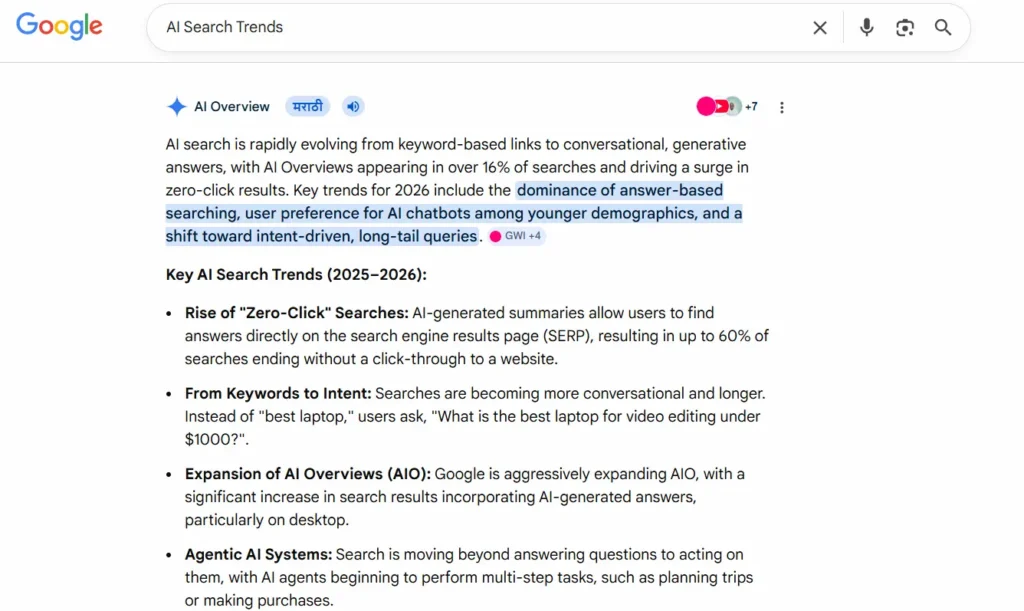
Platforms like Google AI Overviews, Perplexity AI, You.com, and Microsoft Copilot use large language models (LLMs) to identify the most relevant and trustworthy sources. They then craft a direct response that often cites those pages by name.
How AI Search Engines Select and Cite Website Content?
AI systems do not pick sources at random. They evaluate pages for relevance, factual accuracy, and clarity. A page that answers a question directly in the first two sentences is far more likely to be cited than one that buries its answer deep in the body copy.
The selection process relies heavily on content relevance, how well a page’s language, structure, and intent match the user’s query. Pages that use clear headings, short paragraphs, and precise language have a measurable advantage in AI extraction.
Difference Between Traditional SEO, AEO, and GEO
Traditional SEO focuses on ranking in classic search engine result pages using on-page optimization, backlinks, and technical performance. It targets click-through traffic from keyword-matched results.
Answer Engine Optimization (AEO) goes further. It optimizes content specifically for AI systems and voice assistants that generate direct responses. AEO prioritizes conversational queries, structured formatting, and featured snippet capture.
Generative Engine Optimization (GEO) is the newest discipline. It prepares content for citation by generative AI tools, platforms that synthesize answers from multiple web sources rather than simply ranking pages.
Debunking multilingual SEO myths is just one example of the kind of authoritative, specific content these systems favor when selecting citation sources for international queries.
Explore Further: Future of SEO: Integrating AIO, GEO, AEO, and SXO Strategies
Why AI-Generated Search Results Are Changing Organic Search?
AI-generated results increasingly provide complete answers without requiring a click. A user who receives a comprehensive response in Google AI Overviews may never visit your page at all.
This shift means that earning a citation within the AI response is often more valuable than ranking second or third in traditional results.
AI Overviews now appear for a significant and growing share of informational and transactional queries. Understanding Google WebMCP and how AI agents retrieve and interpret web content gives publishers a significant strategic edge as this shift accelerates.
Get Your Website Featured in AI Answers
Boost visibility in AI search results with expert managed SEO, structured data optimization, and content strategies tailored for generative search.
Why Getting Featured in AI Answers Matters for SEO and Brand Visibility?
Being cited in AI-generated answers provides compounding benefits that go beyond a single traffic spike.
- First, AI citations reinforce brand authority. When Perplexity, ChatGPT, or Google directly names your site as a source, users associate your brand with expertise.
- Second, platforms like Perplexity prominently display clickable source links, and many users follow them for deeper reading.
- Third, consistent citation by AI tools embeds your brand entity in AI training data and real-time retrieval systems, which increases future citation likelihood.
- Fourth, pages that AI systems cite regularly tend to share traits with pages that rank well in traditional search, so AI optimization and SEO frequently reinforce each other.
How AI Search Engines Choose Content for AI Answers?
Understanding the selection criteria is the foundation of an effective optimization strategy.

The Role of Content Clarity and Extractability
AI engines extract information automatically. They need content that is clean, scannable, and unambiguous. Walls of dense text, vague headings, and passive voice all reduce extractability.
Use short sentences. Place the direct answer at the top of each section. Use descriptive, question-style headings. This structure enables AI models to quickly identify what each section covers and whether it aligns with the user’s intent.
Why Topical Authority Matters for AI Visibility?
AI systems prefer websites with demonstrated expertise across a topic area. A site that thoroughly covers one subject is more trustworthy than one with scattered, shallow content.
Topical authority grows through content clusters: a pillar page covering a broad subject, supported by cluster pages that address related subtopics in depth. Internal linking between these pages signals to both search engines and AI retrieval systems that your site is a comprehensive resource.
Tactics like LLM seeding and strategically placing accurate, original content across platforms that AI systems index help accelerate AI models’ recognition of your expertise.
How Structured Data and Schema Markup Help AI Understand Content?
Schema markup communicates content meaning directly to machines. FAQ schema, Article schema, HowTo schema, and Speakable schema all help AI engines identify relevant sections and understand the information your page offers.
For e-commerce publishers, properly structured data implementation, similar to the principles behind Google Shopping feed optimization, enables AI systems to accurately extract product details, pricing, and reviews.
The same principle applies across content types: explicit markup removes ambiguity for AI parsers.
Why EEAT Signals Influence AI-Generated Answers?
Google’s EEAT framework (Experience, Expertise, Authoritativeness, and Trustworthiness) directly influences which content AI systems choose to cite. AI engines apply similar criteria when evaluating source credibility.
Strong EEAT comes from verified author bios with professional credentials, citations from recognized industry sources, editorial policies that show how your site handles corrections, and a transparent organizational identity.
Your domain’s trust history also matters. Understanding the role of free vs paid domain names in domain authority is a small but relevant part of the broader trust picture that AI systems evaluate.
Maintaining robust site security and adhering to compliance standards, such as HIPAA for WordPress websites in regulated industries, further reinforces the trustworthiness signals that AI engines measure.
The Importance of Freshness, Accuracy, and Content Updates
AI retrieval systems prioritize current, accurate information. A page last updated three years ago loses ground rapidly to competitors who keep their content up to date.
Regular content maintenance is an active competitive strategy. Scheduling periodic audits, verifying statistics, and updating outdated examples directly affect how AI systems perceive your content’s reliability.
Essential Steps to Get Your Website Featured in AI Answers
These are the specific, actionable steps that move your content closer to AI citation.
Target Conversational and Question-Based Keywords
AI engines answer questions. Your keyword strategy must reflect that. Use research tools to surface the exact questions your audience asks, then build content that answers them directly.
Queries beginning with “what is,” “how to,” “why does,” and “what are” align naturally with AI query patterns. Long-tail, conversational phrases that reflect real user language consistently outperform generic keywords for AI answer capture.
Create Direct Answer First Content
Place the core answer within the first two sentences of every section. AI systems frequently extract the opening of a section for citations. Content that buries its key point 400 words in rarely earns citations.
Use the inverted pyramid structure: lead with the conclusion, then provide supporting details, examples, and context.
Optimize Headings for AI Extraction
Frame headings as clear statements or questions. “How does schema markup help SEO?” performs better in AI extraction than a vague heading like “Schema and SEO.” Descriptive headings function as semantic signals that help AI systems match sections to specific query types.
Every H2 and H3 should convey a standalone idea. If someone reads only the headings, they should understand the entire article’s structure.
Build Comprehensive Topical Authority
Cover every relevant dimension of your subject area. AI systems reward depth. A site that answers 60 related questions on a topic is more citable than one that covers only the basics.
Create dedicated pillar pages for your core topics and build supporting cluster content around them. Link between related articles consistently. This structure mirrors the way AI workflows for web creators approach information retrieval, mapping relationships between concepts to better serve users.
Add Structured Data and Schema Markup
Implement the FAQ schema on pages that answer multiple questions. Add Article schema with author name, publisher, and date published. Use the Speakable schema to flag sections that are ideal for voice-based AI responses.

Validate all schemas with Google’s Rich Results Test before publishing. Malformed markup provides no benefit and may introduce indexing issues.
Improve Website Trust and EEAT Signals
Add verified author profiles to every published page. Include each author’s professional background, credentials, and links to external profiles.
Display a clear editorial policy, correction process, and content review standards. Add industry affiliations, certifications, or awards relevant to your niche. The goal is to make it effortless for both users and machines to verify your credibility.
Defending your site’s integrity is also part of trust building. Sites that proactively address threats, such as AI-powered cyberattacks, help protect the uptime and data integrity on which EEAT evaluations depend.
Optimize Content for Featured Snippets and AI Overviews
Featured snippets and AI Overviews share selection criteria. Pages that regularly earn featured snippets also appear in AI Overviews.
Target paragraph snippets with 40 to 60-word definitions. Use numbered lists for step-by-step instructions. Build comparison tables for “X vs Y” queries.
Structure FAQs with clearly separated question-and-answer pairs. These formats are machine-readable and can be directly transferred into AI response structures.
Publish Original Research and Information Gain Content
AI systems prioritize content that contributes new information to the web. Original data, proprietary surveys, case studies, and expert commentary that are not available elsewhere are highly citeable.
“Information gain” content material that goes beyond what existing pages offer is one of the most powerful differentiators for AI citation.
Commissioning original research, publishing proprietary benchmarks, or synthesizing data from multiple sources into a unique analysis all qualify.
This directly connects to why resources like the build AI citations guide emphasize original content as the cornerstone of a sustainable AI visibility strategy.
Improve Technical SEO and Website Performance
AI crawlers exhibit behavior similar to standard search bots. A slow, inaccessible, or poorly structured website is crawled less thoroughly, reducing its AI citation potential.
Prioritize Core Web Vitals for enterprise websites and all site types, particularly Largest Contentful Paint (LCP) and Cumulative Layout Shift (CLS). Choosing the fastest WordPress themes optimized for speed is one practical step that reduces load times and improves crawlability from the ground up.
Reducing WordPress plugin bloat is another performance lever that many publishers overlook. Excess plugins add HTTP requests, slow load times, and create conflict risks that destabilize your site.
Ensure your XML sitemap is current. Fix broken links after migration and on-going site changes, since dead links undermine crawlability and trust.
Also, ensure that WordPress URL redirects are handled correctly; unresolved redirect chains waste crawl budget and dilute link equity. Decisions about site architecture, including subdomain vs subdirectory structure, also affect how AI systems attribute topical authority across your domain.
Meeting accessibility compliance and WCAG standards improves the user experience and the semantic quality of your HTML, thereby enhancing AI extractability.
Optimize for Entity SEO and Semantic Search
AI language models understand the web through entities: people, places, organizations, products, and concepts. Optimizing for entity SEO means explicitly and consistently defining these elements across your site.
Use your brand name consistently. Create an About page that clearly describes your organization. Add author pages with structured data. Reference your entities in context with recognized industry terms and authoritative external sources.
For publishers exploring advanced architecture, Next.js headless WordPress separates content delivery from the CMS, which can improve both performance and semantic clarity, two factors that benefit entity recognition by AI systems.
Keep Content Updated and Accurate
Schedule content reviews every three to six months for high-traffic pages. Update statistics, replace outdated references, and verify that all factual claims remain accurate.
Content pruning to recover lost traffic after Google updates is a proven way to maintain a lean, high-quality content library.
Removing, consolidating, or improving underperforming content keeps your overall domain quality high, a signal AI systems weigh when selecting citation sources.
Best Content Formats That Perform Well in AI Answers
Not all content formats are equally effective for AI citations. These are the formats that consistently earn placement.

- Definition paragraphs (40–60 words) give AI a ready-made answer for “what is” queries. Keep them precise and free of jargon.
- Numbered how-to lists match instructional query intent exactly. AI systems frequently reproduce step lists verbatim in their responses.
- Comparison tables serve “X vs Y” queries. They are fast to extract and visually distinctive in AI responses.
- FAQ sections directly mirror the conversational structure of AI queries. Each question-and-answer pair is an independent citation opportunity.
- Original statistics and data tables carry enormous citation value. AI systems regularly reference proprietary research because it offers unique information unavailable elsewhere.
- Expert quotes and author commentary provide the human authority signal that distinguishes your content from AI-generated filler.
Common Mistakes Preventing Websites From Appearing in AI Answers
Many websites unknowingly block themselves from AI citation. These are the most common errors.
- Thin content pages with fewer than 600 words rarely earn AI citations. AI systems need sufficient depth to evaluate and trust a source.
- Missing EEAT signals anonymous content with no author attribution, no external citations, and no editorial transparency scores poorly on trust evaluations.
- Without schema markup, AI engines guess at meaning and structure, often incorrectly.
- Keyword-stuffed, unreadable text content written for density rather than clarity fails the extractability test every time.
- Outdated information, stale statistics, and inaccurate facts cause AI systems to prioritize fresher sources over content.
- Blocking AI crawlers, some robots.txt configurations inadvertently block legitimate AI indexing bots.
- Poor site performance a slow WordPress website reduces crawl frequency and signals unreliability to both Google and AI retrieval systems.
Future Trends in AI Search and Generative Engine Optimization
The AI search landscape is changing faster than any other area of digital marketing. These trends will define the next phase of optimization.
- Multimodal AI search is expanding. AI engines increasingly process images, video, and audio alongside text. Optimizing non-text assets with accurate metadata, captions, and transcripts will become a significant ranking factor.
- Real-time retrieval augmentation means AI systems are moving beyond static training data. Platforms like Perplexity already pull live web content at the moment of each query. Freshness and crawl speed are therefore more important than ever.
- Agent-based AI browsing is becoming mainstream. AI agents navigate websites autonomously on behalf of users, retrieving specific data. Semantic HTML, machine-readable structure, and clean navigation are all directly relevant to how well your site performs with autonomous AI agents.
- Personalized AI answers will depend on user context, location, and preference data. Brands with consistent entity signals and high citation frequency across AI platforms will appear more often in personalized responses.
The future of WordPress and web publishing in an AI-first internet is closely tied to how well content management systems and publishers adapt to these retrieval patterns.
CMS platforms that generate clean, semantic HTML, support rich structured data, and deliver fast page loads will have a natural advantage in AI indexing.
Keeping pace with the best AI web design templates and design frameworks built with machine readability in mind is one practical way to stay ahead.
GEO is not a temporary technique. It represents a permanent shift in how the web distributes authority and attention. Brands that invest in it today will compound that advantage as AI search continues to capture a larger share of all information retrieval.
Conclusion: Build Content AI Systems Want to Cite
Getting your website featured in AI answers demands a deliberate, layered strategy that blends the principles of traditional SEO with the specific requirements of machine learning systems.
Prioritize clear, answer-first writing. Build deep topical authority through content clusters. Implement schema markup consistently.
Strengthen EEAT signals at every level of your site. Keep content current and accurate. Monitor your AI visibility with dedicated tools and adjust based on what you observe.
The websites that dominate AI-generated search results are not always the largest brands. They are the clearest, most trustworthy, and most comprehensive.
These qualities are achievable for any publisher who commits to content quality, technical excellence, and a deep understanding of how AI systems evaluate and use information.
FAQs About Featuring Your Website in AI Answers
What are AI Answers in search engines?
AI Answers are AI-generated responses shown in platforms like Google AI Overviews, ChatGPT, Gemini, and Perplexity. These systems pull information from trusted websites to provide direct answers to user queries.
How can I get my website featured in AI Answers?
Create clear, authoritative, and well-structured content that directly answers user questions. Use schema markup, improve technical SEO, target conversational keywords, and build topical authority to increase your chances of being cited.
Does traditional SEO still matter for AI search results?
Yes. Traditional SEO remains important for rankings, crawlability, and indexing. AI search optimization builds on SEO by adding Answer Engine Optimization and Generative Engine Optimization strategies.
What type of content performs best in AI Overviews?
How-to guides, FAQs, definitions, comparison articles, and data-driven content perform well because AI systems prefer concise, informative, and easy-to-extract information.
Why is schema markup important for AI Answers?
Schema markup helps search engines and AI systems better understand your content. Structured data like FAQ, Article, and HowTo schema improves content visibility in AI-generated search results and featured snippets.