Whether you are trying to outrank a competitor, find the perfect keyword, or fix a broken website structure, you cannot rely on guesswork. This is where SEO tools come into play. Among the dozens of options available, three names consistently dominate the conversation: SEMrush vs Ahrefs vs Moz.
Choosing between these three industry giants is often the hardest decision a marketing team or business owner has to make. They all offer robust features, comprehensive data, and loyal user bases.
Each tool follows a different approach with its own strengths and pricing, making it suitable for some businesses and less effective for others.
This guide offers a clear comparison of SEMrush, Ahrefs, and Moz, covering features, usability, data quality, and pricing to help you choose the right SEO tool for your budget.
TL;DR: SEMrush vs Ahrefs vs Moz at a Glance
- SEMrush is best for all-in-one SEO and digital marketing, with strong keyword research, content optimization, and competitor analysis features.
- Ahrefs excels in backlink analysis, technical SEO insights, and deep competitor research backed by an extensive data index.
- Moz is ideal for beginners and small businesses looking for an easy-to-use SEO tool with clear metrics and learning resources.
Why Comparing SEMrush, Ahrefs, and Moz Matters for SEO Success?
Selecting an SEO tool is not just about buying software; it is about choosing a partner for your digital growth. The right tool provides the insights you need to pivot your strategy before you lose traffic. It helps you uncover hidden opportunities your competitors have missed.
Conversely, the wrong choice can lead to wasted budget and data paralysis. If a tool is too complex, your team may never use it to its full potential. If it is too basic, you might miss critical technical issues that hurt your rankings.
By comparing SEMrush vs Ahrefs vs Moz, you can align your tool stack with your specific business goals. Are you a content-heavy blog needing keyword ideas?
An agency needing automated reporting? Or a technical SEO expert focused on site architecture? Understanding the nuances of these three platforms is the first step toward SEO success.
Turn SEO Insights Into Real Growth
Get expert managed SEO services that apply the right tools strategies and data to improve rankings traffic and conversions for your business.
Overview of SEMrush, Ahrefs, and Moz as Leading SEO Tools
Before we dive into the granular feature comparisons, it is essential to understand the core identity of each platform.
What is SEMrush and How it Supports SEO and Marketing?
SEMrush has evolved from a simple SEO tool into a comprehensive digital marketing ecosystem. It markets itself as a solution for “Traditional SEO + AI search + GEO.” It is widely regarded as the best “all-in-one” tool because it goes beyond standard organic search data.
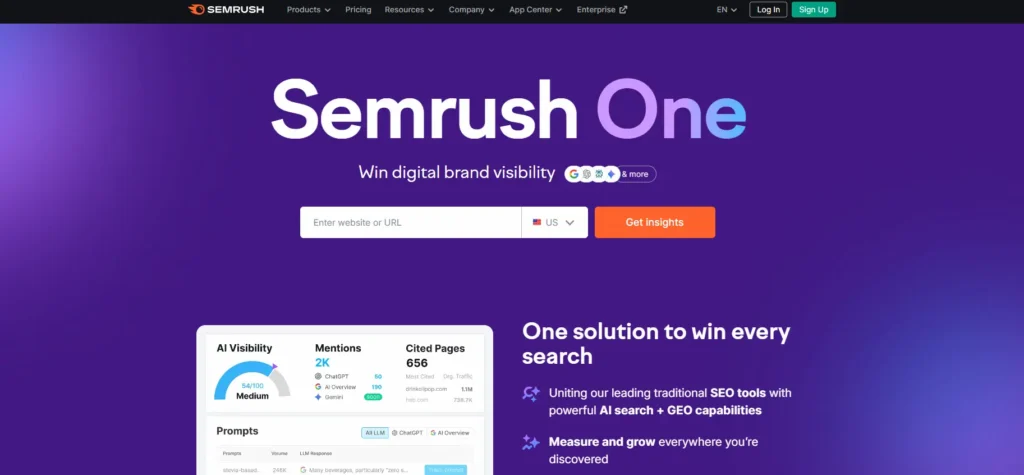
SEMrush provides extensive features for paid advertising (PPC), social media management, content marketing, and deep competitor intelligence.
With its new “Semrush One” packaging, it places heavy emphasis on AI visibility, helping brands understand not just where they rank on Google but also how they appear in AI-generated answers.
It is built for scalability, supporting growing brands and agencies that need to monitor multiple websites and track thousands of keywords daily.
What is Ahrefs, and Why is it Popular for Backlink Analysis?
Ahrefs built its reputation on having the world’s best backlink checker, powered by the second-most active web crawler after Google. For years, if you wanted to know who was linking to your site (or your competitor’s), Ahrefs was the default choice.
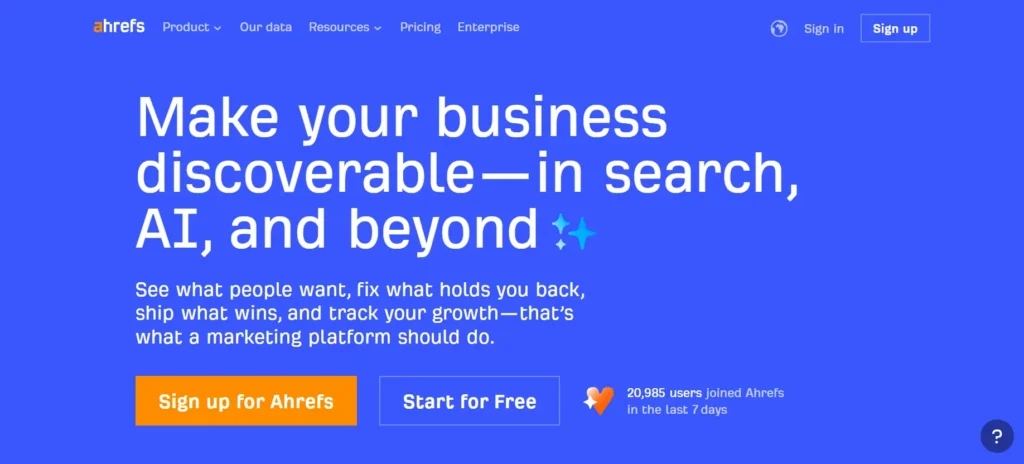
Today, Ahrefs is a full-suite SEO platform. It excels in data visualization and finding “content gaps.” Ahrefs positions itself as a tool to help businesses stay discoverable in search and AI.
It is particularly loved by technical SEOs and data junkies who appreciate its clean interface and the depth of its “Site Explorer” and “Keywords Explorer.” Recent updates have added a “Social Media Manager” and “Brand Radar” to track visibility in AI overviews, keeping it on the cutting edge.
What is Moz Pro and How it Helps Beginners and Small Businesses?
Moz is a veteran of the SEO industry. Founded by Rand Fishkin, Moz played a massive role in educating the market about what SEO actually is.
Moz Pro is known for its user-friendly metrics, specifically Domain Authority (DA) and Page Authority (PA), which have become industry standards for measuring site strength.
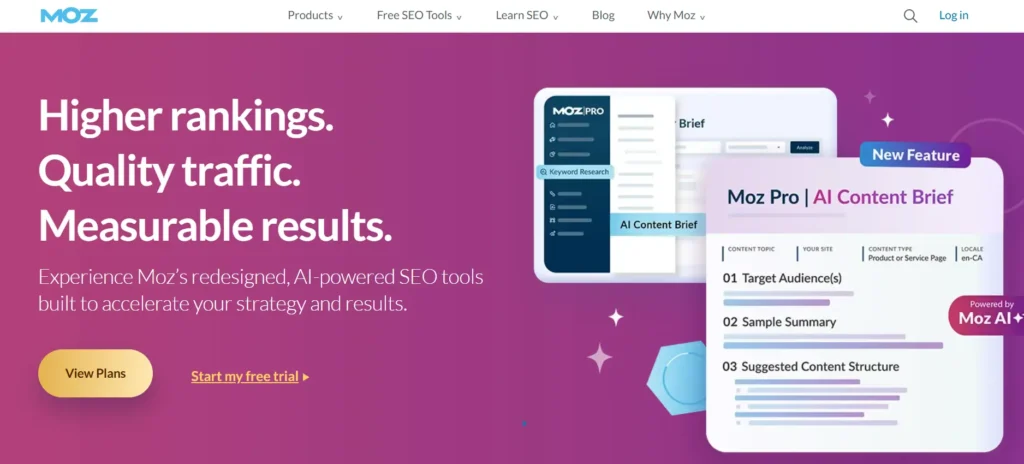
Moz focuses on simplifying SEO. It strips away the overwhelming clutter of more complex tools and presents data in an easy-to-understand way.
It is an excellent entry point for small businesses, beginners, and in-house marketers who need to manage SEO without getting bogged down in overly technical data.
Moz offers a balance of keyword research, site auditing, and rank tracking at a generally lower entry price point than its premium competitors.
SEMrush vs Ahrefs vs Moz: Feature-by-Feature Comparison
To truly understand which tool wins the SEMrush vs Ahrefs vs Moz battle, we must strip away the marketing jargon and look at the actual capabilities.
Keyword Research Capabilities in SEMrush, Ahrefs, and Moz
This section compares how SEMrush, Ahrefs, and Moz help identify high-value keywords using accurate search volume, difficulty scores, and search intent insights.
- SEMrush is often the winner for keyword volume and variety. Its Keyword Magic Tool is legendary in the industry, allowing users to generate millions of keyword ideas from a single seed phrase. It provides excellent data on “Search Intent” (Informational, Navigational, Commercial, Transactional), which is vital for content strategy.
- Ahrefs takes a slightly different approach. Its Keywords Explorer provides unique click-stream data, showing you not just how many people search for a term, but how many actually click on a result. It also supports keyword research across platforms, a massive advantage for ecommerce and video creators.
- Moz offers a streamlined Keyword Explorer. It groups keywords by topic, which is helpful for semantic SEO. It provides a “Priority” score that combines volume, difficulty, and opportunity to help you decide which keywords to target first. While its database is generally smaller than SEMrush or Ahrefs, the data is highly curated and reliable.
Backlink Analysis and Link Building Tools Comparison
This section compares how SEMrush, Ahrefs, and Moz analyze backlinks, evaluate link quality, and support effective link-building strategies.

- Ahrefs remains the gold standard here. Its index is updated incredibly fast. If you get a new backlink today, Ahrefs will likely show it to you tomorrow. The interface for analyzing broken links, referring domains, and anchor text distribution is intuitive and powerful.
- SEMrush has invested heavily to close the gap. Their backlink database is now comparable in size to Ahrefs. They offer great outreach tools that help you manage link-building campaigns directly within the platform, a feature Ahrefs lacks natively without heavy manual work.
- Moz invented the “Domain Authority” metric, so its backlink data is respected. However, its crawler is generally slower than Ahrefs and SEMrush. You might wait longer to see new links appear in your profile. Moz is sufficient for basic link tracking but may frustrate power users who need real-time data.
Rank Tracking and SERP Monitoring Features
Track keyword positions across devices and locations while monitoring SERP features to measure visibility changes and SEO performance over time.
- SEMrush offers daily rank tracking as a standard feature across its plans (500 keywords daily on the Starter plan). It also provides excellent visualization of SERP features, showing whether you own a Featured Snippet or if a competitor does.
- Ahrefs updates rankings weekly on its standard plans. To get daily updates, you often need to purchase an add-on (Project Boost), which can increase the cost. However, Ahrefs provides an unmatched “SERP history” view that lets you see how the top 10 results for a keyword have changed over months or years.
- Moz offers solid rank tracking, but the entry-level plans have lower limits than their prices suggest. It focuses on “Search Visibility” scores, which give you a high-level view of your overall SEO health rather than just individual keyword positions.
Read More: How to Rank in a Competitive Niche
Site Audit and Technical SEO Capabilities
This section compares how these tools identify technical SEO issues, analyze site health, and provide actionable recommendations to improve crawlability, performance, and search visibility.
- SEMrush offers a fast, highly actionable site audit tool. It assigns a “Health Score” and prioritizes issues by severity (Errors, Warnings, Notices). It provides clear instructions for fixing each issue, making it great for non-technical users.
- Ahrefs has a web-based site audit tool that is incredibly deep. It is excellent for visualizing site structure and finding internal linking opportunities. It is slightly more technical and customizable, allowing advanced users to set specific crawl parameters.
- Moz offers a “Site Crawl” that is very forgiving and easy to read. It doesn’t overwhelm you with data and explains issues in plain English (e.g., “Missing Title Tag”) and why they matter. It is the best option for users who find technical SEO intimidating.
Content Optimization and SEO Content Research Tools
Explore how SEMrush, Ahrefs, and Moz help plan, optimize, and improve content using data-driven insights, topic research, and on-page SEO recommendations.

- SEMrush is the clear leader for content marketing. Its “SEO Writing Assistant” and “Content Template” tools analyze top-ranking competitors and provide real-time recommendations on word count, readability, and semantic keywords as you write.
- Ahrefs offers a “Content Explorer,” a search engine for content. You can find the most shared and linked-to articles for any topic. It is great for research, but it lacks a direct writing assistant tool like SEMrush.
- Moz focuses on “On-Page Grader.” You enter a URL and a keyword, and it grades your optimization efforts. It is simple and effective, but lacks the AI-driven content generation and deeper analysis features of SEMrush.
Competitor Analysis and Market Research Insights
Uncovering your competitors’ strategies is essential to identifying market gaps and opportunities to outperform them in search rankings.
- SEMrush shines brightest here. Its “Market Explorer” and “Traffic Analytics” tools allow you to analyze a competitor’s entire marketing strategy, including their estimated traffic sources, audience demographics, and even their display advertising creative.
- Ahrefs is excellent for SEO-specific competitor analysis. You can see exactly which keywords bring your competitors the most traffic and which pages have the most links. However, it lacks the broader market intelligence (audience age, gender, interests) that SEMrush provides.
- Moz provides basic competitor overviews. You can compare your DA and link profile against competitors, but it does not offer the granular traffic intelligence found in the other two.
User Interface, Ease of Use, and Learning Curve
A tool’s effectiveness depends largely on how quickly and intuitively your team can navigate its features to extract actionable insights.
- Moz is the easiest to learn. Its interface is clean, spacious, and labeled clearly. If you are new to SEO, Moz feels the most welcoming.
- Ahrefs has a “pro” feel. It is dense with data but very logically organized. Once you learn the menu structure, it is incredibly efficient to use.
- SEMrush has the steepest learning curve simply because it does so much. The sidebar is packed with tools for SEO, Social, PPC, and Content. It can be overwhelming for a new user to navigate through the sheer volume of features.
Read More: How to Improve WordPress User Experience
SEMrush vs Ahrefs vs Moz Pricing Plans and Value for Money
Pricing is often the deciding factor. Let’s break down the current cost structures based on the latest data.

Moz Pricing
Moz is the most accessible for small budgets.
- Starter ($49/mo): Great for a single website. Includes 50 tracked keywords and basic SEO tools.
- Standard ($99/mo): The typical entry point for small businesses, offering 3 tracked sites and 300 keywords.
- Medium ($179/mo): Increases limits significantly (10 sites, 1,500 keywords).
- Savings: You save 20% by paying yearly.
Ahrefs Pricing
Ahrefs has moved to a usage-based credit system, which can be complex.
- Lite ($129/mo): Essential data for small businesses. 5 projects and 750 tracked keywords.
- Standard ($249/mo): Adds crucial features like “Content Explorer” and historical data. 20 projects and 2,000 keywords.
- Advanced ($449/mo): For deeper data needs.
- Add-ons, such as daily rank tracking or API access, often require additional “Project Boost” payments ($20-$200/mo per project).
- Free Tools: Ahrefs offers “Ahrefs Webmaster Tools” for free, which gives limited access to Site Explorer and Site Audit for websites you own.
SEMrush Pricing
SEMrush positions itself as a premium, all-in-one suite.
- Starter ($165.17/mo billed annually or $199/mo): This is a higher entry point than the others but includes comprehensive features: AI Visibility Toolkit, 5 projects, 500 daily tracked keywords, and competitor insights.
- Pro+ ($248.17/mo billed annually or $299/mo): Adds historical data, content optimization tools, and tracking for 15 websites.
- Advanced ($455.67/mo billed annually or $549/mo): For agencies needing Share of Voice, API access, and migration support.
Value Analysis:
- Moz is the undisputed value leader for those with a tight budget (under $100).
- SEMrush offers high value if you use all its features (SEO, PPC, Social). The price is higher, but you replace multiple other tools.
- Ahrefs is expensive for casual users but invaluable for heavy data users. The credit system means you must be efficient with how you click around the tool.
Best Use Cases for SEMrush, Ahrefs, and Moz
Selecting the right software depends heavily on your specific marketing focus, technical expertise, and budget constraints.
Choose SEMrush If
SEMrush is the definitive choice for full-stack marketers or agencies that need to manage SEO, content marketing, and PPC campaigns from a single dashboard.
It is powerful for businesses that require robust local SEO features and listing management tools to dominate regional search results.
Additionally, if you prioritize granularity and need daily rank tracking without paying for expensive add-ons, or if you need AI-driven assistance for writing and optimizing content, SEMrush offers the most complete toolkit for scaling your visibility.
Choose Ahrefs If
Ahrefs is the go-to solution for SEO professionals focused on aggressive link building and deep backlink analysis.
It is the preferred tool for technical SEOs who need to visualize site structure and diagnose complex indexing issues, as well as creators who need to analyze keyword volumes for platforms beyond Google, such as YouTube and Amazon.
If you appreciate a clean, data-first interface and want to specifically target “Content Gaps” where your competitors are outperforming you, Ahrefs provides the precise data you need.
Choose Moz If
Moz is the ideal starting point for beginners, solopreneurs, or small business owners who are managing their own SEO and need a gentle learning curve.
It is the most logical option if you are working with a strict budget under $100 per month, but still require reliable industry-standard data.
Furthermore, if your strategy relies heavily on monitoring “Domain Authority” metrics and you need a tool that is simple, straightforward, and easy to explain to non-technical clients, Moz delivers essential insights without the overwhelm.
How to Choose the Right SEO Tool?
Making the final decision in the SEMrush vs Ahrefs vs Moz debate requires an honest assessment of your team and goals.
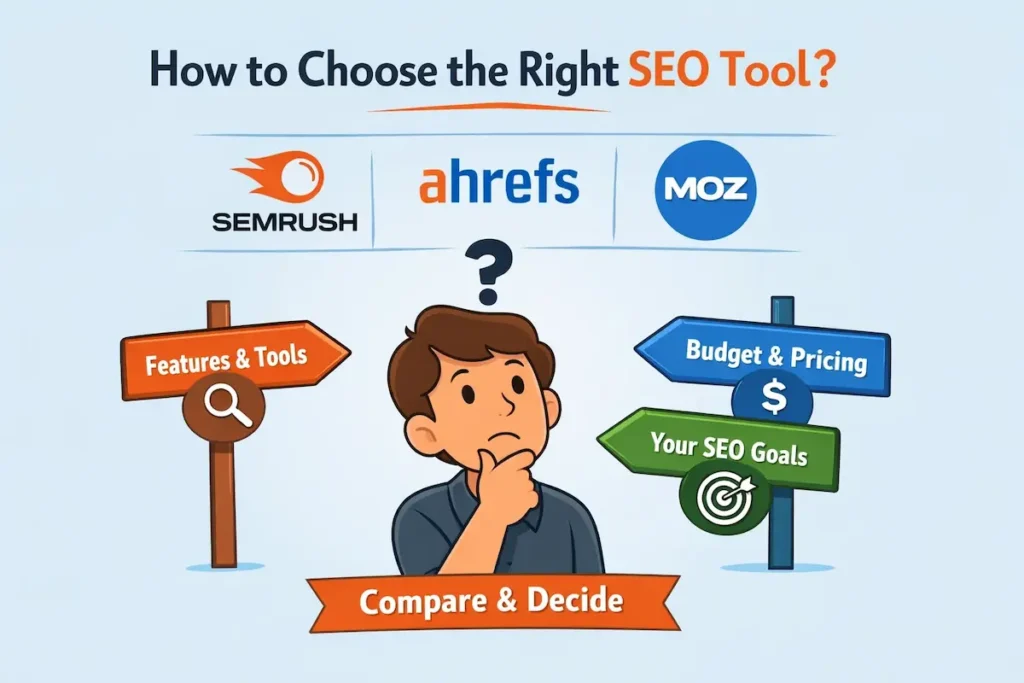
- Assess Your Skill Level: If you have never done SEO before, Moz is the safest place to start. If you are an expert, Ahrefs or SEMrush will provide the horsepower you need.
- Define Your Strategy: If your strategy relies on PR and link building, Ahrefs is your best friend. If your strategy relies on content marketing and blogging, SEMrush’s keyword and writing tools are superior.
- Count Your Seats: Look at how many users are included. Ahrefs charges for additional seats heavily. Moz includes multiple seats in higher tiers. SEMrush charges per additional user ($45/mo).
- Check the Frequency: Do you need to see rankings move every day? Go with SEMrush. Is weekly reporting sufficient? Ahrefs or Moz will work fine.
Explore Further: AI SEO Trends You Should Know to Stay Ahead
Final Verdict on SEMrush vs Ahrefs vs Moz
There is no single “best” tool, but there is a best tool for you.
- SEMrush is the powerhouse. It is the best choice for marketers who want one login to rule them all. It justifies its higher price tag by offering a replacement for a keyword tool, a rank tracker, a social media scheduler, and a competitor spy tool.
- Ahrefs is the specialist. It is the best choice for SEO purists. If you live and breathe backlinks and technical audits, the data quality in Ahrefs is hard to beat.
- Moz is the trusted guide. It is the best choice for small businesses and beginners. It offers professional-grade data without the overwhelming complexity, at a price point that is easier to swallow for smaller operations.
Ultimately, all three tools offer free trials or limited free versions (like Ahrefs Webmaster Tools). The best way to decide is to run a test project on each. See which interface makes sense to your brain and which data helps you make the smartest decisions for your business.
FAQs About SEMrush vs Ahrefs vs Moz
Which is better for SEO beginners: SEMrush, Ahrefs, or Moz?
All three tools work well for beginners. Moz offers a more straightforward interface and learning resources. SEMrush and Ahrefs provide more advanced features that may require time to learn.
Can I use SEMrush, Ahrefs, and Moz together?
Yes. Many SEO professionals use more than one tool. Each platform offers unique datasets that can complement one another for keyword research, backlink analysis, and audits.
Which SEO tool provides the most accurate data?
No SEO tool delivers perfectly accurate data. SEMrush, Ahrefs, and Moz use different data sources and algorithms. Accuracy depends on the feature being used and the market being analyzed.
Which tool is better for keyword research and content planning?
All three platforms support keyword research and content planning. SEMrush focuses on topic research and content optimization. Ahrefs emphasizes keyword difficulty and search intent. Moz provides clear keyword metrics for decision-making.
Are these SEO tools suitable for small businesses and agencies?
Yes. SEMrush, Ahrefs, and Moz offer plans for small teams and growing businesses. The right choice depends on the budget, SEO goals, and the level of features required.