Crawl errors are silently killing your rankings, and most site owners never know it. When search engines can’t access your pages, those pages simply don’t get indexed. No index means no traffic.
This guide breaks down every major type of crawl error, explains exactly why crawl errors matter, and walks you through proven fixes using Google Search Console and technical SEO best practices.
TLDR: Crawl Issues That Negatively Impact Search Rankings
- Crawl errors block indexing: When search engine bots can’t access your pages, those pages won’t appear in search results, directly hurting organic visibility.
- The most common types are DNS errors, 5xx server errors, redirect loops, 404s, soft 404s, broken links, and robots.txt blocks.
- Find them fast: Use Google Search Console’s Coverage report, the URL Inspection Tool, and server logs to identify and prioritize errors.
- Fix systematically: Tackle site-level errors before URL-level errors, use proper redirects, clean up your sitemap, and monitor regularly to prevent recurrence.
What Are Crawl Errors in Technical SEO and How Search Engines Interpret Them?
A crawl error occurs when a search engine bot visits your site and can’t successfully retrieve a page. Google’s crawler, Googlebot, continuously crawls the web to discover and index content.

When it hits a broken page, a misconfigured server, or a blocked resource, it logs that failure as a crawl error. Search engines interpret these failures differently. A temporary server hiccup might not affect rankings immediately.
But repeated failures across an entire site signal to Google that your site is unreliable. Google then reduces how often it crawls your site, shrinking your crawl budget and slowing the discovery of new pages.
Crawl errors fall into two main categories in Google Search Console:
- Site errors: Problems affecting your entire site; DNS lookup failures, server connectivity issues, and robots.txt fetch failures.
- URL errors: Problems tied to individual URLs; 404 errors, soft 404s, redirect errors, and access-denied responses.
Understanding how search engines interpret these failures is the first step to fixing them effectively.
Fix Crawl Errors and Strengthen Your Technical SEO
Eliminate crawl errors, improve site speed, and boost rankings with expert WordPress technical SEO services.
Why Crawl Errors Matter for Google Search Rankings and Organic Visibility?
Crawl errors matter because Google can only rank pages it can access and index. If Googlebot can’t reach a page, that page doesn’t exist in Google’s eyes, no matter how good the content is.
Here’s why this directly damages your overall SEO performance:
- Lost indexing: Google encountered an error? It won’t index that page, which means it can’t appear in search results.
- Wasted crawl budget: Google counts every crawl request. When Googlebot wastes time on broken or blocked URLs, it crawls fewer of your active pages.
- Damaged authority flow: External links pointing to broken pages deliver no SEO value. The link equity simply disappears.
- Poor user experience signals: Slow page load times and error messages increase bounce rates, further harming your rankings.
- Delayed discovery: New pages take longer to appear in search results when crawl efficiency is poor.
The vast majority of ranking issues with technically sound content stem from crawlability problems. Fixing crawl errors is one of the highest-ROI activities in technical SEO.
How to Find Crawl Errors in Google Search Console and Server Logs?
Finding crawl errors starts with Google Search Console. Navigate to Index → Coverage. The report shows four status categories: Error, Valid with warnings, Valid, and Excluded.
Focus on the Error tab first. The Coverage report shows you:
- Server errors (5xx): Pages that returned server error responses.
- Redirect errors: Pages caught in redirect loops or chains.
- Submitted URL not found (404): Sitemap-submitted pages that return a 404 status code.
- Blocked by robots.txt: Pages Google requested but couldn’t access.
Use the URL Inspection Tool within Search Console to examine individual pages. It shows you the last crawl date, the HTTP status code Google received, and whether the page is indexed. This is your fastest way to diagnose a specific URL.
For a deeper diagnosis, review your server logs. Log files show every request Googlebot makes, including response codes and timing.
You can identify patterns, like a specific subdirectory returning 500 errors, that won’t appear clearly in Search Console alone.
Common Crawl Errors That Hurt Rankings and Their SEO Fixes
We will now look at specific errors. We will move from critical site-wide failures to individual page issues.

Prioritize Site-Level Errors Before URL-Level Errors
Always fix site errors before URL errors. A DNS server failure or complete hosting outage affects every single page on your site. Fixing one broken URL while your entire site is unreachable accomplishes nothing.
In Search Console, the Site Errors section flags the big three: DNS errors, server connectivity issues, and robots.txt fetch failures. Resolve these first. Then move to individual URL-level errors once your site is fully accessible to search engine bots.
DNS Errors and Host Resolution Failures
A DNS error means Googlebot couldn’t resolve your domain name to an IP address. This happens when your DNS server is down, misconfigured, or experiencing a DNS timeout.
When Google crawls your site and encounters a DNS lookup failure, it can’t reach any page. The entire site is blacklisted from Googlebot until the DNS issue is resolved.
Common Causes:
- DNS provider outage or misconfiguration.
- Expired domain with lapsed DNS records.
- Incorrect nameserver settings after a hosting migration.
- DNS timeout caused by an overloaded DNS provider.
How to Fix DNS Errors:
- Log in to your DNS provider and verify all records (A, CNAME, MX) are correct.
- Use tools like Google’s DNS checker to test DNS resolution.
- Switch to a more reliable DNS provider if outages are frequent.
- Reduce TTL (Time to Live) values before planned migrations to speed up change propagation.
Server Errors 5xx and Hosting-Related Failures
Server errors (5xx status codes) mean Google requested your page, but the server couldn’t fulfill the request. A 500 Internal Server Error is the most common. A 503 Service Unavailable usually indicates temporary downtime or server overload.
If Google encountered repeated 5xx errors on your site, it may temporarily reduce crawl frequency. Persistent server errors can cause previously ranked pages to be deindexed.
Common Causes:
- Overloaded hosting service with insufficient server resources.
- Misconfigured PHP or database connection errors.
- Plugin or theme conflicts on WordPress sites.
- Server returns errors during traffic spikes.
How to Fix 5xx Errors:
- Check your hosting provider’s error logs for the specific server issue.
- Upgrade your hosting plan if server resources are consistently maxed out.
- Implement server-side caching to reduce load times and resource usage.
- Work with your hosting service to configure proper error handling.
Redirect Errors, Redirect Chains, and Redirect Loops
Redirect errors happen when a URL points to another URL that itself redirects, creating redirect chains, or when two URLs point to each other, creating a redirect loop that never reaches a final destination.
Google follows redirects, but redirect chains waste crawl budget. Each extra hop delays Googlebot and dilutes link equity. A redirect loop causes Google to abandon the crawl entirely and log a redirect error.
How to Fix Redirect Errors:
- Audit all redirects using SEMrush or your server configuration.
- Replace redirect chains with direct 301 redirects from the original URL to the final destination.
- Identify and break any redirect loops by updating the server response for one URL in the chain.
- Update internal links to point directly to the canonical URL, not to redirecting URLs.
Proper redirect management is a core part of any website migration SEO strategy.
404 Errors and Broken Links That Damage Crawl Efficiency
A 404 error means the requested page no longer exists or never existed at that URL. A broken link, whether external or internal, sends both users and search engine bots to a dead end.
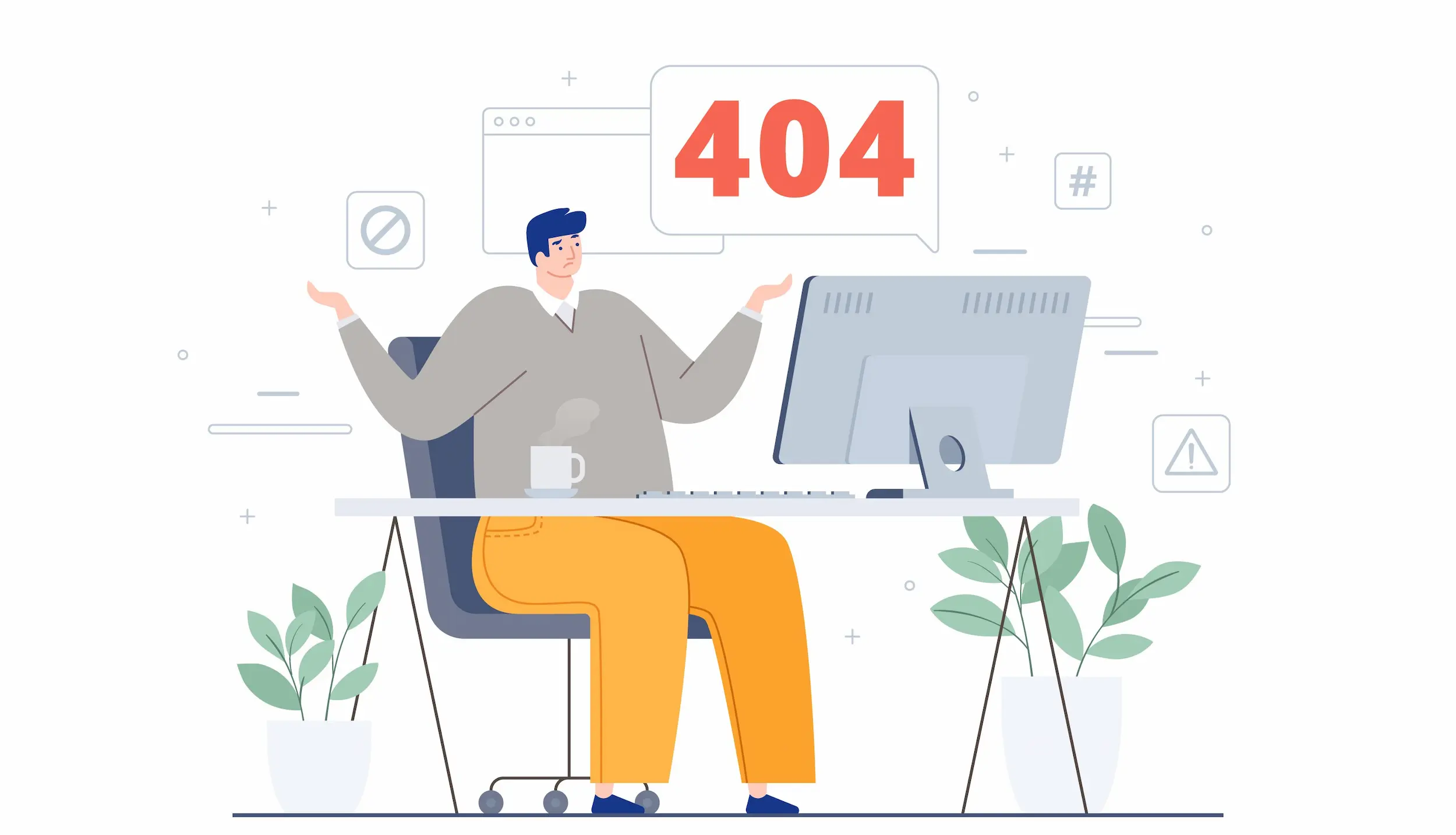
404 errors on pages that never had value are less critical. But 404 errors on previously indexed pages or pages receiving external links directly hurt SEO performance.
How to Fix 404 Errors:
- Use Search Console to identify submitted or linked URLs returning 404 responses.
- Redirect deleted pages (301) to the most relevant active page permanently.
- Fix internal links pointing to URLs that no longer exist.
- If a page has no relevant replacement, let it return a clean 404; don’t redirect to the homepage.
Fixing broken links across your site also improves your internal linking structure, passing authority more effectively to other pages.
Soft 404 Errors and Thin Content Pages
A soft 404 occurs when a page returns a 200 OK status code but delivers no real content, an empty page, a “no results found” message, or extremely thin content. Google considers these pages to be errors even though the server reports everything is fine.
Soft 404s waste crawl budget on pages that provide zero value. Google counts these pages as site errors even if your server returns a success response.
How to Fix Soft 404 Errors:
- Add meaningful, unique content to thin pages or consolidate them with stronger pages.
- Return a proper 404 status code for pages that genuinely have no content.
- Use the noindex tag on low-value pages you want to keep but not index.
- Review filtered search result pages and pagination that produce empty page states.
Blocked URLs by robots.txt and Noindex Conflicts
Your robots.txt file tells search engine bots which pages to crawl and which to skip. Accidentally blocking important pages in your robots.txt file is a serious and surprisingly common crawl error.
A noindex conflict occurs when you block a page in robots.txt but also use a noindex meta tag. Since Googlebot can’t crawl the page, it can’t see the noindex directive, and may still index the page based on external links.
How to Fix robots.txt Issues:
- Test your robots.txt file using Google Search Console’s robots.txt Tester.
- Never block CSS, JavaScript, or other resources Googlebot needs to render your pages.
- Remove blocks on pages you want Google to index, especially after site redesigns.
- Use noindex tags (not robots.txt) to prevent search engines from indexing specific pages.
Managing your robots.txt and meta directives correctly ensures that Googlebot focuses on your most important active pages.
Crawl Anomalies and Mobile Usability Crawl Issues
Crawl anomalies are unusual errors that don’t fit standard categories, such as pages returning an empty response body, pages with permission issues, or URLs that respond differently across user agent strings.
Mobile usability errors occur when Googlebot’s mobile crawler encounters pages that aren’t properly optimized for mobile devices. Since Google uses mobile-first indexing, these issues directly affect how Google views and ranks your pages.
How to Fix Crawl Anomalies:
- Use the URL Inspection Tool to check what Google received in the response body for affected URLs.
- Ensure your server doesn’t return different content based on user agent (cloaking).
- Fix mobile usability issues flagged in Search Console under Experience → Mobile Usability.
- Test pages using Google’s Mobile-Friendly Test tool and resolve viewport, font, and tap target issues.
Sitemap Errors and XML Sitemap Submission Issues
Sitemap errors occur when your XML sitemap references URLs that return errors, redirect, or are blocked.
Submitting a sitemap with hundreds of broken URLs tells Google that your site management is poor, and may cause it to trust your sitemap less.
How to Fix Sitemap Errors:
- Submit your sitemap via Google Search Console under Sitemaps and review the report for errors.
- Remove redirecting URLs from your sitemap; only list canonical, final destination URLs.
- Exclude pages with noindex tags from your sitemap entirely.
- Keep your sitemap updated to include only active pages with a 200 status code.
A clean, accurate sitemap directly supports faster indexing of new and updated pages across your site.
Diagnosing Crawl Error Causes Using Logs, Crawlers, and HTTP Headers
To fix these issues, you must first accurately diagnose the root cause.

Run a Full Site Crawl to Reproduce Technical Errors
Before you can fix a crawl error, you need to reproduce it. Run a full site crawl using a tool like Screaming Frog, setting the user agent to Googlebot. This shows you exactly what Googlebot sees when it visits each URL on your entire website.
Export the crawl data and filter by status code. Group 4xx and 5xx errors. Identifying patterns and errors concentrated in a specific directory often points to a server configuration issue rather than individual page problems.
Inspect HTTP Headers and Response Codes for Failing URLs
HTTP headers contain critical diagnostic information. Use a tool like curl or browser developer tools to inspect the full response headers for any failing URL.
Check the status code, the Location header (for redirects), and the Content-Type header. Sometimes a page appears to load visually, but the server returns a misleading status code in the response header, which is exactly how soft 404 errors happen.
The URL Inspection Tool in Search Console also shows you what Google received in its full response for any specific URL, making it one of the most powerful diagnostic tools available.
Compare Affected URLs with Recent Site Deployments
Crawl errors often appear right after a site update or deployment. If a batch of errors appeared on a specific date, compare that date with your deployment log.
Common culprits include updated .htaccess files that accidentally block certain URL patterns, new CMS themes that change URL structures, or plugin updates that conflict with your server configuration. Pinpointing the deployment that caused the error makes fixing it dramatically faster.
Identify Plugin, Theme, or CDN Conflicts in WordPress
WordPress sites are particularly prone to crawl errors caused by plugin or theme conflicts. A caching plugin might serve stale error pages. A security plugin might block Googlebot based on its IP range. A CDN misconfiguration might return incorrect responses for certain page types.
To diagnose these conflicts:
- Deactivate plugins one at a time and re-test the failing URL.
- Switch to a default theme temporarily to rule out theme-specific issues.
- Check your CDN settings to ensure it passes the correct HTTP headers to Googlebot.
- Review your security plugin’s settings to ensure it doesn’t treat search engine bots as threats.
Fix Crawl Errors Using Search Console and Technical SEO Best Practices
Once you’ve identified and diagnosed your crawl errors, fix them systematically using Search Console as your central hub.
Follow this priority order:
- Fix DNS and server errors first: These affect the entire site and block all crawling.
- Resolve redirect chains and loops: Update redirects to go directly to the final destination URL.
- Handle 404 errors on indexed pages: Redirect deleted pages or restore them if they had significant traffic.
- Clean up robots.txt conflicts: Use Search Console’s robots.txt tester after every change.
- Address soft 404s and thin content: Add content, consolidate pages, or return proper 404 responses.
- Submit fixes for validation: In Search Console, select affected URLs and click “Validate Fix” to prompt Google to recrawl.
After fixing errors, monitor the Coverage report weekly. It typically takes Google one to two weeks to reprocess pages after a fix is submitted for validation.
Pair Search Console with a professional SEO audit to surface deeper issues that the Coverage report alone won’t reveal, such as crawl budget inefficiencies caused by duplicate content or faceted navigation.
Tools to Detect Crawl Errors and Monitor Technical SEO Health
The right tools make crawl error detection fast and reliable. Here are the most effective options:
- Google Search Console: Free, authoritative, and directly reflects what Google sees. The Coverage report and URL Inspection Tool are essential.
- Rank Math: WordPress SEO plugin that integrates with Search Console, monitors index status, detects redirection issues, validates sitemaps, and helps prevent crawl errors directly inside your dashboard.
- Screaming Frog SEO Spider: Crawls your entire site and reports every status code, redirect chain, and blocked resource. Invaluable for large sites.
- Ahrefs Site Audit: Cloud-based crawler that monitors your site on a schedule and alerts you to new errors.
- Semrush Site Audit: Flags crawl errors, broken links, and redirect issues with actionable recommendations.
Use Google Search Console as your baseline, and supplement it with one crawl tool and server log analysis for a complete picture of your site’s technical SEO health.
Preventing Future Crawl Errors and Building a Resilient Technical SEO System
Fixing crawl errors reactively is important. But proactively preventing them is what separates high-performing sites from those that constantly fight ranking drops.

Build a resilient technical SEO system with these practices:
- Set up automated crawl monitoring: Schedule weekly crawls with Screaming Frog, Ahrefs, or Semrush. Configure alerts for any new 4xx or 5xx errors.
- Monitor Search Console weekly: Check the Coverage report every week, not just after problems appear. Catching errors early prevents them from accumulating.
- Use a staging environment: Test all site changes, theme updates, plugin changes, and URL restructuring there before deploying to production.
- Maintain a redirect map: Every time you delete or move a page, log the old URL and its new destination. Apply redirects immediately rather than letting 404 errors accumulate.
- Audit your sitemap monthly: Ensure your XML sitemap always reflects your active pages and uses correct canonical URLs.
- Review robots.txt after every deployment: A single misplaced line in your robots.txt file can accidentally prevent search engines from crawling your entire site.
- Choose a reliable hosting provider: Frequent server downtime directly causes crawl errors. A stable hosting service with strong uptime guarantees is a technical SEO investment.
Teams that treat technical SEO as an ongoing process, not a one-time fix, maintain stronger crawl efficiency and consistently outperform competitors in organic search.
Conclusion
Crawl errors are among the most damaging and overlooked technical SEO problems. They prevent search engines from accessing your pages, waste your crawl budget, and block new content from appearing in search results. But they’re also fixable with the right process.
- Start with Google Search Console. Identify your most critical site-level errors and resolve them first.
- Then work through URL-level errors systematically, fixing redirect chains, 404s, soft 404s, and blocked resources.
- Use the URL Inspection Tool and server logs to diagnose root causes.
- And build monitoring into your regular workflow, so crawl errors never quietly accumulate.
Technical SEO health is not a destination; it’s an ongoing commitment. Every site deployment, every new plugin, every redirect carries the potential to introduce new errors.
The teams that win in search are the ones that catch and fix these issues fast.
FAQs About Crawl Errors
Why do crawl errors happen on websites?
Crawl errors happen when search engines cannot access or process a page correctly. This may occur due to DNS failures, server errors, broken links, or incorrect redirects.
Technical website issues such as slow loading, blocked resources, or faulty code can also trigger errors. Fixing these problems ensures smoother crawling and better visibility in search results.
What are the most common crawl errors that hurt rankings?
The most common crawl errors include 404 errors, server 5xx errors, redirect loops, DNS failures, and soft 404 pages. These issues waste crawl budget and delay indexing. If multiple errors affect the same URL or repeat across the site, rankings may drop significantly.
Can crawl errors affect only one page or the entire site?
Some errors impact just one page, such as a broken internal link. Others, like DNS or server failures, affect the whole domain. Site-level errors are more serious because they can prevent Google from accessing many URLs at once.
How does slow loading cause crawl errors?
Slow-loading pages may trigger timeout errors. If the server responds too slowly, Googlebot may stop crawling the same URL. Over time, this reduces crawl frequency and delays search result updates.
How can I fix crawl errors and prevent Google from missing important pages?
Use Google Search Console to identify issues. Repair broken links, correct redirects, and improve server performance. Adjust settings in robots.txt carefully so you do not accidentally prevent Google from accessing important content. Regular monitoring helps maintain strong search visibility.