If you have ever wondered why your WordPress site feels sluggish despite having a “premium” theme and managed hosting, the answer usually lies in how the site was built, not just how it is maintained. A performance focused WordPress development service is not about running a speed plugin after launch.
It is a development philosophy where every technical decision, from database structure to how third party scripts are loaded, is made with site performance as the primary consideration.
A 1-second delay in page load time can cost you 7% of conversions. That is not solely a developer’s concern; it is also a business problem. And solving it starts at the code level, not the plugin settings page.
TL;DR: Here’s What This Article Covers at a Glance
- A performance focused WordPress development service treats speed as a core requirement, not an afterthought added after launch
- Every layer of the stack matters, from how database queries are written to how third-party scripts are loaded and how images are delivered
- Core Web Vitals are engineered during development, not patched post-launch
- Smart caching using page caching, object caching, and content delivery networks works best when the underlying codebase is already clean and lean
- Signs you need this service include failing Core Web Vitals in Google Search Console, declining SEO rankings despite good content, and site speed degrading as the site grows
- Seahawk Media builds WordPress sites where performance is validated at every stage, from architecture to pre-launch testing, not treated as a final checklist item
What Does “Performance Focused” Actually Mean in WordPress Development?
Most WordPress sites are built to work. A performance-focused WordPress site is built to work fast, stay fast under heavy traffic, and scale without degrading performance. Those are very different standards.
When a WordPress developer builds with performance as a core priority, every decision carries a speed implication.
Which database queries run on page load? How many HTTP requests does the homepage trigger?
Are third-party scripts deferred, or are they blocking the render path? Are lightweight themes used as the foundation, or is the site built on a page builder that generates bloated markup?
Standard WordPress development gets the site live. Performance focused WordPress development gets the site live and measurably fast, with a codebase that does not accumulate technical debt over time.
The difference is visible in your Core Web Vitals scores, your bounce rate, and your organic search rankings within weeks of launch.
How Seahawk Media Approaches Performance Focused WordPress Development?
At Seahawk Media, performance is not a phase of the project. It is the lens through which every development decision is made.
From the initial architecture discussion to plugin selection, custom development, template design, and pre-launch performance testing, site performance is measured and validated at every step.
We work with lightweight themes as the starting point, avoiding page builders that generate technical debt, configuring multi-layer caching strategies tailored to each site’s traffic patterns, and delivering sites that are verified against Core Web Vitals benchmarks before they ever go live.
For businesses that have outgrown their current WordPress site or are launching something new and need to get it right the first time, our WordPress development service is built around one standard: a seamless user experience that does not slow down under pressure.
Make Your WordPress Site Faster Where it Matters
From Core Web Vitals to server-level optimization, Seahawk Media helps you improve speed, stability, and real-world performance with a clean, scalable approach.
Why WordPress Performance is a Business Priority, Not Just a Technical One?
Google uses Core Web Vitals as a ranking signal. This means your site’s loading speed, visual stability, and interactivity directly influence where you appear in search results.
Poor performance does not just frustrate visitors; it also undermines the brand. It suppresses your SEO rankings and quietly drains your conversion rate month after month.
Here is what slow load times cost businesses in real terms:
- Higher bounce rates, especially on mobile users arriving from search
- Lower Quality Scores in paid campaigns, which increases your cost per click
- Reduced crawl efficiency, which limits how much of your site Google indexes
- Damaged brand credibility, because slow sites feel untrustworthy and outdated
On the other hand, a WordPress site that loads in under 2 seconds, maintains visual stability as content loads, and responds instantly to user input builds trust before a visitor even reads a single line of copy. That is the compounding return of professional WordPress development done right.
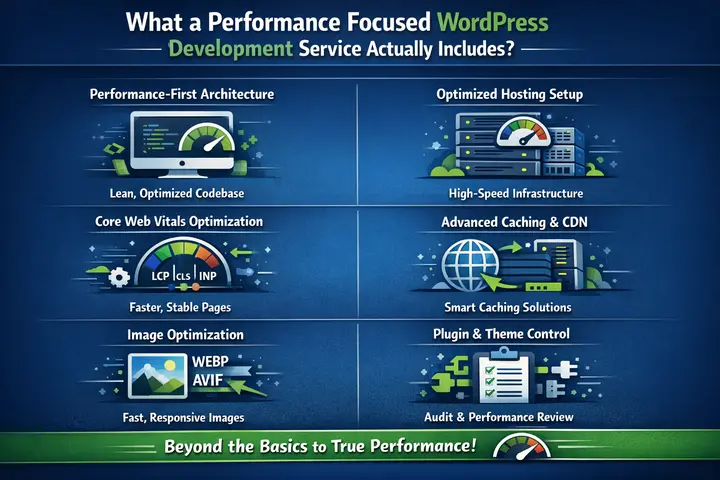
What a Performance Focused WordPress Development Service Actually Includes?
This is where the service goes far beyond what most agencies deliver. Let’s break it down by each layer of the stack.
Performance-First Architecture and Codebase
A WordPress developer building for performance writes lean, purposeful code. Custom WordPress development avoids unnecessary abstractions, keeps the number of active hooks minimal, and ensures every database query is optimized before it reaches production.
This means choosing custom blocks over page builders, writing queries that retrieve only the data each page actually needs, and avoiding the kind of auto-loading plugin code that runs on every single page regardless of whether it is relevant.
Clean architecture at the code level is the single most impactful factor in long-term site performance.
Hosting Infrastructure That Matches Your Traffic Needs
No amount of optimization compensates for a hosting environment that cannot handle the load. A performance focused development service includes helping you select and configure a server stack that suits your actual traffic patterns.
Modern server configuration standards like NGINX, PHP 8+, and Redis object caching make a measurable difference in how quickly the server processes requests and sends the first byte to the browser.
Time to First Byte (TTFB) is one of the most reliable indicators of server-side performance. It is determined almost entirely by your hosting infrastructure and server-side caching setup.
Core Web Vitals Optimization Built Into Development
Core Web Vitals measure three things:
- How fast the main content loads (Largest Contentful Paint or LCP)
- How stable the page is as it renders (Cumulative Layout Shift or CLS)
- Lastly, how quickly the page responds to the first user interaction (Interaction to Next Paint or INP, which replaced First Input Delay in 2024).
A performance focused WordPress developer addresses each of these during development, not after launch. Above-the-fold content is prioritized in templates so LCP loads as quickly as possible.
Elements are given fixed dimensions so the browser reserves space and accurately measures visual stability, eliminating layout shift. JavaScript execution is deferred or conditionally loaded to reduce input delay.
These are not plugin settings. They are architectural decisions that have to be made at the development stage.
Smart Caching and CDN Strategy
Caching allows a WordPress site to serve pre-built pages rather than rebuilding them from scratch on every visit. This dramatically reduces server load and improves page load time for every visitor after the first.
A well-configured performance stack includes multiple caching layers working together.
- Page caching stores fully rendered HTML.
- Object caching with Redis stores the results of expensive database queries so they do not run repeatedly.
- Browser caching tells the user’s browser to hold onto static assets like CSS, JavaScript, and fonts so returning visitors experience near-instant load times.
Content delivery networks (CDN) complement caching by serving assets from servers geographically close to each visitor.
CDNs like Cloudflare and Fastly significantly reduce latency, especially for audiences spread across multiple regions. A performance focused development service configures these layers as part of the project, not as an afterthought.
Image Optimization at the Development Layer
Unoptimized images are one of the most common causes of poor LCP scores and inflated page weight.
Modern image formats like WebP and AVIF deliver the same visual quality as JPEG and PNG at significantly smaller file sizes.
Responsive image sizing with srcset attributes prevents mobile users from downloading desktop-resolution images over a 4G connection.
Implement lazy loading for offscreen images so only what is visible in the viewport loads on initial page render.
This reduces both initial page load time and the total data transferred, which matters enormously for mobile users.
These image optimization decisions are built into the development workflow at Seahawk Media, not left for a site owner to configure post-launch.
Plugin and Theme Governance
Not every plugin is a performance risk, but every plugin adds code that must be parsed and executed.
A performance focused WordPress development service includes an audit of every plugin and theme for its impact on load times and database query volume.
Caching plugins can help, but they are not a substitute for clean code. If the underlying codebase generates excessive database queries or loads render-blocking external scripts, no caching plugin will fully compensate.
Lightweight themes and custom development ensure the foundation is sound before caching is layered on top.
How This Differs From Standard WordPress Development?
Standard WordPress development delivers a working website. Performance optimization is treated as a separate project, often initiated only when someone notices the site is slow.
Performance focused development treats speed as a requirement, not a feature. Before any code ships, performance budgets are defined.
Staging environment testing includes automated Lighthouse audits. Deployment workflows flag regressions so a new plugin or template update does not silently degrade the site’s performance metrics.
The result is a WordPress site that passes Core Web Vitals at launch, maintains those scores as content grows, and provides the development team with clear data when something changes.
Signs You Need a Performance Focused WordPress Development Service
You may already be dealing with the consequences of a site that was not built with performance in mind.
A few signals worth paying attention to:
- Your Google PageSpeed Insights score is below 70 on mobile despite having a CDN in place.
- Your site’s speed degrades noticeably as you add new pages or plugins.
- Google Search Console is flagging Core Web Vitals failures across key templates.
- Your mobile bounce rate is significantly higher than your desktop bounce rate, even when the content is identical.
These are not maintenance issues. They are development issues. They require a WordPress developer who understands how to build for optimal performance from the ground up, not one who applies caching plugins and calls it speed optimization.
Wrapping Up
A performance focused WordPress development service is what separates a website that technically exists from one that actively drives business results.
When your WordPress site loads quickly, maintains visual stability, and responds instantly on every device, it ranks better, converts more visitors, and delivers the kind of user experience that keeps people coming back.
Speed is not a feature you add later. It is an outcome of how well your site was built in the first place. If your current WordPress site is not meeting that standard, now is the time to change the approach.
FAQs About Performance Focused WordPress Development
Can a performance focused development service help an existing WordPress site or only new builds?
It works for both. For new builds, performance is engineered into the architecture from day one, which is always the most efficient approach.
For existing WordPress sites, a performance audit identifies the specific bottlenecks, whether that is bloated plugins, unoptimized database queries, missing caching layers, or poor image delivery, and development work is done to resolve them systematically rather than applying surface-level fixes.
How do Core Web Vitals affect my WordPress site’s search rankings?
Google uses Core Web Vitals as a ranking signal, which means your scores directly influence how your pages rank in search results.
A WordPress site with poor Core Web Vitals can be outranked by a competitor with weaker content simply because their site delivers a faster, more stable user experience. These metrics need to be addressed at the development level, not just through plugins.
What is the difference between WordPress speed optimization and performance focused WordPress development?
WordPress speed optimization typically refers to improvements made to an existing site, things like enabling caching, compressing images, or minifying CSS and JavaScript.
Performance-focused WordPress development goes deeper. It means building the site from the ground up with speed as a core requirement, so the architecture, database structure, theme, and every plugin choice are all evaluated for their performance impact before a single page goes live.