Search is no longer just about keywords and blue links. AI search trends are rewriting how search engines understand, process, and deliver results to users. In 2026, every SEO professional needs to grasp how artificial intelligence is shifting the rules of organic visibility.
These changes affect everything from content strategy to technical optimization. If you want to stay ahead, you need to understand what is driving these shifts and how to respond.
TL;DR: What You Need to Know
- AI-powered search engines now generate answers directly in the SERP, reducing clicks to websites and demanding a new approach to content.
- Conversational, intent-driven queries are outpacing traditional keyword searches, making long-tail and entity-based strategies essential.
- Trust signals like E-E-A-T, structured data, and content authenticity are critical for AI systems to cite and surface your content.
- SEO success now depends on optimizing for multiple platforms and formats, not just Google’s classic ranking factors.
Understanding AI Search and Its Impact on SEO
AI search is transforming how information is discovered and delivered, shifting SEO from ranking pages to earning visibility within intelligent, context-driven answers.
What is AI Search and How Does It Work?
AI search refers to search engines that use large language models (LLMs) and machine learning to understand queries deeply and generate relevant, conversational answers.

Unlike traditional search, AI-powered systems do not simply match keywords to pages. They interpret the meaning, context, and intent behind a query. Then they synthesize information from multiple sources to build a direct response.
Google’s AI Overviews, Microsoft Copilot, and platforms like Perplexity and You.com are examples of this shift. These tools pull from indexed content, prioritize authoritative sources, and present answers without always sending users to a website.
Understanding how these AI systems crawl and evaluate content is essential for any modern SEO strategy.
AI Search vs Traditional Search Engine Optimization
Traditional SEO focused heavily on ranking signals: backlinks, keyword density, page authority, and technical performance. AI search changes the equation significantly.
In AI search, relevance is determined by how well your content answers a question completely and accurately. The system rewards depth, accuracy, and trustworthiness, not just keyword repetition.
This does not mean traditional SEO best practices are irrelevant. Technical health, structured data, and quality backlinks still matter. But they now serve a different purpose, helping AI systems discover, understand, and cite your content.
Why AI Search Trends Matter for SEO Professionals?
The rise of AI search directly affects organic traffic, click-through rates, and content strategy. Many businesses are already seeing drops in organic visits as users get answers without clicking through to any site.
At the same time, brands that position themselves as trusted, authoritative sources are being cited in AI-generated answers, gaining visibility in an entirely new way.
This is why keeping up with the latest AI SEO trends is no longer optional for marketing teams. It is a competitive requirement.
Stay Visible in the Age of AI Search
Future proof your SEO with expert strategies designed to boost rankings, visibility, and real business growth.
Top AI Search Trends Shaping SEO
Explore the most impactful AI search trends redefining how users discover content and how businesses must evolve their SEO strategies to stay visible.
Rise of Generative AI Search and AI Overviews in SERPs
Google’s AI Overviews now appear at the top of many search results pages. These summaries pull content from multiple sources and present a synthesized answer directly in the SERP.
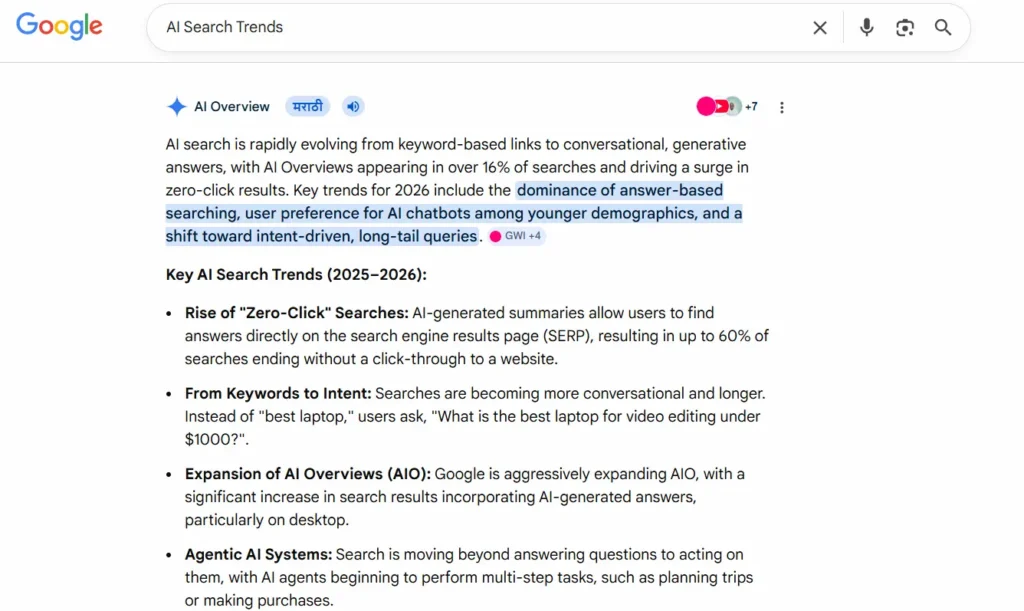
For SEO professionals, this creates a dual challenge. Organic clicks to traditional results are falling. But being cited as a source inside an AI Overview can drive significant brand awareness and referral traffic.
To maximize your chances of being cited, focus on creating thorough, factual, and well-structured content. Use clear headings, accurate data, and authoritative sources.
Long Tail and Conversational Search Queries Are Dominating
AI search systems are highly effective at handling complex, conversational queries. Users now phrase searches the way they would ask a person a question. This has dramatically increased the volume and diversity of long-tail keyword searches.
Short, generic keywords are declining in influence. The opportunity lies in targeting specific, intent-rich phrases that reflect real user needs.
Content that mirrors natural language, addresses specific questions, and provides complete answers performs significantly better in AI search environments.
Zero Click Searches and Declining Organic CTR
Zero-click searches occur when a user gets their answer directly from the SERP without visiting any website. AI Overviews, featured snippets, and knowledge panels all contribute to this trend.
Studies show that organic click-through rates have fallen noticeably in categories where AI-generated answers are common. SEO strategies must now account for this reality.
The response is not to abandon organic SEO. Instead, brands should focus on building visibility through structured data, appearing in AI summaries, and capturing users at deeper stages of research where a single answer is not sufficient.
Multimodal Search is Transforming Content Discovery
AI search is no longer limited to text. Users now search using images, voice, and video. Google Lens, for example, allows users to search visually by pointing their camera at an object or scene.
This trend demands that SEO strategies include image optimization, descriptive alt text, and proper file naming. Content discovery in 2026 happens across multiple input types, and brands that optimize only for text are leaving visibility on the table.
Check out the current State of WordPress SEO on this live panel discussion by experts.
AI-Powered Search Assistants and Conversational Interfaces
Platforms like Google’s Gemini, Microsoft’s Copilot, and ChatGPT are acting as search interfaces. Users ask multi-turn questions, follow up, and refine their queries conversationally.
These AI assistants prioritize content that is clear, authoritative, and easy to parse. FAQs, structured answers, and well-organized content formats are gaining importance.
SEO professionals must think about how their content reads in a conversational flow, not just how it ranks for a single keyword.
Content Personalization Driven by AI Algorithms
AI allows search engines to deliver highly personalized results based on a user’s location, search history, preferences, and behavior patterns.

The same query can return different results for different users. This makes understanding audience segments more important than optimizing for a single universal keyword. Brands must create content that resonates with specific user contexts, not just broad topics.
Entity-Based SEO and Semantic Search Evolution
Modern search engines understand entities, real-world concepts, people, places, and things, not just keywords. Semantic search connects these entities and identifies their relationships.
Entity-based SEO means building content that establishes clear associations between your brand, your topics, and related concepts.
This includes using consistent terminology, building topical authority, and ensuring that your content clearly references recognized entities.
Understanding co-occurrence signals and semantic relationships is increasingly important as search engines move further from keyword matching toward concept understanding.
E-E-A-T and Trust Signals Becoming More Critical
Google’s E-E-A-T framework, Experience, Expertise, Authoritativeness, and Trustworthiness, has never been more important. AI systems use these signals to determine whether your content is worthy of being surfaced or cited.
Displaying real author credentials, citing reputable sources, and maintaining factual accuracy all contribute to your E-E-A-T score. AI content farms and low-quality generated text are being aggressively filtered out.
Investing in AI content practices that support SEO while maintaining human oversight and quality standards is the correct approach.
Structured Data and Content Formatting for AI Extraction
AI systems love well-organized content. Structured data markup helps search engines extract and understand your content with precision. When implemented correctly, it can earn your pages rich results, enhance SERP visibility, and increase the likelihood of being cited in AI Overviews.
The importance of schema markup for SEO continues to grow. Article, FAQ, Product, HowTo, and Local Business schema are among the most impactful markup types to implement.
Content formatting also matters. Use short paragraphs, clear subheadings, numbered lists, and direct answers. This formatting helps AI systems quickly identify the most relevant portion of your content.
AI-Generated Content and Content Authenticity Challenges
Generative AI tools have made it extremely easy to produce large volumes of content. This has created a flood of low-quality, generic material across the web.
Search engines are actively developing ways to detect and devalue unhelpful AI-generated content. Google’s helpful content system specifically targets material created for search engines rather than people.
Your content score, how well your content serves real user intent, is now a primary quality indicator. Brands must prioritize authenticity, original research, expert perspectives, and genuine value in every piece they publish.
Voice Search and Natural Language Processing Growth
Voice search has continued to grow alongside the proliferation of smart speakers, voice assistants, and mobile voice input. Users asking voice queries expect direct, conversational answers.
Optimizing for voice search means writing in natural language, targeting question-based queries, and ensuring your site loads quickly. Voice search optimization strategies also involve improving local relevance and providing clear, concise answers within your content.
Visual Search and Image-Based Query Expansion
Visual search is growing rapidly. Platforms like Google Lens, Pinterest Lens, and Bing Visual Search allow users to find information using images rather than words.
For SEO, this means optimizing images with descriptive file names, accurate alt text, and surrounding context that reinforces what the image depicts.
Product pages, local businesses, and visual-heavy content categories stand to gain the most from strong image SEO practices.
Video Content Optimization for AI Search Engines
Video content is increasingly appearing in AI search results. YouTube, as the second-largest search engine in the world, is deeply integrated with Google’s AI systems.

Optimizing videos with keyword-rich titles, detailed descriptions, accurate transcripts, and chapter markers helps AI systems understand and surface video content. Embedding videos on relevant web pages strengthens on-page signals and provides additional context.
This aligns with broader SEO advice that emphasizes video as an important discovery channel alongside written content.
Real-Time and Context-Aware Search Experiences
AI search systems can now incorporate real-time signals. News, events, stock prices, sports scores, and local availability are all surfaced dynamically based on the freshness and context of a query.
For content creators, this means that freshness and timeliness matter more than ever. Updating existing content regularly and publishing timely articles on trending topics gives your site relevance signals that AI systems reward.
The Google News SEO optimization framework is a strong reference point for publishers who want to leverage real-time indexing and freshness signals.
AI Search Platforms Beyond Google
Google still dominates. But AI search is becoming a multi-platform reality. Perplexity, You.com, Bing Copilot, and ChatGPT’s search integrations are all attracting significant user bases.
Each platform has different content preferences and citation behaviors. SEO strategies must account for visibility across this broader ecosystem, not just Google’s algorithms.
This aligns with the concept of Answer Engine Optimization, where the goal is to be the source that AI systems cite, regardless of which search platform the user uses.
Decline of Traditional Ranking Factors
Exact-match keyword stuffing, low-value link exchanges, and thin content pages are now actively penalized or simply ignored by AI-powered systems.
Answer Engine Optimization (AEO) involves actively structuring your content to ensure it gets cited in AI-generated answers. It’s all about making your information easily accessible and relevant for AI systems, enhancing visibility and engagement.
Understanding which signals matter most today requires periodic technical SEO audits and a willingness to retire outdated practices.
Data Driven SEO and Predictive Search Insights
AI tools now allow SEO professionals to predict content trends, identify emerging keyword opportunities, and model the impact of content changes before publishing.
Predictive analytics and search intent modeling give forward-thinking marketers a significant advantage. Using the right keyword research tools that integrate AI capabilities helps identify these opportunities efficiently.
Data-driven SEO replaces guesswork with precision. It enables smarter content planning, faster pivots, and more accurate performance forecasting.
Search Intent Becomes More Granular and Complex
In 2026, search intent is no longer limited to informational, navigational, transactional, or commercial. AI systems understand highly nuanced intent, distinguishing between a user who is researching, comparing, about to purchase, or just curious.
Content must be crafted to match this specificity. A page that broadly covers a topic without addressing a precise user need will struggle to rank.
Building a strong hub pages optimization strategy, with pillar content and supporting topic clusters, helps AI systems understand the depth and breadth of your topical authority.
AI Citation Optimization and Answer Engine Optimization
Answer Engine Optimization (AEO) is the practice of structuring content specifically to be cited in AI-generated answers. It is one of the most important emerging disciplines in modern SEO.
AEO involves providing direct, factual answers to common questions, using structured data, citing credible sources, and establishing your brand as a knowledge authority.
Being cited in AI answers provides visibility even when users receive an answer without clicking through. Over time, this builds brand recognition and trust that supports broader SEO performance.
How to Adapt Your SEO Strategy for AI Search Trends?
Adapting to AI search requires a shift in mindset. The goal is no longer just to rank; it is to become the most trustworthy, useful, and well-structured source for AI systems to cite.
- Start with a thorough technical SEO audit to ensure your site is crawlable, fast, and free of indexing errors. Technical health is still the foundation. Without it, even excellent content may not be discovered or cited properly.
- Next, invest in implementing structured data. Marking up your content with Schema.org vocabulary helps AI systems extract precise information about your pages. FAQ, Article, and HowTo schemas are particularly effective for AI citation.
- Build topical authority through comprehensive content clusters. Use hub page structures to connect your pillar content with supporting articles. This signals to AI systems that your site covers a topic deeply and consistently.
- Prioritize E-E-A-T across all your content. Feature real authors with verifiable credentials. Cite primary sources. Keep your content factually accurate and regularly updated.
For managed SEO services that adapt to AI search evolution, work with professionals who understand both traditional technical SEO and the newer demands of generative AI systems.
Finally, use backlink-building strategies that prioritize earning citations from credible, authoritative domains. These external trust signals remain important for both traditional rankings and AI citations.
The Future of SEO in an AI-Driven Search Ecosystem
The future of SEO is not the death of search optimization; it is its evolution. Search will remain the primary way users discover information, products, and services. But the mechanisms for achieving and measuring visibility will continue to change.

AI search systems will become more personalized, multimodal, and conversational. The distinction between a search engine and an AI assistant will continue to blur.
SEO professionals thrive by honing their expertise, prioritizing content quality, and ensuring technical excellence. They abandon the pursuit of algorithmic shortcuts and dedicate themselves to building content ecosystems that AI systems naturally cite, surface, and trust.
The skills behind WordPress SEO optimization and technical SEO services remain valuable; they simply need to be applied within an AI-aware strategic framework.
The brands that win in this environment will be those that serve their audiences first and optimize for machines second. That principle has always been at the heart of good SEO; AI search simply makes it even more important.
Conclusion: Embracing AI Search Trends for Sustainable SEO Growth
AI search trends are not a passing disruption; they represent a fundamental transformation in how information is discovered and consumed online.
In 2026, every SEO strategy must account for AI Overviews, zero-click behavior, multimodal search, and the growing importance of entity-based and semantic understanding.
The businesses that succeed will be those that build genuine authority, produce accurate and helpful content, and maintain strong technical foundations. Structured data, E-E-A-T, and long-tail intent alignment are not optional enhancements; they are core requirements.
Adapting to these AI search trends takes time, expertise, and consistent effort. Whether you are optimizing an existing strategy or building from scratch, the path forward is clear: create content that people trust, structure it so machines can understand it, and keep improving based on real data.
Brands that are built on trust, depth, and relevance will dominate the future of search. Start building yours today.
FAQs About AI Search Trends
How do AI search trends affect my website’s organic traffic?
AI search tools like Google’s AI Overviews answer queries directly in the SERP. This reduces clicks to individual websites. You need to optimize your content so it appears as a cited source within these AI-generated answers to maintain visibility.
What is the difference between SEO and Answer Engine Optimization (AEO)?
Traditional SEO focuses on ranking web pages in search results. AEO focuses on structuring content so AI systems can extract and cite it in direct answers. Both matter in 2026, but AEO is the newer and faster-growing priority.
Does AI-generated content hurt your SEO rankings?
Yes, it can. Google actively devalues thin, unhelpful, and purely AI-generated content. Search engines reward content that demonstrates real expertise, original insight, and genuine value. Always apply human oversight and editorial quality to any AI-assisted writing.
Why is E-E-A-T important for AI search optimization?
AI systems assess content by utilizing E-E-A-T signals: Experience, Expertise, Authoritativeness, and Trustworthiness. If your content lacks strong trust signals, it may get filtered out. Incorporating credible authors, accurate facts, and reliable sources enhances your E-E-A-T.
How do you optimize content for voice search?
Write in natural, conversational language. Target question-based queries. Keep answers direct and concise. Ensure your site loads quickly and performs well on mobile devices. These steps align your content with how voice assistants retrieve and read answers aloud.