WordPress premium support is the tier of professional WP support that sits between standard maintenance plans and full-time dedicated developers. It typically includes 24/7 response, defined SLAs, dedicated account management, real-time backups, and white-glove handling for critical incidents. Premium support comes from two main sources in 2026: hosting providers like GoDaddy that bundle it with managed WordPress hosting, and independent specialists that provide it as a standalone service that follows the site across any host.
This guide explains exactly what WordPress premium support includes, what it costs, when you genuinely need it, and how to choose between hosting-bundled and independent premium support based on your specific situation.
WordPress premium support is a higher service tier than standard WordPress maintenance, typically including 24/7 response with defined SLAs, dedicated account managers, real-time backups, priority handling for critical incidents, and broader scope coverage including custom development time.
Premium support is offered by hosting providers like GoDaddy bundled with managed WordPress hosting, and by independent specialists like Seahawk that provide premium-tier support as a standalone service.
Pricing typically ranges from $99 to $999 per month depending on the provider and scope. Independent premium support follows the site across any host, while hosting-bundled premium support is tied to staying with that specific hosting provider.
TL;DR: WordPress Premium Support
- WordPress premium support sits between standard maintenance plans and dedicated developers, typically including 24/7 SLA, dedicated account management, and real-time backups
- Two main sources offer premium support in 2026: hosting providers like GoDaddy that bundle it with managed WordPress hosting, and independent specialists that provide it as a standalone service
- Hosting-bundled premium support is convenient but creates lock-in and is usually limited to that host’s environment
- Independent premium support follows the site to any host and typically covers a broader WordPress scope, including custom development
- Premium support pricing ranges from $99 to $999 per month, with most premium tiers landing between $299 and $599 per month
- For most active business sites generating $5K plus per month, premium support pays for itself with the first prevented critical incident
- Seahawk’s VIP WordPress care plan at $599 per month delivers full premium support, including 24/7 triage, same-day response, real-time backups, and dedicated account management without requiring you to switch hosts
What WordPress Premium Support Actually Includes?
Premium support is differentiated from standard support by the depth of coverage, response speed, and level of accountability. Here are the eight features that define genuine premium support in 2026.
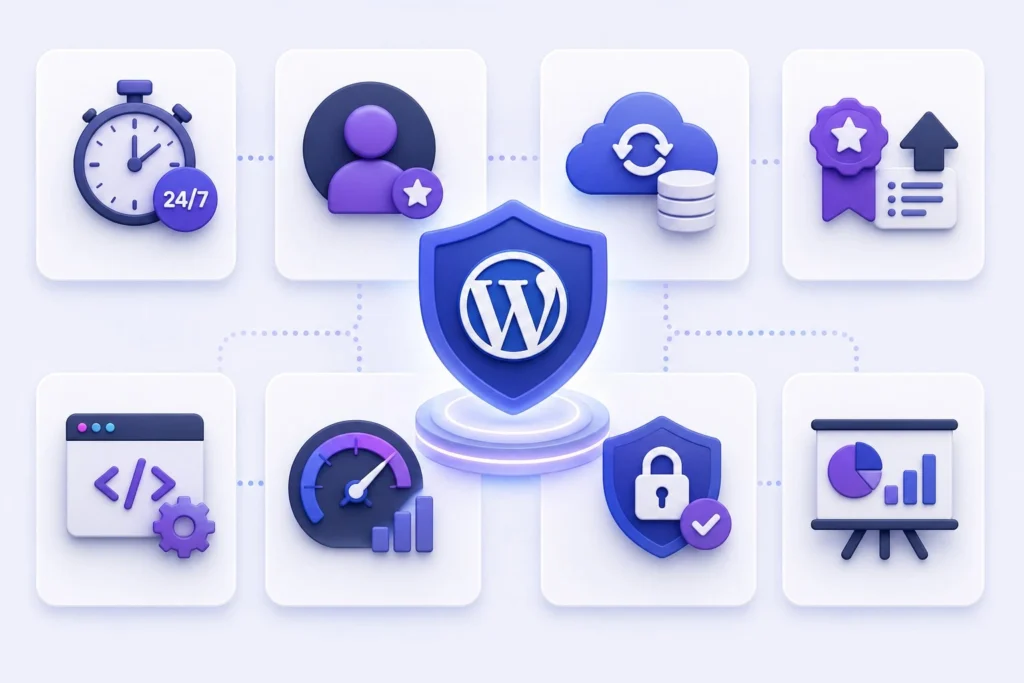
24/7 Response with Defined SLAs
Standard support typically offers business-hours response with a 24 to 48-hour resolution target. Premium support delivers 24/7 coverage with documented response times by severity. Critical issues (complete site outage, active hack, broken checkout) receive a response within 30 minutes. High-severity issues get under 1-hour response. Medium-severity issues get a same-business-day response.
The key distinction is that premium SLAs are documented in the contract, not just described in marketing copy. A premium provider commits to specific response times in writing. A standard provider uses words like “priority” and “fast” without committing to specific numbers.
Dedicated Account Management
Standard support routes tickets to whichever specialist is available. Premium support assigns a named account manager who knows your site, your business context, and your communication preferences. The account manager is the single point of contact for ongoing strategy conversations and the escalation path for any issue that requires senior intervention.
Real-Time or Near-Real-Time Backups
Standard plans typically include daily backups. Premium plans include real-time backups that capture every change as it happens, with the ability to restore to any point in the last 30 to 90 days. For e-commerce stores and content publishers, this is the difference between losing 24 hours of orders or content versus losing minutes.
Priority Queue for Critical Issues
Premium support tickets automatically jump the queue. When a critical issue is reported, it gets worked on immediately rather than queued behind lower-severity tickets from standard plan clients. This is operationally how premium providers deliver the SLAs they promise.
Custom Development Time Included
Standard plans cover maintenance only. Premium plans typically include a monthly allotment of custom development hours, usually 5 to 20 hours per month, that can be used for feature additions, integrations, or performance work without separate billing.
Performance Monitoring and Optimization
Standard plans include uptime monitoring and basic performance reports. Premium plans include continuous Core Web Vitals tracking, real-user monitoring, and proactive optimization work to maintain performance over time as the site evolves.
Security Hardening and Compliance Support
Premium plans typically include advanced security hardening (WAF rules, login protection, file integrity monitoring), regular security audits, and support for compliance requirements such as PCI-DSS for eCommerce or a basic GDPR/CCPA review.
Strategic Quarterly Reviews
Premium support includes quarterly strategy sessions with the account manager covering site performance trends, upcoming priorities, technical debt review, and recommendations for future investment. Standard support is reactive. Premium support includes proactive planning.
Premium WordPress Support That Follows Your Site Anywhere.
Seahawk’s VIP plan delivers 24/7 triage, same-day response, real-time backups, and dedicated account management for $599 per month. No hosting lock-in, no scope limitations, no after-hours surcharges.
Two Sources of WordPress Premium Support in 2026
WordPress premium support comes from two structurally different types of providers, and the choice between them shapes everything from cost to portability.
Source 1: Hosting-Bundled Premium Support
GoDaddy is the main hosting provider that explicitly markets a branded product called “WordPress Premium Support” as part of its managed hosting offering. Other major managed hosts like WP Engine, Kinsta, and SiteGround do not sell a separate product by that name, but they do include 24/7 support across their managed WordPress hosting plans, with enhanced support features at higher hosting tiers.
The practical effect is similar: the hosting and support are bundled together. The strategic difference is that GoDaddy positions premium support as a distinct upgrade buyers can recognize and shop for, while Kinsta and WP Engine treat support as an inherent feature of their hosting product rather than a separately branded service.
What hosting-bundled premium support typically includes: Hosting infrastructure management, WordPress core and plugin updates, daily backups, basic performance optimization, and technical support for WordPress questions related to the hosting environment. At higher hosting tiers, this includes faster response times, named support engineers for enterprise accounts, and enhanced uptime SLAs.
What it typically does not cover at the same depth as independent premium support: Custom development time, dedicated account management for smaller plans, a broad WordPress strategy beyond hosting-related issues, white-label coverage for agencies managing client sites on different hosts, and full third-party integration support.
Pricing: Bundled into the hosting plan price. GoDaddy positions premium support as an upgrade, typically priced at $25 to $100 per month above the base hosting cost. Kinsta and WP Engine include 24/7 support at all tiers, with premium support coverage included in mid-to-upper tier plans starting at $30 to $200 per month for the hosting itself.
Best for: Site owners who are already committed to a specific managed host, want a single-vendor relationship for hosting and support, and primarily need help with hosting-environment issues rather than a broad WordPress strategy.
Source 2: Independent Premium Support
Independent providers like Seahawk, WP Buffs, SiteCare, FixRunner, and Pronto Marketing offer premium support as standalone services, independent of any specific hosting provider. The site can be hosted anywhere, and the support relationship continues across hosting changes.
What independent premium support typically includes: Everything hosting-bundled support covers, plus broader WordPress scope, including custom development, dedicated account management at all premium tiers, third-party integration support, eCommerce-specific premium coverage, white-label options for agencies, and strategic planning beyond hosting concerns.
Pricing: Standalone monthly fees ranging from $99 to $999 per month, depending on the provider and tier, separate from hosting costs.
Best for: Site owners who want premium support that follows the site across hosting changes, agencies managing multiple client sites on different hosts, eCommerce stores needing WooCommerce-specific premium coverage, and businesses that view WordPress support as a strategic capability rather than just hosting infrastructure.
Hosting-Bundled vs Independent: The Real Tradeoffs
The choice between hosting-bundled and independent premium support comes down to four factors.
| Dedicated to all premium tiers | Hosting-Bundled (GoDaddy, WP Engine, etc.) | Independent (Seahawk, WP Buffs, SiteCare) |
| Portability | Tied to staying with the host | Follows the site across any host |
| Scope | Hosting-related WordPress support | Full WordPress capability |
| Account Management | Limited at lower tiers | Dedicated at all premium tiers |
| Custom Development | Usually separate billing | Often included in premium plans |
| Hosting Migration Support | None (you stay with the host) | Included in many premium plans |
| White-Label for Agencies | Generally not available | Available at multiple providers |
| Pricing Structure | Bundled with hosting cost | Standalone monthly fee |
The honest framing: hosting-bundled premium support is good for sites that are happy with their host and primarily need help with hosting-environment issues. Independent premium support is better for sites that want to keep their support relationship stable across hosting decisions, need broader WordPress capability, or operate at a scale where custom development and strategic planning matter as much as routine maintenance.
Most enterprise WordPress operations end up using both. Managed hosting with included basic support handles infrastructure, and an independent premium support relationship handles everything above the infrastructure layer.
Comparing WordPress Premium Support Providers in 2026
Here is how the major WordPress premium support options compare, including hosting-bundled and independent providers.
| Provider | Type | Premium Tier Pricing | Includes Custom Dev | White-Label |
|---|---|---|---|---|
| GoDaddy WordPress Premium Support | Hosting-bundled (branded product) | Custom (with hosting) | No | No |
| WP Engine Managed Hosting | Hosting with bundled 24/7 support | $20+ /mo for hosting | No | No |
| Kinsta Managed Hosting | Hosting with bundled 24/7 support | $35+ /mo for hosting | No | No |
| Seahawk VIP | Independent | $599/mo | Includes development hours and SEO work | Yes |
| WP Buffs Custom Pro | Independent | Custom pricing | Limited | Yes |
| SiteCare Enterprise | Independent | Custom pricing | Limited | No |
| FixRunner Premium | Independent | Subscription | Limited | No |
| Pronto Marketing | Independent | Custom pricing | Limited | No |
The pattern across providers is consistent. Hosting-bundled premium support is competitively priced because the hosting margin subsidizes it, but scope is constrained. Independent premium support has a higher standalone cost but delivers a broader scope and portability.
For agencies specifically, only Seahawk and WP Buffs offer genuine white-label premium support that lets the agency deliver premium-tier service to its own clients under its own brand. This is a meaningful differentiator that hosting-bundled providers do not match.
When Do You Actually Need WordPress Premium Support?
Premium support is genuinely the right tier in five specific situations.
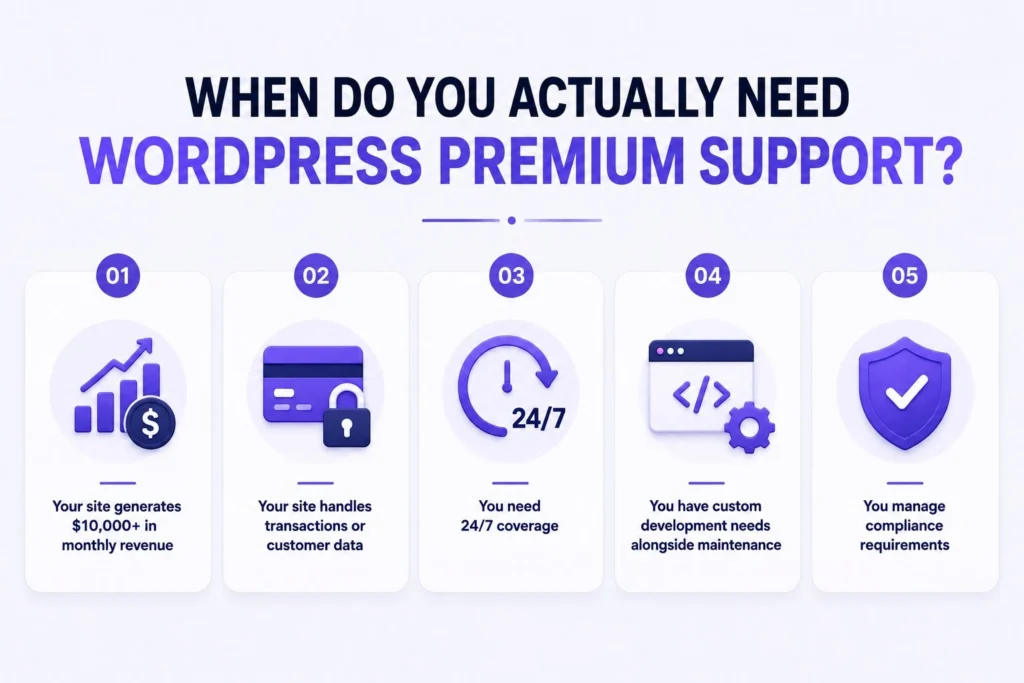
Your site generates $5,000 or more in monthly revenue. At this revenue level, the math on downtime cost makes premium support pay for itself with the first prevented critical incident. A $599 monthly plan is a small fraction of what one extended outage would cost in lost sales.
Your site handles transactions or customer data. WooCommerce stores, membership sites, and any platform that processes payment information benefit from premium support’s faster response times, real-time backups, and PCI-aware security hardening. Standard support is not designed for transaction-critical workloads.
You need 24/7 coverage. If your site serves customers across time zones, runs marketing campaigns at unpredictable times, or simply cannot afford to wait until business hours when something breaks, the 24/7 SLA in premium support is structurally necessary. Standard support does not provide this.
You have custom development needs alongside maintenance. A site that needs ongoing feature additions, integrations, or performance work benefits from premium plans that bundle custom development hours, eliminating the friction of separately billing every small task.
You manage compliance requirements. PCI-DSS for eCommerce, basic GDPR/CCPA for European visitors, ADA/WCAG for accessibility, or industry-specific requirements all benefit from premium support’s compliance-aware approach. Standard support does not typically cover this scope.
For sites that do not match any of these five criteria, premium support is an over-investment. A standard maintenance plan at $49 to $99 per month delivers appropriate coverage at an appropriate cost.
What WordPress Premium Support Actually Costs?
Pricing for premium support varies significantly based on whether the provider uses subscription pricing, hourly add-ons, or hosting-bundled tiers.
Hosting-Bundled Premium Support Pricing
GoDaddy and similar hosting providers structure premium support as an upgrade to standard managed hosting. The premium upgrade typically adds $25-$100 per month to the base hosting plan. The total monthly cost, including hosting and premium support, typically falls in the $50 to $200 range for small- to mid-size sites.
For enterprise sites on dedicated hosting, premium support is typically included with enterprise hosting plans that start at several hundred dollars per month and scale based on infrastructure requirements.
Independent Premium Support Pricing
Independent premium support tiers typically fall into three pricing bands:
Entry premium tier ($99 to $299/mo): Covers 24/7 response, dedicated account management, real-time backups, and limited custom development hours. Suitable for growing business sites and small eCommerce operations.
Mid premium tier ($299 to $599/mo): Covers everything in the entry tier plus a broader scope, more development hours, advanced performance monitoring, and quarterly strategic reviews. Suitable for mid-market business sites and active eCommerce stores.
Enterprise premium tier ($599 to $999/mo plus): Covers full premium scope plus dedicated senior engineers, advanced compliance support, white-glove handling for high-stakes work, and custom SLAs. Suitable for high-traffic publishers, enterprise eCommerce, and businesses where downtime cost exceeds $5,000 per hour.
Seahawk’s VIP plan at $599 per month sits at the boundary between mid-premium and enterprise-premium, including 24/7 triage, same-day response, real-time backups, dedicated account management, hosting migration support, after-hours updates, and SEO optimization on up to 10 pages. The plan is priced below most competitors’ equivalent enterprise tiers while offering comparable scope.
For agencies, white-label premium support is structured to enable them to resell premium-tier services to clients under their own brand, with built-in margins.
How to Choose Between WordPress Premium Support Providers?
The right premium support provider depends on five specific factors. Use this framework to narrow the choice.
Are you committed to staying with your current host?
If yes, hosting-bundled support is reasonable because the lock-in is not a concern. GoDaddy offers a branded WordPress Premium Support product. Kinsta, WP Engine, and SiteGround include 24/7 support across their managed hosting plans without branding it as a separate premium product. All of these deliver appropriate coverage for hosting-related issues.
If no, or if you might change hosts in the next 12 to 24 months, independent premium support is structurally better because it follows the site. Seahawk, WP Buffs, SiteCare, FixRunner, and Pronto Marketing all offer this portability.
Do you need custom development alongside support?
If yes, look for premium plans that bundle development hours. Seahawk’s VIP plan includes development capacity. Most hosting providers charge separately for premium support and any custom work, which can become expensive for sites with regular development needs.
Are you an agency managing client sites?
If yes, only providers offering genuine white-label premium support deliver what you need. Seahawk and WP Buffs are the two main options here. Hosting-bundled providers do not generally offer white-label.
What is your compliance environment?
If you need PCI-DSS, GDPR, ADA/WCAG, or industry-specific compliance support, look for providers with documented compliance capability. SiteCare leads on SOC 2 Type II compliance. Other providers handle compliance on a case-by-case basis.
What is your downtime cost?
If your downtime cost exceeds $5,000 per hour, enterprise premium tiers with dedicated engineers and custom SLAs are worth the higher cost. If your downtime cost is under $1,000 per hour, the mid premium tier is appropriate. If under $200 per hour, standard support is likely sufficient; premium is overinvestment.
Final Thoughts
WordPress premium support is a meaningful upgrade from standard maintenance for sites that genuinely need it: active business sites, eCommerce stores, high-traffic publishers, and operations where 24/7 reliability is operationally necessary. For sites that do not meet those criteria, premium is an overinvestment, and standard support is more cost-effective.
The choice between hosting-bundled support (GoDaddy’s branded premium support, or Kinsta and WP Engine’s bundled 24/7 support) and independent premium support (Seahawk, WP Buffs, SiteCare) comes down to scope and portability. Hosting-bundled support is convenient and competitively priced for sites committed to a specific host. Independent support is structurally better for sites that want their support relationship to follow them across hosting changes, need broader WordPress capability beyond hosting issues, or operate at a scale where dedicated account management and custom development hours matter as much as routine maintenance.
Most enterprise WordPress operations use both. Managed hosting with included basic support handles infrastructure. Independent premium support handles everything above the infrastructure layer. This combination is structurally more capable than either approach alone, and the total cost is often lower than the cost of enterprise hosting plans that bundle premium support at the highest tier.
Get WordPress Help in Under 60 Minutes.
Seahawk’s WordPress support team responds to critical issues in under 60 minutes with three-timezone coverage. $39 per hour, no retainer, no after-hours surcharges. Same caliber team as premium plans, without the monthly subscription.
Frequently Asked Questions
What is WordPress Premium Support?
WordPress premium support is a higher service tier than standard maintenance, including 24/7 response with defined SLAs, dedicated account managers, real-time backups, priority handling for critical incidents, and broader scope coverage, including custom development time. It is designed for active business sites, eCommerce stores, and high-traffic operations where standard support is insufficient.
What is the difference between premium and standard WordPress support?
Standard WordPress support covers routine maintenance: scheduled updates, daily backups, security scanning, and basic uptime monitoring with business-hours response. Premium support includes 24/7 SLA-backed responses, dedicated account management, real-time backups, a priority queue for critical incidents, custom development hours, advanced performance monitoring, and strategic quarterly reviews. Standard support is sufficient for most personal sites and small business sites. Premium support is appropriate for active business sites, eCommerce stores, and operations where 24/7 reliability is operationally necessary.
When do I need WordPress premium support instead of the standard support?
You need premium support when your site generates $ 5,000+ in monthly revenue, handles transactions or customer data, requires 24/7 coverage, has ongoing custom development needs alongside maintenance, or operates under specific compliance requirements. For sites that do not meet any of these criteria, standard support is appropriate; premium support is overinvestment.
How do I switch from hosting-bundled to independent premium support?
Switching takes 1 to 2 weeks. The independent provider performs an initial site audit, documents the current configuration, sets up monitoring and backup integrations, and onboards your team to the new support relationship. The site can stay on its current host throughout the switch. Many sites use independent premium support alongside their hosting plan rather than replacing hosting-bundled support, with the independent provider handling everything above the infrastructure layer.
Can WordPress Premium support be white-labeled for agencies?
Yes, but only with specific providers. Seahawk and WP Buffs both offer white-label premium support that agencies can deliver to clients under their own brand. Hosting-bundled providers like GoDaddy do not generally offer white-label premium support. For agencies managing multiple client sites at the premium tier, white-label capability is essential, limiting realistic provider options to a handful of independent specialists.