Getting your content cited by AI platforms is no longer optional; it’s essential. AI citations determine whether your brand appears in ChatGPT, Perplexity AI, and Gemini when users ask questions in your niche. The shift toward generative AI tools for search means your content must meet a higher standard to earn visibility.
This guide covers everything you need to build a sustainable strategy to earn AI citations across multiple generative AI search engines and AI assistants. You will learn how AI models select sources, how to structure content correctly, and how to measure your AI visibility over time.
TL;DR: Earning Your Place in AI-Generated Answers
- AI citations require structured, authoritative, and clearly formatted content that generative AI tools can parse and trust.
- Topical authority and third-party validation are the top signals AI models use when selecting citations.
- Structured data, APA-style references, and multiple formats increase the likelihood that your content earns citations.
- Tracking AI responses and visibility requires dedicated tools beyond traditional SEO analytics.
What Are AI Citations and Why They Matter for SEO and AI Search Visibility
AI citations help your content get discovered, trusted, and directly used in artificial intelligence-powered search results.
Definition of AI Citations in Generative AI Search Engines
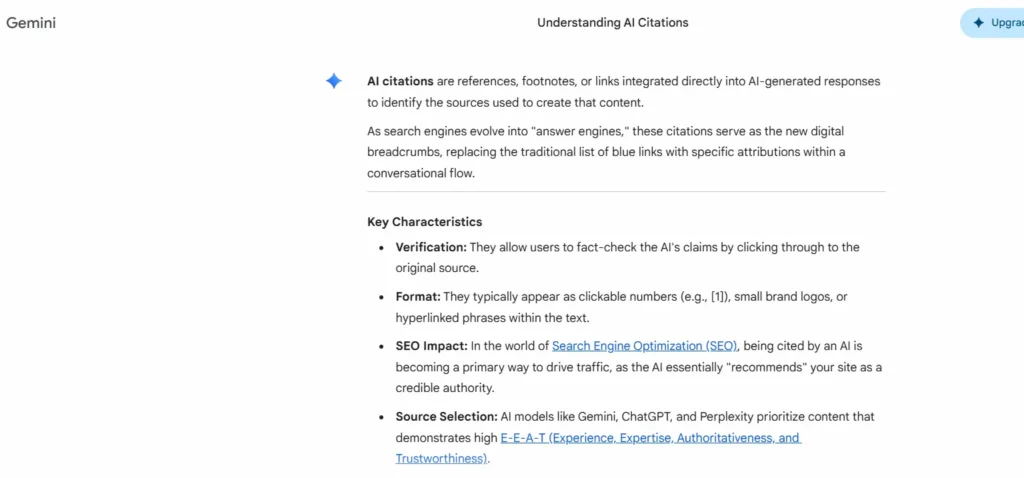
AI citations are references that generative AI systems include in their responses to attribute information to a source. When ChatGPT, Perplexity AI, or Gemini pulls a fact, definition, or explanation, it often cites the source website. These references are called AI citations.
In the context of generative artificial intelligence, a citation works much like an academic reference. The AI model attributes a data point or claim to a specific source. This gives the source credibility and drives referral traffic.
Difference Between Traditional SEO Citations and AI Citations
Traditional SEO citations refer to mentions of your business name, address, and phone number across directories. They are tied to local SEO and Google Maps rankings.
AI citations are different. They reflect whether a large language model considers your content trustworthy enough to include in its AI-generated answers.
Traditional SEO still matters, but AI citations require a fundamentally different approach. You must produce citation-worthy content, content that directly answers questions with accuracy, depth, and structure.
Why AI Citations Drive Visibility in ChatGPT, Perplexity, and Gemini?
When a user types a question into Perplexity AI or uses Bing Copilot, the AI system scans multiple sources and synthesizes an answer.
It then cites the sources it trusted most. Being cited puts your brand in front of users who may never click a traditional search result.
Google AI Overviews work the same way. They pull content from websites and cite them at the top of the search results page. This is not a blue link buried below paid ads. It is a direct answer with your brand name attached.
The Shift From Blue Links to AI-Generated Answers
Users are abandoning blue links in favor of AI-generated direct answers. They want quick access to information without having to click through multiple pages.
Understanding technical SEO tips alone is no longer sufficient. You need to adapt your content marketing strategy to the rules of generative engine optimization to stay competitive in AI search.
Turn AI Citations Into Real Rankings with Expert Managed SEO Services
Build authority, earn AI citations, and drive consistent organic growth with expert-led SEO tailored to your business goals.
How AI Models and AI Search Engines Decide Which Sources to Cite?
AI systems do not randomly select sources. They follow a specific set of signals when selecting citations. Understanding these signals gives you a clear roadmap.

- Accuracy and factual reliability are the primary filters. AI models cross-reference information across multiple sources. If your content conflicts with the consensus, it will not be cited. Run a thorough WordPress site audit to identify and remove outdated facts and broken pages that could signal low quality.
- Domain authority and backlinks influence AI citation selection. Sites with strong backlink profiles and consistent publishing records are more likely to be trusted by large language models. Third-party validation, such as coverage in industry publications, also plays a significant role.
- Content structure matters enormously. AI systems prefer content that is logically organized with clear headings, lists, and definitions. Content that mirrors how a question would be answered verbally tends to perform better.
- Freshness is another key factor. AI models prefer recently updated content, especially for fast-moving topics. Understanding how Google indexes content through AI-powered protocols helps you stay aligned with how modern AI crawlers access and evaluate your pages.
- Finally, schema markup and structured data help AI systems understand what your content is about. Adding structured data to your WordPress site creates a machine-readable layer that makes it easier for AI models to extract and cite specific information.
Steps to Build AI Citations in ChatGPT, Perplexity, and Gemini
Use a structured, authority-driven approach to create content that AI models can easily extract, trust, and cite across platforms.
Step 1: Audit Your Pages
Start by finding the gaps. Type questions related to your niche into ChatGPT, Perplexity AI, and Gemini. Note which sources they cite and why those sources were chosen over yours.
This prompt audit reveals the content formats, topics, and depth that AI assistants currently reward. Compare your existing pages with competitors cited in your SEO checklist to identify structural or technical gaps in your content.
Step 2: Structure Content for AI Answers on WordPress
AI search engines reward content that directly answers questions. Use an FAQ structure. Begin each section with a clear question and follow it with a direct answer in the first sentence.
Avoid burying the main point in lengthy introductions. AI systems scan the top of each section for the answer. Improving the user experience on your WordPress site by reducing friction makes key answers scannable from the very first line, a quality signal that AI models actively reward.
Use proper heading hierarchy. H2 for major sections. H3 for subsections. This mirrors how AI models understand content structure, making it far easier for them to extract citation-worthy passages.
Step 3: Use Formatting Patterns AI Tools Prefer for Citations
AI models respond to multiple formats. Do not rely on long blocks of prose alone. Use a combination of numbered lists, bullet points, summary boxes, tables, and short paragraphs. Each format helps AI systems extract specific types of information more easily.
- For definitions, use a clear pattern: “X is defined as Y.”
- For processes, use numbered steps.
- Use Tables for comparisons.
These formatting choices create structured data points that AI models can pull into their AI-generated answers as in-text citations.
Add FAQ schema markup to reinforce machine readability. Learn how to apply schema markup in WordPress so that AI and search engines can parse your content at a structural level.
Step 4: Build Topical Authority to Earn AI Citations Consistently
Topical authority means covering a subject so thoroughly that AI systems and search engines recognize you as the definitive resource. This requires a content cluster strategy.

Create a pillar page for each major topic. Then build supporting content that links back to that pillar. Over time, this signals to large language models that your site is a reliable reference. Mastering content relevance across your entire content library is central to this strategy.
Focus on covering each topic in multiple formats and from multiple angles. This mirrors the way academic work uses multiple sources to establish credibility. The more comprehensively you cover a subject, the more citation-worthy your content becomes.
Step 5: Optimize Technical WordPress Setup for AI Visibility
A slow or technically broken site will not earn AI citations regardless of content quality. AI crawlers need to access your pages efficiently. Fix Core Web Vitals issues using dedicated Core Web Vitals optimization services to ensure fast loading and stable layouts.
Make sure your robots.txt does not block AI crawlers. Several generative AI tools use their own bots to index content. Review your crawl settings and verify that AI indexing bots can fully access your content.
Track overall site health using Google Search Console to identify indexing problems, coverage errors, and content gaps that could be suppressing your AI visibility.
Step 6: Build Authority Signals That Influence AI Citation Selection
AI systems rely on external authority signals just as search engines do. The same signals that improve your PageRank also improve your likelihood of being cited in AI-generated answers.
Digital PR is a powerful tool here. Working with white-label digital marketing companies that specialize in outreach can accelerate your coverage in industry publications, coverage that AI models treat as third-party validation.
Being referenced by platforms that AI models actively crawl, such as Wikipedia and major news outlets, further reinforces your credibility as a citable source.
Step 7: Outreach and Distribution Strategies to Earn AI Citations
Create shareable, link-worthy content that other websites want to reference. Data studies, original research, and comprehensive guides perform particularly well. When your content is referenced by industry publications, AI models pick up those mentions during indexing.
Distribute your content across industry platforms where AI models crawl regularly. Use marketing automation tools to maintain a consistent publishing and outreach cadence without sacrificing quality.
Also consider community platforms. Strategic participation on Reddit, Quora, and niche forums creates natural mentions that AI systems index.
Learning how to use Reddit for SEO helps you increase the organic reach of your content in communities that AI models actively monitor and cite.
Step 8: Measure AI Citations, AI Responses, and Visibility Performance
You cannot improve what you do not measure. Start by tracking how often your content appears in AI-generated answers. Manual prompt testing across ChatGPT, Perplexity AI, and Gemini gives you a baseline.
Use dedicated rank tracking and keyword manager tools alongside specialized AI monitoring platforms to identify trends in your AI visibility.
Combine this with data from tracking your WordPress site optimization to connect technical improvements with measurable gains in AI citation rates.
Set up a weekly process: run key industry prompts, record which sources AI systems cite, and track your brand’s appearance rate over time. Document changes and link them to content updates so you can see what drives improvements.
Choosing AI Tools for Citation Monitoring and Tracking AI Visibility
Several AI tools now specialize in monitoring AI search and citation tracking. Platforms like Semrush, Ahrefs, and newer AI-specific solutions track citation rates across generative AI platforms.

When evaluating these tools, prioritize those that monitor multiple AI engines simultaneously. ChatGPT, Gemini, and Perplexity AI each have slightly different citation behaviors.
A tool that tracks only one engine gives an incomplete picture of your overall AI visibility. Also, look for tools that track brand mentions in AI-generated responses, even when your content isn’t explicitly linked.
Studying how different AI assistants handle attribution and accuracy reveals important patterns about how AI tools source and reference information, context that directly informs your citation monitoring strategy.
Emerging platforms built specifically for generative engine optimization are evolving rapidly. The arrival of tools built on models like GPT-5 and next-generation AI systems signals how quickly AI capabilities are changing, which means your citation monitoring approach must continuously evolve alongside them.
Citing AI-Generated Content Correctly, APA Style, and Best Practices
When you use AI-generated content in your own writing, you must cite it accurately. Citing ChatGPT and other generative AI tools is a growing challenge for content teams and academics alike.
- In APA style, you cite AI-generated content by naming the AI model, the version, and the date the content was generated. The APA style format for citing ChatGPT includes the developer name (OpenAI), the model name, and the access date. A reference list entry follows the same structure as citing software or digital tools.
- The Chicago Manual of Style and Chicago style guidelines treat AI-generated content similarly. Include the prompt used, the model, and the date of output.
Both APA and Chicago style treat text generated by AI as a primary source, requiring an in-text citation and a corresponding reference list entry.
For academic work and professional publications, always disclose when content has been AI-generated. Transparency is essential, both ethically and for long-term credibility.
Governance, Legal, and Ethical Considerations in AI Citations
AI citations raise important questions about accountability and accuracy. When an AI search engine cites your content, it may do so without explicit permission.
Conversely, when AI systems summarize your work without attribution, it raises intellectual property concerns that are increasingly recognized across the publishing industry.
Monitor AI responses for instances where your content is paraphrased without a citation. This is a recognized and growing issue across media, academia, and content marketing.
From a governance perspective, organizations should maintain clear policies on how AI-generated content is produced, reviewed, and cited within their own publications. This protects against reputational damage if AI-generated content turns out to be inaccurate or misattributed.
Ethically, content creators should avoid using AI systems to produce content designed to manipulate AI citation algorithms.
AI models are increasingly sophisticated at detecting low-quality, artificially inflated content. Authentic expertise, clearly attributed research, and transparent sourcing are the only sustainable path forward.
Common Mistakes That Prevent Your Content from Getting AI Citations
Avoid these common pitfalls that reduce your chances of being selected, trusted, and cited by AI search engines.

- Publishing thin content is the number one barrier. AI models skip shallow pages that lack depth. Every page competing for AI citations should comprehensively address a topic with substance and specificity.
- Ignoring structured data is a costly oversight. Without schema markup, AI systems must guess at the context and meaning of your content. Adding the FAQ, How-To, and Article schemas significantly improves AI parseability.
- Failing to update content means your pages fall behind on factual accuracy. AI models prefer fresh content, especially for evolving topics. Review older content regularly and refresh it with updated data and current references.
- Blocking AI crawlers in your robots.txt file is a common technical error. Review your crawl settings and verify that AI indexing bots can access your content without restrictions.
- Focusing only on traditional search without adapting to AI search behavior leaves significant visibility on the table. The SEO practices to avoid include over-optimizing for exact-match keywords while ignoring the conversational, intent-driven patterns that AI search rewards.
Future of AI Citations and How to Stay Ahead in AI Search
The future of AI citations is moving toward real-time indexing, multi-modal content, and personalized AI responses.
- AI models will increasingly cite video transcripts, podcast episodes, and images alongside traditional text content.
- Generative engine optimization will evolve as AI search behavior evolves. The platforms that dominate AI search today, ChatGPT, Perplexity AI, Gemini, and Bing Copilot, will be joined by new entrants.
- The future of WordPress is deeply tied to how well it adapts to AI-driven content discovery, and sites built on flexible, well-structured content will hold a natural advantage.
- To stay ahead, invest in original research. Proprietary data, unique surveys, and exclusive case studies are inherently citation-worthy. AI systems have no better source than original, well-documented data.
- Also, watch emerging standards around AI content attribution. As regulatory frameworks catch up with generative artificial intelligence, new rules around citations, attribution, and content rights will take shape.
Brands that already practice transparent sourcing and accurate citation will be far better positioned when those rules take effect.
Conclusion
Building AI citations requires a combination of technical precision, depth of content, and authority-building over time.
The brands that win in AI search are those that consistently publish trustworthy, well-structured, and factually accurate content. Success in generative engine optimization is not a one-time fix; it is an ongoing discipline.
- Start with an audit. Find the gaps between your current content and what AI models are citing in your niche.
- Then close those gaps systematically, through better formatting, richer topical coverage, structured data, and strategic outreach across industry platforms.
- Measure your AI visibility regularly and adapt your approach as AI platforms evolve.
- Track brand mentions in AI responses and connect performance changes to specific content improvements.
- Treat AI citations the same way you treat backlinks, as signals of trust that must be earned through genuine quality.
The content marketing playbook is being rewritten. Those who act on generative engine optimization now will hold a lasting competitive advantage in both traditional search results and AI-generated answers for years to come.
FAQs About AI Citations
What are AI citations in artificial intelligence tools?
AI citations are references that tools like ChatGPT, Perplexity, and Gemini use when generating answers. These systems analyze high-quality content and cite sources that are clear, authoritative, and relevant. If your page is structured well, AI can pull content directly and include it in responses.
How can I get my content cited by AI search engines?
Start with a clear title, strong headings, and concise answers. Use the same approach across pages for consistency. Focus on topical authority, structured formatting, and factual accuracy so AI tools trust and select your content.
Does artificial intelligence rank content the same way as Google?
Not exactly. While traditional SEO still matters, artificial intelligence tools focus more on clarity, context, and extractable answers. They prefer content that can be easily summarized and used directly in responses rather than just ranked on a results page.
Can you give an example of AI citation optimization?
An example would be writing a definition in 2-3 lines under a keyword-rich heading. Add a short list or table below it. This format helps AI tools understand and cite sources efficiently.
Should I use the same approach for all AI platforms?
Yes, mostly. While platforms differ slightly, the same approach works well. Focus on structured content, clear intent, and authority. This increases your chances of being cited across multiple AI tools.