Global corporations require robust digital ecosystems that handle massive traffic, integrate with legacy systems, and provide bank-grade security. This is where enterprise web development comes into play.
Enterprise-level web development is the process of creating and maintaining complex web applications and websites tailored for large-scale businesses.
Unlike small business websites, these platforms serve as the digital backbone of an organization. They facilitate internal workflows, manage customer interactions, and drive global operations.
This guide explores the essential features, best practices, and technologies that define successful enterprise web solutions.
TL;DR: Secure and Scalable Enterprise Web Applications Explained
- Enterprise web applications are built to support complex business operations, high traffic volumes, and long-term scalability.
- Security is a top priority, with features like data encryption, compliance standards, and role-based access control protecting sensitive information.
- Seamless integration with existing systems such as CRM and ERP platforms ensures smooth data flow and operational efficiency.
- Following best practices such as modular architecture, continuous testing, and performance optimization helps enterprises build reliable, future-ready digital platforms.
What is Enterprise Web Development?
Enterprise development involves building a web portfolio or application suite designed to support the distinct goals of a large business.
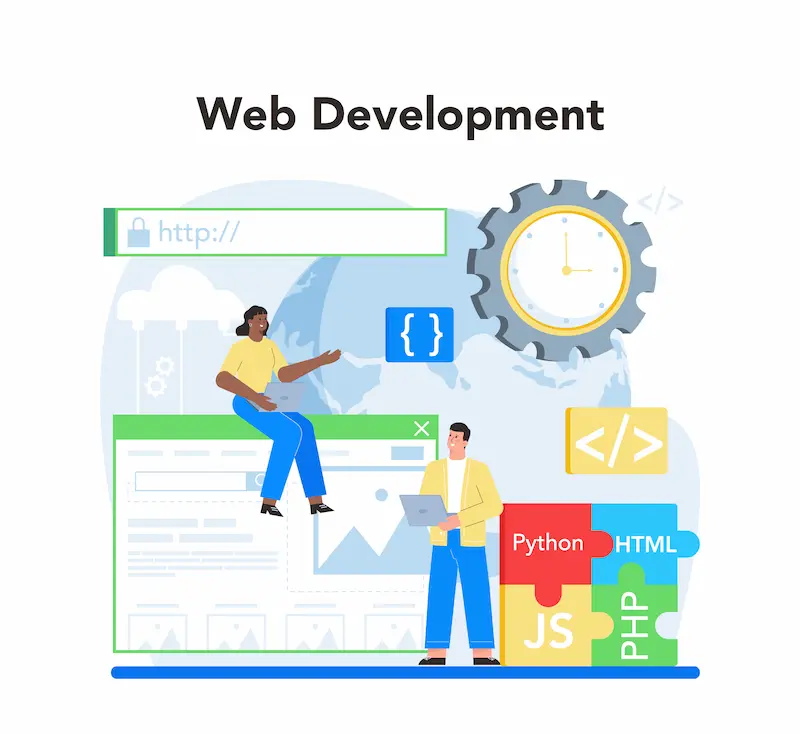
These applications include customer-facing portals, internal employee dashboards, supply chain management systems, and enterprise resource planning (ERP) interfaces.
The primary goal is not just to display information but to automate business processes. A successful website development strategy ensures that the digital infrastructure aligns with the company’s long-term operational objectives.
Build a Scalable Enterprise WordPress Platform
Transform your enterprise website into a secure, high performance digital asset with custom WordPress solutions.
How Enterprise Web Development Differs from Traditional Web Development?
While traditional web development focuses on establishing an online presence, enterprise digital platform development focuses on functionality at scale.
- Scale: Traditional sites might handle thousands of visitors. Enterprise sites must handle millions of concurrent users without crashing.
- Complexity: Small sites often use standalone Content Management Systems (CMS). Enterprise solutions require complex databases and custom-built logic.
- Maintenance: A brochure site needs occasional updates. Enterprise apps need continuous integration and dedicated DevOps teams.
- Stakeholders: Traditional projects usually involve a small team. Enterprise projects involve multiple departments, legal compliance teams, and executive stakeholders.
Why Enterprise Web Development is Critical for Large Businesses?
Large businesses cannot rely on off-the-shelf software for everything. Custom web development provides a competitive edge. It allows organizations to own their data and tailor user experiences.
Furthermore, it improves efficiency. By integrating disparate tools into a unified web ecosystem, employees spend less time switching contexts.
For customer-facing platforms, high-quality web development services build trust. It signals that the company is modern, secure, and reliable.
Core Features of Enterprise Web Development
To succeed, an enterprise application must possess specific characteristics. These core features separate a fragile prototype from a resilient enterprise solution.
Scalable Architecture for Enterprise Web Applications
Scalability is the ability of a system to handle growing amounts of work. In enterprise software and web development, this means the application must perform well whether ten people or ten million people are using it.
Developers achieve this through horizontal scaling (adding more servers) and vertical scaling (adding power to existing servers).
Cloud-native architectures are essential here. They allow resources to expand automatically during traffic spikes, ensuring the system never goes offline during critical sales periods.
Enterprise Level Security and Data Protection
Security is the top priority in enterprise digital platform development. Large organizations are prime targets for cyberattacks. A breach can cost millions in fines and reputational damage.
Core security features include:
- Data Encryption: Encrypting data both at rest and in transit.
- Compliance: Adhering to standards like GDPR, HIPAA, or CCPA.
- Penetration Testing: Regular ethical hacking to find vulnerabilities.
- Identity Management: Ensuring only authorized personnel have access to sensitive data.
Seamless Integration with Enterprise Systems and APIs
No enterprise application exists in a vacuum. It must talk to existing software. Scalable enterprise web applications rely heavily on Application Programming Interfaces (APIs).
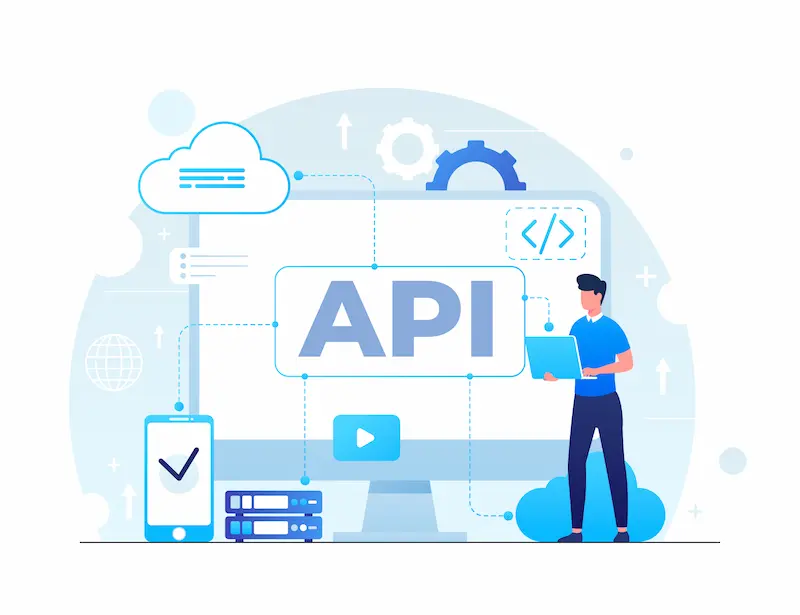
The web app must seamlessly exchange data with CRMs (such as Salesforce), ERPs (such as SAP), and payment gateways. Good integration eliminates data silos. It ensures that when a customer places an order on the web, the inventory system updates instantly.
High Performance, Reliability, and Uptime Optimization
Downtime costs money. For a global retailer, even a few minutes of downtime can mean lost revenue. Enterprise-grade web solutions focus on high availability.
This involves using Content Delivery Networks (CDNs) to deliver assets to users worldwide quickly. It also requires efficient coding practices to minimize load times. Database optimization is also critical to prevent slow queries from bottlenecks.
User Centric Design and Enterprise UX Best Practices
Historically, enterprise software was clunky and hard to use. That has changed. Today, web development for large organizations prioritizes User Experience (UX).
Whether the user is an employee or a customer, the interface must be intuitive. Complex workflows should be simplified. Good UX reduces training costs for internal tools and increases conversion rates for external sites.
Role-Based Access Control and User Management
In a large company, not everyone should see everything. Web development for large organizations implements strict Role-Based Access Control (RBAC).
Administrators have full access. Managers see reports. Junior staff see only their tasks. This granular control prevents data leaks and ensures users are not overwhelmed by irrelevant information.
Mobile First and Responsive Enterprise Web Design
The modern workforce is mobile. Enterprise-grade web solutions must adopt a mobile-first approach.
Field agents need to access ERP systems on tablets. Executives need to view dashboards on phones. Responsive design ensures the web application functions perfectly across all device sizes, touchscreens, and operating systems.
Best Practices for Enterprise Web Development
Building large-scale software is risky. Projects can go over budget or fail to launch. Following established best practices in enterprise software and web development mitigates these risks.

Strategic Planning and Enterprise Web Development Roadmap
Coding should not start immediately. A discovery phase is vital. Stakeholders must define specific goals, target audiences, and functional requirements.
Create a detailed roadmap. This document should outline milestones, deliverables, and timelines. It aligns the development team with business leadership, ensuring everyone understands what “success” looks like.
Choosing the Right Technology Stack for Enterprise Web Solutions
The technology stack serves as the foundation of your project. In enterprise-grade web solutions, stability beats trends.
Choose languages and frameworks with long-term support and large developer communities. Avoid “flavor of the month” technologies that might vanish in a year. The stack must support the scalability and security requirements identified in the planning phase.
Modular and Microservices-Based Architecture
Monolithic architectures, where the entire app is one giant code block, are complex to maintain. Modern enterprise web applications favor microservices.
In this approach, the application is broken into small, independent services. The user profile system is one service; the billing system is another. If one breaks, the whole site doesn’t crash. This also allows different teams to work on different features simultaneously.
Continuous Testing and Quality Assurance for Enterprise Websites
Bugs in enterprise software can be catastrophic. Comprehensive Quality Assurance (QA) is non-negotiable.
Enterprise web solutions teams use automated testing frameworks. These tools run thousands of tests every time code is updated. They check for broken links, functionality errors, and security gaps. Manual testing complements this for UX verification.
CI/CD Pipelines and DevOps for Enterprise Web Projects
Speed to market is crucial. DevOps practices streamline the release process. Continuous Integration and Continuous Deployment (CI/CD) pipelines automate the movement of code from development to production.
This allows web development teams to release updates daily or weekly, rather than annually. It creates a feedback loop where features are improved rapidly based on user data.
SEO Best Practices for Enterprise Web Development
Enterprise sites often have thousands of pages. Technical SEO is a massive challenge.
Enterprise-level web development must ensure:
- Crawlability: Search engines must be able to index the site structure.
- Speed: Core Web Vitals must be optimized.
- Structure: Proper use of schema markup and canonical tags to avoid duplicate content issues.
Accessibility and Compliance in Enterprise Web Applications
Accessibility is a legal and ethical requirement. Enterprise applications must be usable by people with disabilities.
Enterprise-grade web solutions should adhere to WCAG (Web Content Accessibility Guidelines). This includes screen reader support, keyboard navigation, and proper color contrast. Ignoring this can lead to lawsuits and alienate a portion of the user base.
Enterprise Web Development Technologies and Frameworks
Selecting the right tools is half the battle. Here are the standard technologies used by top-tier enterprise website development service providers.
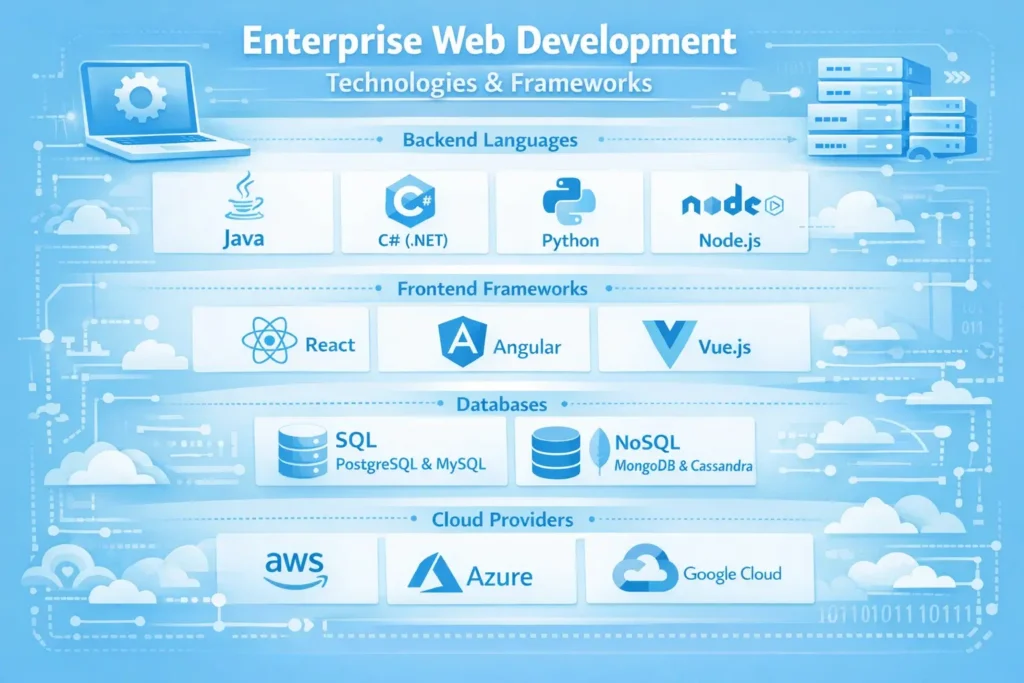
Backend Languages: These technologies power the core logic, scalability, and performance of enterprise web applications.
- Java: The gold standard for enterprise backends due to its stability and multithreading capabilities.
- C# (.NET): ideal for organizations already invested in the Microsoft ecosystem.
- Python: Excellent for data-heavy applications and AI integration.
- Node.js: great for real-time applications and high-concurrency environments.
Frontend Frameworks: These frameworks control the user interface and ensure fast, interactive, and user-friendly experiences.
- React: highly flexible and supported by Facebook (Meta).
- Angular: A comprehensive framework by Google, popular for strict enterprise structures.
- Vue.js: Lightweight and easy to integrate into existing projects.
Databases: These systems store, manage, and retrieve large volumes of enterprise data efficiently and securely.
- Relational (SQL): PostgreSQL and MySQL for structured transactional data.
- NoSQL: MongoDB or Cassandra for unstructured data and massive scaling.
Cloud Providers: These platforms deliver scalable infrastructure, high availability, and global reach for enterprise web solutions.
- AWS, Microsoft Azure, and Google Cloud Platform are the leaders for hosting website development projects.
Enterprise Development Trends and Future Outlook
The landscape of enterprise website development is shifting. To stay ahead, businesses must adopt emerging trends.
- Artificial Intelligence (AI) Integration: AI is no longer sci-fi. Chatbots handle customer service. Machine learning algorithms personalize product recommendations. Enterprise apps are becoming “smart” assistants rather than static tools.
- Progressive Web Apps (PWAs): PWAs offer a native app-like experience in a browser. They load fast and work offline. This reduces the need to develop separate iOS and Android apps, lowering web development costs.
- Low-Code and No-Code Development: Enterprises are using low-code platforms to let non-technical staff build simple internal tools. This frees up professional developers to focus on complex, high-value architecture problems.
- Serverless Computing: Developers are moving away from managing servers entirely. Serverless architecture allows code to run only when triggered. This reduces infrastructure costs and simplifies scaling.
Measuring Success in Scalable Enterprise Web Applications
How do you know if your enterprise web architecture project is a success? You need data.

Key Performance Indicators (KPIs):
- Uptime: Aim for 99.99% availability.
- Page Load Speed: Should be under 2 seconds.
- User Adoption Rate: Are employees actually using the new portal?
- Conversion Rate: For external sites, are visitors becoming customers?
- Error Rate: How often does the system fail?
Regularly reviewing these metrics ensures the software continues to deliver value long after the initial launch.
Conclusion
Enterprise software and web development are complex, high-stakes endeavors. It requires a strategic blend of robust technology, user-centric design, and rigorous security protocols.
By moving away from monolithic legacy systems and adopting scalable, microservices-based architectures, businesses can become more agile. Prioritizing security and accessibility protects the brand and ensures compliance.
Ultimately, successful web application development for enterprises is not just about writing code. It is about building a digital foundation that supports business growth, empowers employees, and delights customers. Investing in the right team, tools, and strategy will yield returns for years to come.
FAQs About Enterprise Web Development
What is enterprise web development?
Enterprise development focuses on building large-scale web applications for complex business needs. These platforms support high traffic, integrate with internal systems, and automate critical workflows. They go far beyond basic websites.
How is enterprise web development different from traditional web development?
Traditional web development focuses on online presence. Enterprise website development focuses on scalability, security, and system integration. It supports millions of users, complex data flows, and continuous updates.
Why do large businesses need enterprise web solutions?
Large organizations need reliable digital systems to manage operations. Enterprise web solutions improve efficiency, reduce manual work, and support global users. They also enhance security and ensure compliance.
What are the key features of enterprise web development?
Core features include scalable architecture, strong security, system integrations, high performance, and role-based access control. User-friendly design and mobile responsiveness are also essential.
How long does enterprise website development take?
Timelines depend on project complexity and scope. Small enterprise projects may take a few months. Large-scale platforms often take six months or longer, including planning, testing, and deployment.