Modern enterprise websites demand more than just content management; they require scalability, flexibility, and speed. By combining WordPress with microservices architecture, organizations can move beyond traditional monolithic limitations and build high-performance digital ecosystems.
This approach enables independent service deployment, seamless integrations, and faster innovation cycles. For agencies and enterprises, it also unlocks opportunities to deliver tailored, scalable solutions across multiple clients and platforms.
As digital expectations continue to rise, adopting a microservices-driven WordPress architecture is no longer optional; it’s a strategic move to future-proof operations. So, let’s look at how it enhances the user experience and maintains a competitive edge in an increasingly complex digital world.
TL;DR: Key Takeaways
- Microservices architecture enhances WordPress by enabling scalability, flexibility, and high performance, allowing businesses to move beyond monolithic limitations.
- Independent deployments accelerate release cycles and reduce operational risks.
- Headless WordPress supports omnichannel delivery through API-driven integrations. Additionally, phased migration ensures minimal disruption and better control over transitions.
- For agencies, it enables efficient multi-client scalability and white-label opportunities.
- Ultimately, aligning architecture with business goals ensures long-term growth, resilience, and competitive advantage.
Microservices Architecture Benefits for WordPress
As WordPress ecosystems grow, traditional architectures often struggle to keep pace.
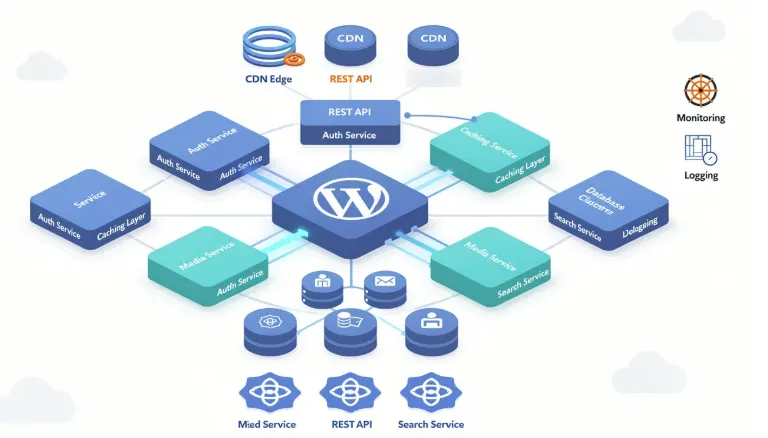
Microservices, however, introduce modularity and flexibility, enabling enterprises and agencies to scale efficiently while maintaining performance and operational agility.
- Improved Scalability and Performance: Microservices enable independent scaling of components. As a result, high-traffic areas, such as search or checkout, can handle load without impacting the entire system.
- Faster, Independent Deployments: Teams can deploy updates to specific services without redeploying the full application. Consequently, this reduces downtime and accelerates release cycles.
- Better Fault Isolation and System Resilience: Failures are contained within individual services. Therefore, issues in one component do not disrupt the overall website experience.
- Flexibility in Technology Stack Selection: Microservices enable teams to choose the best technology for each function. This ensures optimal performance, easier innovation, and long-term scalability.
Business Objectives That Microservices Architecture Supports
As digital ecosystems evolve, businesses must align technology with measurable outcomes. Microservices architecture, therefore, enables organizations to achieve agility, scalability, and reliability while effectively supporting both agency and enterprise growth strategies.
- Reduce Time-to-Market: Independent services allow faster development cycles. Consequently, teams can release new features quickly without waiting for full system updates.
- Enable High-Performance Experiences: Optimized services ensure faster load times. As a result, users benefit from seamless and responsive digital interactions.
- Support Multi-Site Scalability: Agencies can efficiently manage multiple clients. Thus, scaling across sites becomes more streamlined and cost-effective.
- Improve Reliability and Uptime: Isolated services minimize downtime. Therefore, businesses can maintain consistent uptime and meet SLA commitments.
- Enable Modular Growth: Enterprises can expand systems incrementally. This ensures long-term flexibility and sustainable platform evolution.
When to Move From Monolithic to Microservices
As systems grow in complexity, monolithic architectures often become restrictive. Therefore, recognizing key operational and technical signals helps organizations determine when to transition to a microservices-based approach.
- Identifying Performance Bottlenecks: Slow page load times during traffic spikes indicate system strain. Additionally, database contention and backend latency further highlight inefficiencies in handling concurrent requests.
- Recognizing Scaling Pain Points: Difficulty scaling specific components independently can become a limitation. As a result, teams may resort to infrastructure over-provisioning, increasing unnecessary operational costs.
- Measuring Deployment Frequency: Tightly coupled releases often delay deployments. Consequently, production updates become riskier, slowing down innovation and responsiveness to market needs.
- Assessing Team Autonomy Needs: Teams blocked by shared codebases face productivity issues. Therefore, a lack of ownership over services indicates the need for a more modular, autonomous architecture.
Move to Microservices Architecture with Seahawk Media
Transitioning to microservices can be complex. Therefore, Seahawk Media supports enterprise businesses and digital agencies with scalable, white-label WordPress solutions designed to streamline delivery, enhance performance, and drive growth.

Here’s what we offer:
- White-Label Service Packaging: We offer end-to-end services, including WordPress development, site maintenance, and optimization. Moreover, all solutions are fully branded, enabling agencies to deliver seamlessly under their own identity.
- Reseller Pricing & SLA Options: Flexible pricing models are structured based on project volume and complexity. Additionally, tiered SLAs ensure defined uptime, faster support, and reliable response times, thereby improving client satisfaction.
- Partnership Opportunities: Agencies benefit from dedicated support teams that function as an extension of their business. As a result, scalable delivery models help manage multiple clients efficiently.
Planning to Adopt Microservices?
Now is the time to act! Book a free consultation with us to accelerate your business growth.
Comparing Monolithic vs Microservices Architecture
Here is a quick comparison of monolithic vs microservice architecture to help you make the right decision for enterprise WordPress websites.
| Aspect | Monolithic Architecture | Microservices Architecture |
|---|---|---|
| Risk Profile | Monolithic systems suffer from tight coupling, which reduces flexibility and makes changes more complex. They also introduce a single point of failure, increasing overall system risk. | Microservices reduce system-wide risk by isolating services, thereby improving fault tolerance and enabling more resilient architectures. |
| Release Cycle | Deployments are slower because the entire application must be updated together, which delays innovation and increases coordination overhead. | Releases are faster since each service can be deployed independently, allowing continuous delivery and quicker feature rollouts. |
| Deployment Process | Initially, it is easier to manage with lower overhead, but it becomes inefficient as the system scales. | Each service has its own CI/CD pipeline, enabling parallel deployments and greater flexibility. |
| Rollback Strategy | Rollbacks require reverting the entire system, which can be disruptive and time-consuming. | Initially, it is easier to manage with lower overhead, but it becomes inefficient as the system scales. |
| Operational Overhead | Initially easier to manage with lower overhead, but becomes inefficient as the system scales. | While operational complexity is higher, it supports long-term scalability and better resource optimization. |
Headless WordPress and Microservices Integration: Complete Steps
As digital experiences evolve, combining headless WordPress with microservices enables greater flexibility, scalability, and performance. Therefore, businesses can deliver dynamic, API-driven experiences across multiple platforms efficiently and consistently.
Sample Data Flow: WordPress CMS → API Layer → Microservices → Frontend Application
Step 1: Decouple the Frontend from WordPress
Begin by separating the presentation layer from the WordPress backend. Instead of relying on traditional themes, use APIs to deliver content to modern frontend frameworks. This ensures flexibility and independent development cycles.
Step 2: Define Core Business Services
Next, identify which functionalities should be extracted into microservices. Common services include search, authentication, payments, analytics, and notifications. This step helps break down the system into manageable, purpose-driven components.
Step 3: Design Service Boundaries
Then, clearly define the scope and responsibilities of each microservice. Ensure that each service handles a single business capability and operates independently to avoid tight coupling.
Step 4: Build APIs for Each Service
After that, create standardized APIs (REST or GraphQL) for communication between services. Well-defined API contracts ensure consistency, scalability, and easier integration across systems.
Step 5: Implement an API Gateway
Subsequently, introduce an API gateway to act as a single entry point. It manages routing, authentication, rate limiting, and request aggregation, thereby simplifying client interactions.
Step 6: Enable Service Communication
Establish communication patterns between services. Use synchronous APIs for real-time requests and asynchronous messaging (queues/events) for background processes.
Step 7: Set Up Data Management
Ensure each microservice manages its own database or schema. This avoids shared dependencies and improves scalability and fault isolation.
Step 8: Deploy Using Containers
Finally, containerize services using tools like Docker and deploy them via orchestration platforms. This ensures consistency across environments and supports scalable, reliable deployments.
Building a Scalable and Resilient Microservices Ecosystem
To successfully implement microservices with WordPress, organizations must align architecture, teams, and operations. Therefore, focusing on communication, development practices, and system resilience ensures long-term scalability, performance, and reliability.
API Gateway, Communication Patterns & Distributed Systems
An API gateway acts as a centralized entry point, managing routing, authentication, and rate limiting. Moreover, selecting a REST API simplifies standard operations, while GraphQL enables flexible data querying. Additionally, asynchronous messaging supports background tasks, and designing for eventual consistency ensures stability across distributed systems.
Development Teams, Programming Languages & Operations
Defining clear service ownership allows teams to operate independently and efficiently. Furthermore, choosing programming languages based on service requirements enhances performance. At the same time, enforcing coding standards and API contracts ensures consistency, while structured on-call rotations and shared runbooks improve operational readiness.
Continuous Integration, Fault Tolerance & Isolation
Implementing CI/CD pipelines for each service accelerates development and deployment. Consequently, automated testing, especially contract and integration tests, ensures reliability. Meanwhile, circuit breakers enhance fault tolerance, and isolating failures prevents disruptions from cascading across services.
Security, Performance, and Monitoring
Finally, securing APIs through authentication and authorization is critical. Likewise, distributed tracing and centralized logging improve observability. As a result, optimized caching layers across WordPress and microservices significantly enhance overall system performance.
Migration Plan: Phased Microservices Adoption
Adopting microservices requires a structured and low-risk approach. Therefore, a phased migration strategy helps organizations transition smoothly while maintaining system stability, ensuring performance, and minimizing disruptions to ongoing operations.
- Prioritizing Services for Extraction: First, identify non-critical or high-impact components that can be safely decoupled. This approach reduces risk while delivering immediate performance or scalability benefits.
- Containerized Development Environments: Next, implement containerized environments using Docker to ensure consistency across development, staging, and production. As a result, teams can avoid environment-related issues and streamline deployments.
- Controlled Rollouts: Deploy new services behind feature flags to limit exposure. Gradually migrating traffic to microservices ensures stability while enabling quick rollbacks if issues arise.
Finally, validate all changes through comprehensive end-to-end testing in staging environments. Additionally, conduct performance and reliability checks to confirm that new services meet expected standards before full production rollout.
Conclusion
In conclusion, adopting a microservices architecture with WordPress empowers enterprises and agencies to build scalable, flexible, and high-performing digital platforms.
By moving away from monolithic limitations, businesses can accelerate deployments, improve resilience, and deliver seamless user experiences across channels. Moreover, a phased migration approach ensures minimal risk while maximizing long-term value.
For agencies, especially, this model unlocks new revenue streams through scalable, white-label services. Ultimately, success lies in aligning technology with business objectives.
With the right strategy and partner, such as Seahawk Media, organizations can confidently future-proof their digital ecosystem and stay competitive in an increasingly demanding market.
FAQs About Microservices Architecture for WordPress
What are WordPress microservices?
WordPress microservices break a monolithic WordPress site into smaller components, with each service handling a specific task. These different microservices use a modular approach to function independently, enabling independent scaling as the site grows.
How does WordPress integrate with APIs?
The WordPress REST API, a built-in REST API, allows WordPress applications to expose data via REST. As a result, services communicate with other services and external systems through HTTP requests.
When should businesses adopt microservices?
Businesses managing complex sites, complex applications, or scaling mid-sized sites should consider a microservices setup, especially when performance and flexibility become critical in a WordPress project.
How do microservices improve performance?
They enable automatic scaling and scale individual components, such as image processing or processing data, ensuring the entire site performs efficiently under load.
What role do developers play?
Skilled WordPress developers manage to integrate microservices, using different technologies, and ensuring each service aligns with broader web development goals.
How are advanced features handled?
Microservices support payment processing, subscription management, user authentication, and personalized content, making them ideal for e-commerce sites and modern web app experiences.
What ensures scalability and reliability?
A scalable architecture uses service discovery, message brokers, and continuous deployment to ensure that services operate reliably, especially in e-commerce environments.