The free vs paid domain names debate is one of the first decisions you will face when setting up a website. And it matters more than most people realize.
On the surface, free sounds like the obvious winner. But in practice, that decision shapes your online identity, your professional credibility, and even your long-term search engine rankings in ways that are easy to overlook at the start. This guide gives you a straightforward answer so you can make the right call for your business, no matter where you are.
TL;DR: Free or Paid Domain Names
- A free domain is rarely free. It usually falls into three categories. A bundled domain for one year. A subdomain like yoursite.wordpress.com that you do not own. Or a low-quality extension with restrictions
- Paid domains give you full ownership and complete DNS control. They also let you switch hosting providers without ever losing your web address.
- Free subdomains actively hurt your long-term SEO. Every backlink and authority signal you build on a platform subdomain does not transfer if you migrate to a custom domain later, meaning you start from scratch.
- Professional credibility takes a real hit with a free subdomain. Research shows 46% of small businesses say a custom domain significantly boosts their credibility, and mobile users are twice as likely to trust a branded domain over a platform subdomain.
- A paid custom domain unlocks professional email addresses like you@yourbrand.com, which a free subdomain simply cannot support in a meaningful way for a client-facing business.
- A .com domain costs roughly $9-$15 per year. That is the smallest investment with one of the biggest returns for any business building a serious online presence.
What Does Free Domain Name Actually Mean?
Here is something most beginners discover too late: there is no such thing as a completely free domain name in the way most people imagine. “Free” almost always comes with conditions, and those conditions vary widely depending on where you get it.
Free Domains Bundled with a Hosting Plan
This is the most common version. Hosting providers like Hostinger, Bluehost, and DreamHost include a free domain name for the first year when you purchase an annual hosting plan.
The provider absorbs the domain registration cost as an incentive to sign up. Your domain works exactly like a paid one during that first year.
The key thing to understand is that renewal fees kick in from year two. Depending on the registrar, that .com renewal can cost anywhere from $15 to $25 per year. So the domain is not truly free over time. It is a discounted first-year bundle with a service you are already paying for.
Free Subdomains from Website Builders
Platforms like WordPress.com offer a free subdomain as your default web address. Instead of yoursite.com, your online address becomes yoursite.wordpress.com. This is a fundamentally different situation from owning a custom domain, and it comes with real limitations for any business that wants to grow.
Completely Free Domains with Obscure Extensions
Some free domain registrars offer domain names under extensions like .tk or .ml at no cost.
These come with significant drawbacks: limited control over DNS settings, minimal privacy protection, and, in many cases, not actually owning the domain outright. The registrar retains the right to reclaim it. For any serious business use, these free domain options are not worth considering.
Unlock Your Domain’s Potential with Seahawk Media
Transform your premium domain into a high-performing digital asset. Partner with us to maximize revenue and achieve unparalleled growth.
What Do You Actually Get with a Paid Domain Name?
A paid domain name gives you something the free alternatives cannot fully replicate: complete ownership of your own web address with no strings attached.
When you register a paid domain through a reputable domain name registrar, you get full control over your DNS settings, the freedom to move between hosting providers without losing your address, and a clean, professional online identity that belongs entirely to you.
Domain registration typically costs between $9 and $15 per year for a standard .com, making it one of the most affordable investments in your business’s online presence.
You also get the ability to set up professional email addresses tied to your domain, like hello@yourbrand.com, which matters more than most people realize when it comes to how potential customers perceive your business.
Free vs Paid Domain Names: What Actually Changes for Your Business
This is where the real differences show up. Let us go through each one honestly.

Ownership and Full Control
With a free subdomain on a platform like WordPress.com, you do not own your web address. The platform does. If you cancel your plan, miss a payment, or the platform changes its policies, your domain is gone along with everything built around it. Your online identity is essentially rented, not owned.
A paid domain gives you full ownership from day one. You control the DNS records, domain records, and every decision about where they point and how they are managed. That level of full control is a non-negotiable foundation for a business that plans to be around in the long term.
Renewal Fees and the Real Long-Term Cost
Many people look at “free” and stop there. But if you plan to run a real online business, looking at the three-year cost is a better idea.
- A free first-year domain from a bundled hosting plan with a $20 renewal in years two and three still costs you $40 over time.
- A premium domain from a transparent registrar with a consistent $12 renewal costs $36 over the same period and gives you more flexibility.
The unexpected costs come when free domains under obscure extensions suddenly charge fees to maintain ownership, or when platform-bundled free domains jump to premium pricing at renewal with little warning.
Professional Branding and First Impression
Your domain name is often the first impression visitors get of your business. A free subdomain like yoursite.wordpress.com immediately signals to potential customers that you have not invested in your own online presence.
It may seem like a small detail, but research shows that 46% of small businesses say a custom domain is a significant boost to professional credibility. Mobile users are twice as likely to trust a website with a branded custom domain compared to a platform subdomain.
For client-facing businesses, agencies, ecommerce stores, or anyone selling a service online, that first impression significantly impacts whether someone trusts you enough to get in touch or make a purchase.
Transferability and Portability
When your business grows, and you want to move to a faster host or a more capable managed WordPress provider, your domain needs to come with you.
Paid domains registered through established domain registrars can be transferred to any new hosting provider after the standard 60-day lock period.
Many free domain options tied to platforms have significant transfer restrictions. In some cases, the domain cannot be transferred at all without paying a substantial fee, or it remains locked to the platform indefinitely. That is a significant drawback if you ever want more control over your hosting environment.
Professional Email Addresses
A paid custom domain lets you create professional email addresses, such as name@yourcompany.com. This matters greatly when communicating with clients, partners, or customers.
A free subdomain either does not support custom email or requires a paid upgrade to unlock it. Using a Gmail or Yahoo address for business communication while your website sits on a free subdomain sends a consistent signal: this is not a fully invested business.
Does a Free Domain Name Actually Hurt Your Search Engine Rankings?
This is one of the most common questions, and the answer depends entirely on which type of “free” you are using.
Free First-Year Domains are Not an SEO Problem
A custom.com acquired free with a Hostinger or Bluehost hosting plan is treated the same as a paid domain by search engines. There is no SEO penalty for how the domain was acquired.
Google does not know or care whether you paid for registration or got it bundled with hosting. What matters to search engine rankings is your content quality, backlinks, and user experience.
Free Subdomains are a Different Story
When your web address is a free subdomain like yoursite.wordpress.com, search engines treat it as an entirely separate site from any custom domain you register later.
Every backlink you earn, every piece of authority you build on that subdomain, does not transfer automatically when you migrate to a paid custom domain. You lose that accumulated momentum entirely.
Google’s John Mueller has confirmed that free subdomain hosting makes SEO harder by limiting trust signals and domain authority consolidation.
Backlinko’s analysis of millions of search results found that content under a main custom domain consistently outperforms standalone subdomains in organic rankings, particularly for competitive keywords.
If you start on a free subdomain and later migrate to a paid custom domain, you are essentially starting your SEO from scratch.
Domain Extensions and User Trust
Even among paid domains, the extension you choose matters for user perception. Research shows that .com domains are 33% more memorable than other top-level domain extensions.
Familiar domain extensions like .com, .net, and .org carry significantly more trust with potential customers and affect click-through rates in search results.
Since click-through rate and on-page engagement are indirect ranking signals, the trust your domain name inspires eventually feeds back into your search engine rankings.
When Does a Free Domain Option Actually Work?
Not every website needs to be a long-term business asset from day one. There are situations where a free domain name makes genuine sense.
If you are running a personal blog for the first time and are not sure whether you will stick with it, a free first-year domain bundled with a hosting plan from Hostinger or Bluehost gives you a real custom domain without an upfront cost while you find your footing.
If you are a developer or student testing a new site build, a free subdomain is completely fine for that purpose. Short-term campaign microsites or experimental projects with no brand investment attached are also reasonable candidates for free domain options.
The important thing is to go in with a clear plan. Understand the renewal fees before you commit to any bundled hosting plan. Know exactly when the free period ends and what you will pay at renewal.
And if your project turns into something serious, plan the transition to a fully owned paid domain early, before you have built up SEO momentum on a subdomain that you then have to abandon.
When Paying for Your Domain is Non-Negotiable?
For any business with real customers, real revenue, or real growth ambitions, a paid custom domain is non-negotiable. Here is when you should not even consider the free route.
- Client-facing businesses where professional credibility drives conversions need a paid custom domain from the start. E-commerce stores where customer trust directly influences purchase decisions cannot afford the credibility hit of a free subdomain.
- WordPress agencies and freelancers whose own websites are their primary marketing tools need to project complete ownership and professionalism.
- Any WordPress site built on WordPress.org with themes like Astra, Kadence, or Divi, or page builders like Elementor or Beaver Builder, requires its own paid custom domain.
- The self-hosted WordPress.org environment is designed specifically for full control, and pairing it with a free subdomain defeats the purpose entirely.
Seahawk Media works with businesses of every size on WordPress builds and migrations, and a paid custom domain is always the first recommendation made. It is the foundation on which everything else sits: your hosting, your SEO, your professional email, and your brand.
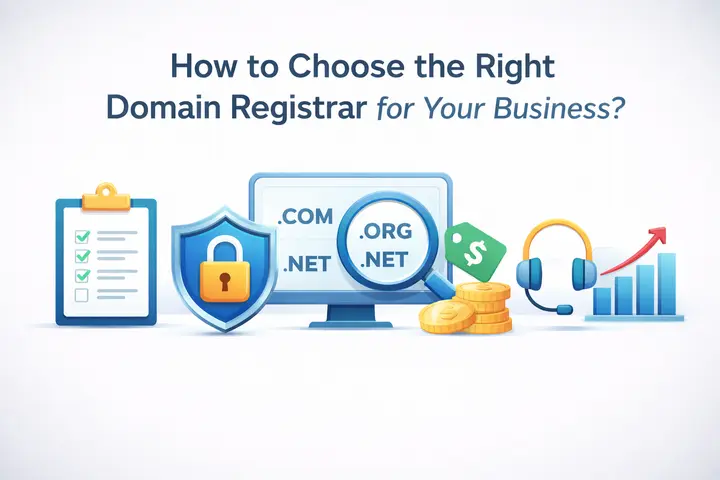
How to Choose the Right Domain Registrar for Your Business?
Once you have decided to go with a paid domain, choosing the right domain name registrar is the next decision. Here is what to pay attention to.
Look Beyond First-Year Pricing
Promotional first-year rates can be very low, sometimes as low as a dollar for a new domain. What matters is the renewal fee in year two and beyond. Always check the renewal pricing before registering. The registrar that looks cheapest on day one is often the most expensive over three years.
Confirm Free Privacy Protection
WHOIS privacy protection keeps your personal contact details out of the publicly accessible domain registration database. Some domain registrars charge an additional cost for this as a separate add-on. It should come included at no extra charge. If a registrar charges separately for privacy protection, look elsewhere.
Check DNS Settings Flexibility
Full access to your DNS settings is essential. You need to be able to point your domain to any hosting provider, set up professional email addresses through a third-party service, and configure DNS records without restriction. Avoid registrars that make DNS management unnecessarily complicated or limited.
Confirm Transfer Flexibility
After the standard 60-day post-registration lock period, you should be free to transfer your domain to any new registrar or hosting provider without paying excessive fees. Check this before you register. Some domain registrars and many free domain options impose long lock-in periods or make transfers prohibitively expensive.
Consider Bundled Hosting Value Carefully
For new websites, a bundled plan can offer strong value. Providers like Hostinger, DreamHost, or Bluehost often include a free domain for the first year. These plans also come with reliable hosting and SSL certificates. Just review the renewal terms beyond year one. Make sure the hosting plan meets your site’s needs before the domain offer influences your decision.
The WordPress Angle: Free Subdomain vs Your Own Domain
For anyone building on WordPress, this distinction is especially important. WordPress.com offers a free subdomain with its free plan, where your address looks like yoursite.wordpress.com. This is fine for hobby blogs with no business purpose.
The moment you are building anything with a business goal behind it, whether that is a portfolio site, a service business site, a WooCommerce store, or a content site you plan to monetize, you need your own paid custom domain on a self-hosted WordPress.org installation.
That setup gives you full ownership of your web address, complete control over your hosting environment, and the ability to use any plugin, theme, or builder you need to grow.
Seahawk Media builds and maintains WordPress sites at every scale. The recommendation is always the same. Start with a paid custom domain that you fully own. It is a small annual investment. But it pays off in professional credibility, stronger SEO authority, and long-term flexibility.
Free Domain vs Paid Domain: Final Thoughts
For anyone building a real business online, a paid custom domain is worth every dollar. It costs less than a takeaway meal per month, and it is the single most important signal of legitimacy your website sends to potential customers and search engines alike.
For short-term projects, personal experiments, or new blogs, a free first-year domain can be a sensible start. It often comes bundled with a reputable hosting plan. Just understand the renewal terms. Know when the free period ends. And have a plan to own your domain as your project grows fully.
The bottom line: don’t let a $10-$12 annual investment hold your business back.
If you are building or migrating a WordPress site, start with the right domain and hosting setup. The team at Seahawk Media is ready to help. We guide you on domain strategy and hosting choices. We also handle full WordPress builds and ongoing maintenance. This way, you can focus on growing your business.
Frequently Asked Questions
Can I transfer a free domain to another hosting provider?
It depends on how you got it. A free first-year domain bundled with a hosting plan from providers like Hostinger or Bluehost can be transferred after the standard 60-day lock period. Free platform subdomains and obscure free domain extensions are often not transferable at all.
How much does a paid domain name actually cost?
A .com domain costs roughly $9 to $15 per year to register and renew through most reputable domain registrars. That works out to less than $1.50 per month, making it one of the most affordable investments for any business building a serious online presence.
Is a free domain name bad for SEO?
A free domain bundled with a hosting plan is not bad for SEO. A free platform subdomain like yoursite.wordpress.com hurts your long-term SEO. Backlinks and domain authority you build there do not transfer when you move to a custom domain. You essentially start from scratch.