If you are looking up law firm website design, you probably have a practical goal in mind. You want the right people to find you online, trust you quickly, and reach out without hesitation.
That sounds simple, but law firm websites have a different job than most business sites. Your visitors often arrive stressed, uncertain, and searching for clarity. Your website has to meet them there.
Here is the part many firms miss. A great law firm website is not just a clean layout with a nice photo and a contact form. It is a client intake tool, a trust builder, and a credibility check all in one place.
When it works, it reduces back and forth, answers key questions before the first call, and nudges the right prospects toward a consultation.
This guide breaks down what makes a law firm website genuinely effective, and how to design one with a clear structure.
Quick Wins: What Actually Makes a Law Firm Website Work
If you do not have time to read the full guide, here are the core takeaways that matter most:
- A great law firm website is built for client acquisition, not just appearance.
- Clear navigation and strong website structure reduce confusion and increase inquiries.
- Mobile friendly websites and fast load times directly impact trust and search rankings.
- Dedicated practice area pages improve law firm SEO and attract targeted traffic.
- Plain language content writing converts better than legal jargon.
- Strategic calls to action support consistent lead generation.
- Strong web design builds credibility within seconds.
- Local SEO helps your firm appear in nearby search results.
- Ongoing updates prevent outdated content from hurting your digital presence.
- Professional law firm website design combines SEO, usability, and conversion strategy.
If your goal is to attract the right clients and grow your legal practice, these fundamentals are non negotiable.
Why Your Law Firm Website Plays a Direct Role in Client Acquisition?
Most people do not hire an attorney the way they buy a product. They look for signals that you are credible, experienced, and safe to talk to.
They also want to know if you handle their exact situation, because legal services feel personal. Your website is where those questions get answered before someone ever speaks to you.
Even when you get referrals, prospects still check your website to validate the recommendation. They want to see who you are, what you specialize in, and how easy it is to reach you.
If the site feels outdated, confusing, or vague, the referral loses momentum. That is the silent cost of a weak website, because you may never know how many people left without contacting you.
Younger audiences are especially likely to judge a firm through its online presence. In Clio’s 2019 Legal Trends Report, 49 percent of Gen Z and 48 percent of Millennials said they care about a lawyer’s website, compared with 34 percent of Gen X and 21 percent of Boomers.
That does not mean older audiences ignore your website. It means the bar is rising as the client mix shifts.
The Shift From Referrals Only to Digital First Discovery
Legal searches often begin with a problem, not a firm name. Someone types a question, checks a few results, and clicks the site that looks most promising.
If your pages explain the issue clearly, show relevant experience, and make next steps obvious, you win attention even if you are not the biggest name in town.
This is also where SEO and design overlap. Search engines reward clarity, structure, and usefulness, and humans do too.
When your practice area pages are thin, your navigation is messy, or your site loads slowly on mobile, you are not just losing rankings. You are losing confidence.
What Potential Clients Subconsciously Look For?
Most visitors will not openly state what they are evaluating, but their behavior reveals it clearly. They want proof that your firm handles cases similar to theirs and reassurance that you are professional and responsive.
Easy access to contact options is equally important, especially because legal stress shortens patience and increases urgency.
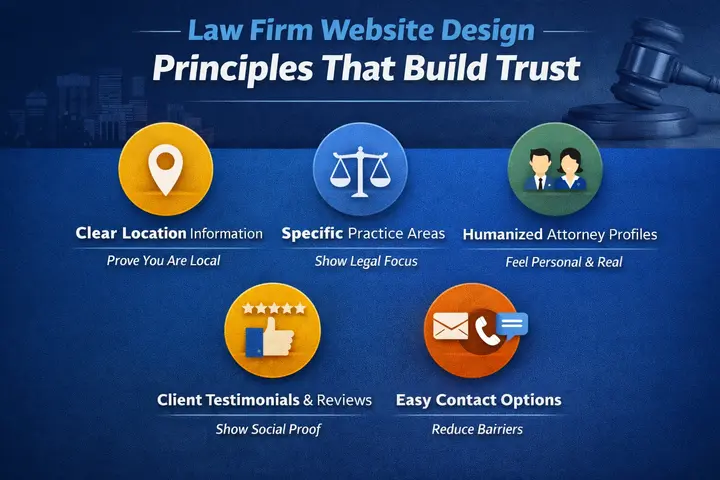
A strong law firm website makes these signals easy to recognize. Clear location details, specific practice areas, and authentic attorney profiles help establish credibility.
Visible but non-intrusive calls to action guide visitors naturally. Together, these elements create a sense of safety that moves someone closer to requesting a consultation.
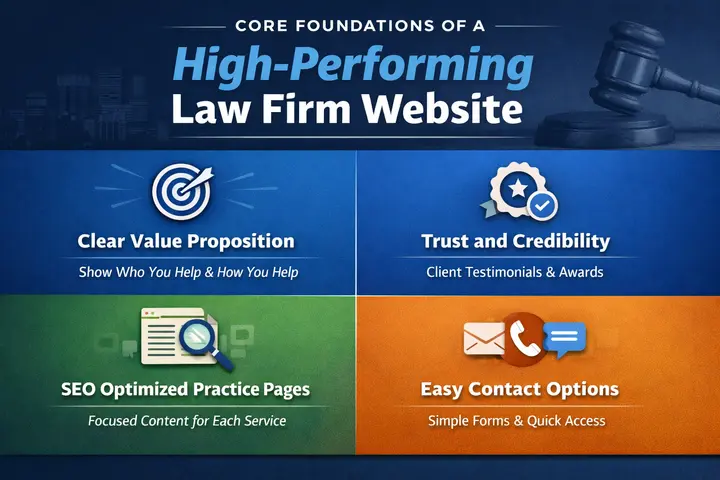
Core Foundations of a High Performing Law Firm Website
Strong foundations determine whether your law firm website converts visitors or quietly loses them. Before visuals or marketing tactics, structure, usability, and performance must work flawlessly.
Clear Site Structure and Navigation
Good navigation is not about creativity. It is about clarity. Visitors should immediately understand what your firm does, whether you handle their issue, and how to contact you.
- Simple menu labels such as Practice Areas, About, Results, Reviews, Blog, and Contact reduce friction and improve usability.
- Clear organization also strengthens SEO. Logical categories, internal links, and consistent page naming help search engines understand your services.
A structured website design supports better indexing, improves rankings, and guides potential clients smoothly toward action.
Mobile Friendly and Responsive Layout
Your law firm website must perform flawlessly on mobile devices.
- Text should be readable, buttons easy to tap, and forms simple to complete. Responsive design ensures your site adjusts smoothly across screen sizes without disrupting usability or clarity.
- Mobile optimization also affects search visibility. Search engines prioritize mobile friendly websites, and slow mobile experiences drive users away.
Many legal searches happen in urgent moments, so a responsive layout ensures clients can quickly find information and contact your firm.
Fast Load Times and Technical Stability
Speed directly impacts trust and conversions. A slow site feels outdated and unreliable, which damages credibility before a visitor even reads your content.
- Fast loading pages keep users engaged and reduce abandonment rates.
- Technical stability also supports long term performance.
- Optimized images, clean code, caching systems, and secure hosting improve reliability and SEO.
A performance focused website design ensures your law firm remains competitive, accessible, and ready to convert visitors into qualified leads.
The Pages Every Great Law Firm Website Must Include
The right pages answer client questions, support SEO, and guide visitors toward contacting your firm. Each page should serve a clear purpose and move prospects closer to a consultation.
- Homepage That Explains Who You Help and How: Your homepage should quickly show who you serve, what legal problems you solve, and what to do next. Use clear practice signals, a short value statement, visible contact options, and one primary call to action that guides visitors toward a consultation.
- About Page That Builds Human Trust: Your About page should feel personal and approachable. Explain why you practice law, how you support clients, and what makes your team different, so visitors feel confident, understood, and comfortable reaching out.
- Practice Area Pages Built for Search and Clarity: Create separate pages for each major service. Explain the issue in plain language, who the service is for, what outcomes look like, and how to get started. Focused pages improve SEO and attract qualified leads.
- Contact Page That Removes Friction: Make it effortless to contact your firm. Display phone number, email, address, hours, and a simple form. Add a short note explaining what happens after submission to reduce hesitation.
- Blog or Resource Section: Use your blog to answer common legal questions, explain processes, and share practical guidance. Helpful content builds trust, supports SEO, and positions your firm as a reliable authority.
How Seahawk Media Helps Law Firms Build High Converting Websites?
Seahawk Media specializes in building performance driven WordPress websites tailored to professional service firms. For law firms, that means combining strategic web design, strong SEO foundations, and conversion focused layouts.
Our approach includes:
- Discovery sessions to understand your practice and goals
- Custom design aligned with your firm’s brand
- Structured content planning for each practice area
- Technical optimization for speed and security
- Ongoing SEO and performance support
We do not rely on cookie cutter templates. Instead, we create custom solutions designed to attract the right clients and support long term growth.
By blending strong design, structured content, and measurable marketing systems, we help firms increase visibility, generate qualified leads, and strengthen their position in a competitive legal market.
Build a Credible Law Firm Website That Drive Results
Seahawk Media builds SEO-ready, conversion-focused law firm websites that attract clients and drive consultations.
What Makes Law Firm Website Content Actually Convert?
A beautiful layout alone does not convince someone to contact a law firm. Content does the heavy lifting.
It explains your services, demonstrates your expertise, answers unspoken questions, and guides potential clients toward action.
In effective law firm website design, content and web design must work together. One without the other limits results.
Great website content starts with understanding intent. People arrive at legal websites because they have a problem and want reassurance that someone can help.
They are not looking for academic explanations. They are looking for clarity, empathy, and direction. That is why strong content writing focuses on real language, simple explanations, and practical next steps.
At a minimum, high converting law firm content should consistently:
- Explain legal processes in plain English
- Address common client fears and misconceptions
- Set realistic expectations about timelines and outcomes
- Show how your firm supports clients at each stage
- Guide readers toward the next step
In addition, content must support both search engine optimization and human readability at the same time. Pages that rank well but fail to engage will not generate leads.
Pages that read well but lack SEO structure will struggle to appear in search results. The balance between these two elements is what separates average law firm websites from high performing ones.
Writing for Real People, Not Legal Peers
Many law firm websites sound like they were written for other lawyers. Long sentences, technical phrasing, and heavy legal terminology may feel professional, but they often confuse visitors. Confusion creates hesitation, and hesitation stops conversions.
High-performing law firm web content uses plain language. It explains legal concepts in everyday terms. It avoids unnecessary jargon.
This approach does not diminish credibility. Instead, it shows confidence and communication skill, which are two traits clients value highly.
Strong content writing for law firms also:
- Uses short, clear sentences
- Breaks complex ideas into simple steps
- Avoids legal citations unless they truly help the reader
- Focuses on client outcomes instead of legal theory
Another important point is tone. Content should feel calm, supportive, and steady. Aggressive sales language can make people uncomfortable, especially when they are already under stress. A measured, helpful tone signals that your firm focuses on solving problems, not just closing deals.
When Seahawk Media builds a law firm website, content strategy always begins with user questions:
- What does this process look like?
- How long does it usually take?
- What should I expect after contacting you?
- What will this likely cost?
Answering these questions clearly builds trust before the first call ever happens.
Showing Empathy Before Selling Services
Legal problems are emotional. Someone dealing with a divorce, criminal charge, or business dispute is often anxious. If your website jumps straight into selling without acknowledging that emotional state, it feels disconnected.
Effective lawyer website design places empathy near the top of important pages. Simple statements that acknowledge stress, uncertainty, or urgency help visitors feel understood.
Once they feel understood, they are more open to reading about your services and expertise. Empathy driven content often includes:
- Recognition of common frustrations
- Reassurance that help is available
- Clear explanation of what happens next
- Emphasis on communication and support
Empathy should also appear in how you describe outcomes. Instead of only listing what you do, explain how your work makes clients’ lives easier or more stable. This shifts the focus from technical tasks to real benefits.
Strong Calls to Action on Every Important Page
A great law firm website never leaves visitors guessing about what to do next. Each key page should guide users toward a clear action, such as calling your office, submitting contact forms, or scheduling a consultation.
Effective calls to action usually:
- Use simple, direct language
- Appear multiple times on long pages
- Stand out visually without feeling pushy
- Match the intent of the page
It also helps to vary placement. A call to action near the top of a page captures visitors who are ready immediately. Another call to action near the bottom supports visitors who need more information first. This layered approach improves lead generation and captures different types of decision makers.
Law Firm Website Design Principles That Build Trust
Trust is the foundation of legal marketing. People do not hire law firms they do not trust. Design plays a major role in how that trust is formed.
Strong web design communicates professionalism without feeling cold. It reflects the firm’s brand, aligns with the legal industry, and supports usability at the same time.
Well designed law firm websites tend to share these characteristics:
- Clean and uncluttered layouts
- Consistent colors and fonts
- Clear navigation paths
- Prominent contact information
- Balanced use of images and text
Beyond visuals, design also shapes how easy it feels to move through the site. Smooth navigation, predictable layouts, and consistent spacing reduce mental effort. The less work a visitor has to do, the more likely they are to stay.
Clean Layouts and Readable Typography
Crowded pages overwhelm visitors. Clean layouts create breathing room and make content easier to digest. Headings, subheadings, and white space help readers scan and understand information quickly.
Typography also matters more than many firms realize. Fonts should be easy to read on desktops, tablets, and mobile devices. Text that strains the eyes creates friction, and friction pushes visitors away.
Good typography choices typically include:
- Font sizes large enough for comfortable reading
- Adequate line spacing
- High contrast between text and background
- Limited use of decorative fonts
Professional Photography and Visual Consistency
Images shape first impressions. Stock photos that look generic can make a firm feel cookie cutter. Custom photos of attorneys, staff, and office environments add authenticity and help humanize your practice.
Visual consistency matters just as much. Colors, spacing, and design elements should feel unified across pages. This creates a polished digital presence and reinforces that your firm pays careful attention to detail.
Consistent visuals also:
- Improve perceived professionalism
- Strengthen brand recognition
- Make pages feel cohesive
Visual Hierarchy That Guides Attention
Visual hierarchy tells visitors where to look first, second, and third. Headlines, subheadings, and buttons should naturally draw the eye through each page.
Good hierarchy supports both usability and search engine understanding. Search engines analyze headings to interpret page topics, which directly affects search results.
Hierarchy also helps accessibility. Screen readers rely on heading structure to move between sections, so clean organization benefits all users.
SEO Essentials for Law Firm Websites
A law firm website cannot generate consistent leads without visibility. That visibility comes from search engine optimization.
SEO ensures your site appears when people perform online searches for legal help. Without it, even the best design will struggle to attract traffic.
Strong law firm SEO combines technical optimization, strategic content, and continuous refinement. It is not a one-time task. It is an ongoing system that supports long-term growth.
Keyword Research Based on Client Intent
Effective SEO begins with understanding how potential clients search. Some queries are broad, while others are highly specific.
A person searching “divorce lawyer near me” has a different intent than someone searching “how long does divorce take in Texas.”
Smart keyword strategy focuses on:
- Service specific queries related to your practice areas
- Location based searches that support local SEO
- Question based searches that allow educational content
- High intent keywords that signal readiness to hire
When your site creates pages aligned with these patterns, you increase your chances of appearing in relevant search results and attracting the right clients.
On Page Optimization
On page SEO ensures each page communicates clearly with both users and search engines. Titles, meta descriptions, structured headings, and internal links help search engines understand your content.
Well optimized pages typically include:
- Clear H1 and H2 structure
- Naturally integrated keywords
- Internal links between related services
- Optimized images with alt text
- Strong calls to action
Pages that are properly structured are easier to crawl, easier to read, and more likely to rank. Over time, this increases traffic and supports steady lead generation.
Local SEO Signals
Most law firms serve specific geographic areas. That is why local SEO is critical. It helps your firm appear in map listings and local pack results when someone searches nearby.
Local optimization includes:
- Fully optimized Google Business Profile
- Consistent name, address, and phone number across directories
- Collection of client reviews
- Location pages where appropriate
Local visibility directly influences how many nearby clients discover your firm.
Technical SEO Health
Technical SEO focuses on performance, structure, and security. A slow or unstable site can damage rankings even if content is strong.
Technical best practices include:
- Fast loading pages
- Secure HTTPS configuration
- Clean URL structure
- Proper indexing and sitemap setup
- Mobile responsiveness
This is where working with experienced SEO experts or professional SEO services becomes valuable. Ongoing monitoring ensures your site remains healthy as algorithms evolve.
DIY Website Builders vs Hiring a Professional Agency
Some small law firms begin with DIY website platforms. These tools allow firms to create a basic website quickly and affordably. For new practices with limited budgets, this can be a reasonable starting point.
However, DIY tools often come with limitations that affect growth. Common limitations include:
- Restricted customization
- Limited SEO flexibility
- Slower performance
- Generic, cookie cutter templates
- Minimal scalability
As your firm grows, these constraints can prevent you from fully optimizing your digital presence.
Working with a professional agency provides deeper strategy and customization. A dedicated design team considers branding, usability, SEO, and performance together rather than treating them as separate elements.
Professional web design also supports:
- Custom layouts aligned with your firm’s positioning
- Integrated analytics and call tracking
- Conversion focused page structure
- Scalable architecture for future expansion
A properly built law firm website becomes a growth asset rather than a simple brochure.
What to Look for When Choosing a Law Firm Web Design Partner
Not all agencies understand the legal industry. When selecting a partner for law firm website design, evaluate both experience and process.
A strong web design partner should demonstrate:
- Experience working with law firms or professional service businesses
- A clear design process from discovery to launch
- Understanding of law firm SEO and content strategy
- Transparent timelines and pricing
- Long term ongoing support
Ask about how they handle website redesign projects, how they approach search engine optimization, and how they ensure your site remains competitive over time.
The right partner focuses not just on visuals, but on business results. Your website should help your firm succeed, attract more clients, and strengthen your digital authority.
Common Law Firm Website Mistakes to Avoid
Many firms unknowingly limit performance due to avoidable issues. Even modern looking sites can underperform if strategy is missing.
Common mistakes include:
- Hidden contact information
- Overly complex navigation
- Outdated content that weakens credibility
- Slow loading pages
- Generic messaging that does not differentiate the firm
Another major issue is neglecting updates. A website is not a one-time launch. It requires maintenance, content updates, SEO adjustments, and performance monitoring. Without careful attention, even a strong launch can fade over time.
Final Thoughts
A great law firm website is not about trends or flashy graphics. It is about clarity, trust, and usability. When your website answers real questions, reflects professionalism, and supports SEO, it becomes a powerful growth engine.
If your goal is to attract the right clients and build a modern firm that stands out in search results, investing in thoughtful website design is one of the smartest decisions you can make.
FAQs about Law Firm Website Design
How often should a law firm website be updated?
A law firm website should be reviewed at least quarterly for content accuracy, SEO improvements, and technical health. Blog content can be updated or added monthly, while design refreshes or usability improvements are typically needed every few years.
How much does law firm website design usually cost?
The cost of law firm website design depends on complexity, number of pages, custom features, and SEO requirements. Basic sites may cost a few thousand dollars, while fully custom, SEO-driven websites with advanced functionality can range higher based on scope.
What is the best platform for law firm website design?
WordPress is widely considered the best platform for law firm websites because it is flexible, SEO-friendly, and easy to scale. It allows full control over design, content, and functionality, while supporting integrations for contact forms, analytics, security, and performance optimization.