
Magento is built for large ecommerce stores that need advanced features and high scalability. WooCommerce is a WordPress-based solution made for small to mid-sized businesses that want flexibility, lower costs, and strong SEO control. Magento vs WooCommerce depends on your business size, budget, and technical needs.
Choose Magento if you handle large catalogs, high traffic, or complex setups. Choose WooCommerce for an easier, more flexible, and cost-effective way to grow your store.
TL;DR:
- Magento is a powerful ecommerce platform built for large, complex, and high-traffic online stores.
- It offers advanced features, high scalability, and full control over customization and performance.
- Magento requires technical expertise and comes with higher development and maintenance costs.
- WooCommerce is a WordPress plugin that turns your site into a flexible ecommerce store.
- It is easy to use, cost-effective, and ideal for small to mid-sized businesses.
- WooCommerce is best for SEO-focused, content-driven, and growing online stores.
What is Magento: Features and Use Case
Magento, now known as Adobe Commerce, is an ecommerce platform designed for large, complex online stores. It offers advanced features, full customization, and strong control over store performance, payments, and product management.
Its biggest strength is scalability. Magento can handle large catalogs, high traffic, and complex business needs, making it ideal for enterprise-level stores and fast-growing brands.
However, Magento requires technical expertise and a higher investment of time. Setup, development, and maintenance costs can be high, which makes it less suitable for beginners or small businesses.
What is WooCommerce: Features and Use Case
WooCommerce is a WordPress plugin that turns your website into a fully functional ecommerce store. It is simple to set up, highly customizable, and widely used by small- to mid-sized businesses.
It offers core ecommerce features such as product management, payments, and shipping, along with thousands of plugins for added functionality. WooCommerce is also strong for SEO since it runs on WordPress.
WooCommerce is free to start, but costs depend on hosting, themes, and plugins. It is best for businesses that want a cost-effective, easy-to-manage, and content-friendly ecommerce solution.
Build an Online Store That Ranks and Converts
If you want a flexible and scalable ecommerce solution, choose WooCommerce. We can help you build, customize, and grow your store with confidence.
Magento vs WooCommerce: Quick Summary
Here’s a quick overview of both these eCommerce platforms for building an online store.
| Feature | Magento | WooCommerce |
|---|---|---|
| Best For | Enterprise stores | Small to mid-sized stores |
| Pricing | Expensive | Affordable |
| Ease of Use | Complex | Easy |
| SEO | Strong | Very flexible |
| Scalability | Excellent | Good with setup |
| Performance | High | Depends on hosting |
Key Features Comparison of Magento and WooCommerce
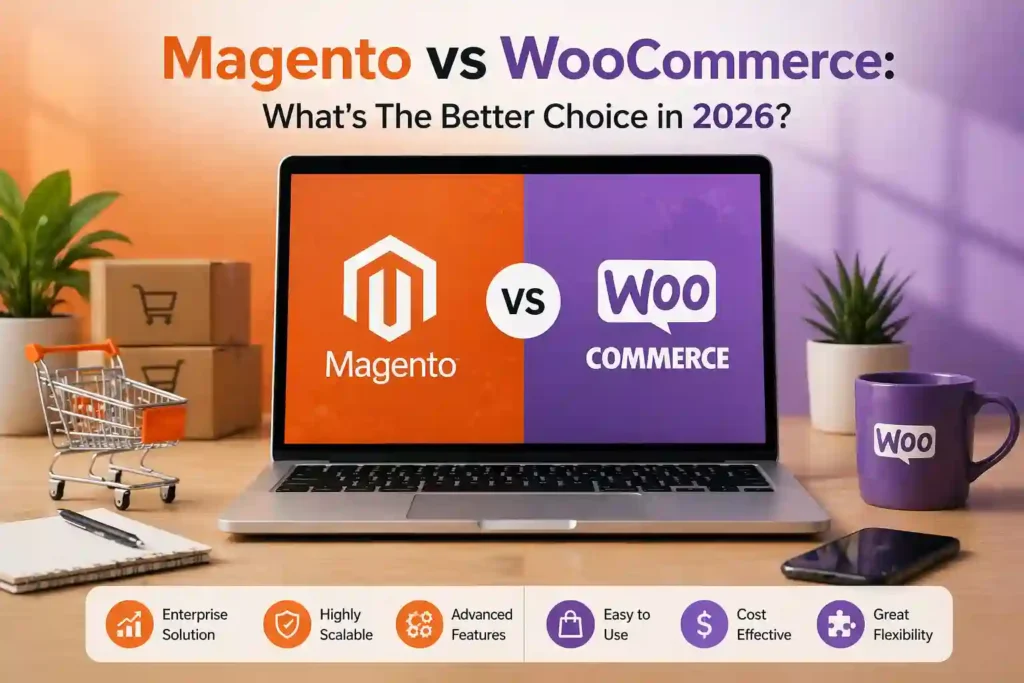
Magento vs WooCommerce compares enterprise power with flexibility and ease of use. Magento is built for large, complex ecommerce operations, while WooCommerce is designed for flexible, cost-effective, and content-driven stores. Your choice depends on scale, budget, and technical needs.
Pricing: Which Platform is More Cost-Effective?
Magento is a premium ecommerce platform with significantly higher costs. Adobe Commerce pricing can start from around $2,000 per year and increase based on hosting, development, and business requirements. You will also need developers, which adds to long-term expenses.
WooCommerce is free to start, but costs come from hosting, premium themes, and plugins. Most small- to mid-sized stores spend between $100 and $ 500 per year, depending on features and scale. It allows you to control costs as you grow.
Magento works best for businesses with larger budgets and complex needs. WooCommerce is ideal if you want a cost-effective and flexible setup that grows with your store.
Verdict: Magento is expensive but powerful. WooCommerce is affordable and flexible.
Ease of Use: Which Platform is Easier?
Magento is complex and requires technical knowledge to set up and manage. Its admin panel can feel overwhelming for beginners, and most customizations require developer support. It is designed for businesses with technical resources that need full control.
WooCommerce is much easier to use, especially if you are already familiar with WordPress. The interface is intuitive, and you can manage products, orders, and content without coding. Most features can be handled through plugins.
Magento offers more control but comes with a steep learning curve. WooCommerce is faster to set up and easier to manage for most users.
Verdict: Magento is powerful but complex. WooCommerce is simple and beginner-friendly.
SEO and Marketing: Which Performs Better?
Magento provides robust built-in SEO features, including customizable URLs, metadata, and integration with analytics tools. It also supports advanced marketing features like promotions, segmentation, and upselling, which are useful for large ecommerce operations.
WooCommerce stands out for SEO because it runs on WordPress. You can use plugins like Rank Math or Yoast SEO to control every aspect of optimization, including content, schema, and technical SEO. This makes it highly effective for content-driven strategies.
Magento is strong for structured ecommerce SEO. WooCommerce offers more flexibility and long-term organic growth potential.
Verdict: Magento is strong out of the box. WooCommerce gives deeper SEO control.
Security and Scalability
Magento offers enterprise-level security with built-in tools such as SSL, two-factor authentication, and regular security updates. It is designed to handle large-scale operations with high traffic and complex product catalogs without performance issues.

WooCommerce also offers strong security, but it depends on your hosting provider and the plugins you use. Tools like Wordfence or iThemes Security help maintain protection. Scalability depends on how well your site is optimized and hosted.
Magento is more reliable for large-scale growth and enterprise needs. WooCommerce works well for small to mid-sized stores when properly set up and optimized.
Verdict: Magento is built for scale and security. WooCommerce depends on setup quality.
Performance and Speed: Which Platform Handles Traffic Better?
Magento is built for high performance and can handle large volumes of traffic and products. It uses advanced caching and a scalable architecture, making it suitable for enterprise stores. However, performance depends on proper hosting and configuration.
WooCommerce performance depends heavily on your hosting environment and on your optimization efforts. With the right plugins and caching tools, it can deliver fast load times for most small to mid-sized stores.
Magento performs better under heavy loads and complex setups. WooCommerce performs well when optimized correctly for moderate traffic levels.
Verdict: Magento handles heavy traffic better. WooCommerce depends on hosting and optimization.
Support and Community: Where Do You Get Better Assistance?
Magento offers structured support, especially for enterprise users. It also has a strong ecosystem of developers and partners who provide technical help and advanced solutions.
WooCommerce relies more on community support, forums, and plugin developers. Since it is built on WordPress, it benefits from a large global community and extensive documentation.
Magento is better for direct and structured support. WooCommerce offers flexibility and access to a wider community of users and developers.
Verdict: Magento provides dedicated support. WooCommerce offers strong community support.
Mobile Optimization: Which Platform Performs Better on Mobile?
Magento supports responsive themes and advanced mobile commerce features, including mobile apps. This allows businesses to deliver a seamless mobile shopping experience across devices.
WooCommerce is also mobile-friendly and supports responsive themes. You can further enhance mobile performance using plugins for mobile optimization, payments, and notifications.
Both platforms perform well on mobile, but Magento offers more advanced capabilities for large-scale mobile commerce strategies.
Verdict: Both are mobile-friendly. Magento supports more advanced mobile setups.
Which Platform Should You Choose Based on Your Needs?
Magento is best for large, complex ecommerce stores, while WooCommerce is better for flexible, cost-effective, and SEO-driven businesses.
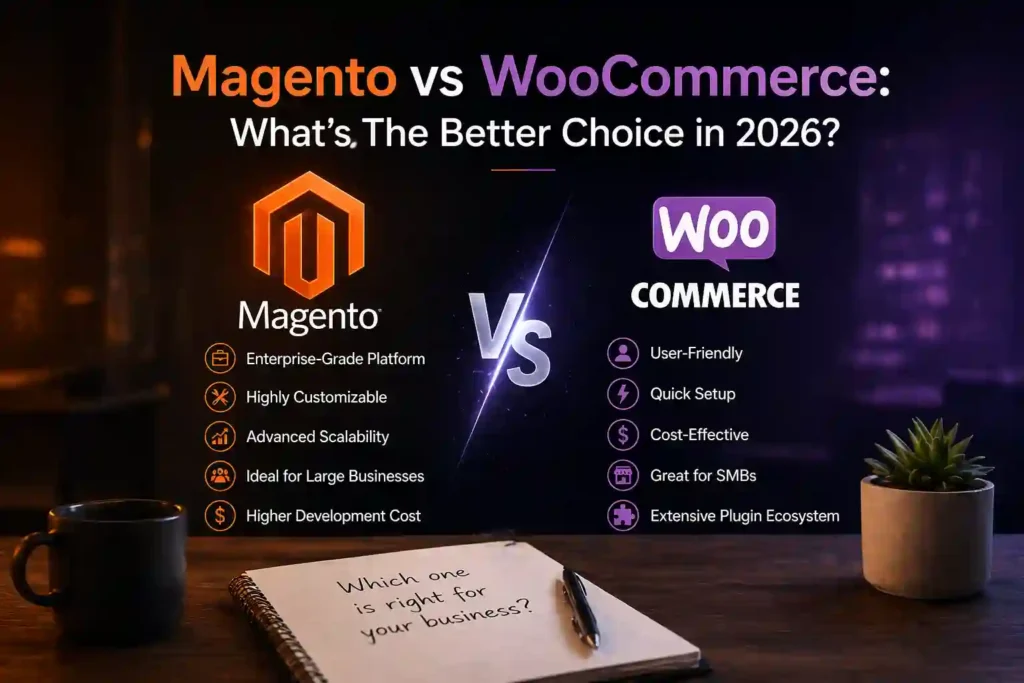
Choosing between Magento and WooCommerce depends on your store size, growth stage, and technical capability.
Magento is built for large-scale ecommerce operations that need deep customization and high performance. WooCommerce is designed for flexibility, lower costs, and easier management, especially for content-driven businesses.
Choose Magento if:
- You manage a large ecommerce store with high traffic or 1,000+ products
- You need advanced features, custom integrations, or multi-store setups
- You have a development team for setup, scaling, and maintenance
Choose WooCommerce if:
- You want a simple and flexible ecommerce setup without heavy technical work
- Your strategy focuses on SEO, blogging, and organic traffic growth
- You need a cost-effective platform that scales gradually with your business
Verdict: Magento fits complex, enterprise-level needs. WooCommerce fits flexible, SEO-driven, and growing stores.
Real Use Cases: Magento vs WooCommerce
Magento handles large-scale and complex ecommerce operations, while WooCommerce performs better for smaller, content-driven, and budget-conscious stores.
Real-world scenarios show how each platform performs across business types, budgets, and scales. Magento is designed for high performance and complexity, while WooCommerce is built for flexibility and faster execution.
- A large ecommerce brand with 10,000+ products and high traffic → Magento handles scale and performance better.
- A content-driven ecommerce store focused on SEO and blogging → WooCommerce performs better due to WordPress integration.
- A startup or small business with a limited budget → WooCommerce is easier to launch and maintain.
- A fast-scaling or enterprise business with complex operations → Magento supports advanced customization and integrations.
Verdict: Magento is better for scale and complexity. WooCommerce is better for flexibility, cost control, and content-driven growth.
Conclusion
Magento is the better choice for large ecommerce businesses that need scalability, advanced features, and full control over performance and customization. It is built for enterprise-level operations where complexity and growth demand a powerful system.
WooCommerce is the better choice for small to mid-sized businesses that want flexibility, lower costs, and strong SEO through WordPress. It allows you to launch faster, manage easily, and scale without heavy technical overhead.
If your priority is enterprise performance and long-term scalability, choose Magento. If your priority is ease of use, cost efficiency, and content-driven growth, choose WooCommerce.
Frequently Asked Questions
Which is better for ecommerce, Magento or WooCommerce?
Magento is better suited to large ecommerce websites that require advanced features, scalability, and custom development. WooCommerce is better for small to mid-sized online stores that want flexibility, lower costs, and strong SEO with WordPress.
Is Magento better than WooCommerce for large online stores?
Yes, Magento is better for large online stores with high traffic and complex product catalogs. It is designed for enterprise ecommerce and can handle scalability, integrations, and performance more efficiently than WooCommerce.
Is WooCommerce better than Magento for SEO?
WooCommerce is generally better for SEO because it runs on WordPress and supports plugins like Rank Math and Yoast SEO. This provides better control over content, metadata, and on-page optimization than Magento.
Which is cheaper: Magento or WooCommerce?
WooCommerce is cheaper for most businesses because it is free to get started and has flexible pricing. Magento requires higher investment for hosting, development, and maintenance, especially for Adobe Commerce setups.
Which platform is easier to use, Magento or WooCommerce?
WooCommerce is easier to use, especially for beginners and small business owners. Magento is more complex and requires technical expertise or a development team to manage and maintain the store.
Can WooCommerce handle large ecommerce websites like Magento?
WooCommerce can handle large ecommerce websites with proper hosting, caching, and optimization. However, Magento is better suited for enterprise-level ecommerce businesses that need advanced scalability and performance.


