Directus vs WordPress Headless comes down to performance, scalability, and how easily you can build and manage your project. Directus performs better for data-heavy systems with faster API handling, while WordPress Headless is easier to use and delivers faster SEO results for content-driven websites.
If you are deciding between the two, the key question is how each platform performs in real-world use cases. This guide compares Directus and WordPress Headless across API speed, frontend performance, SEO readiness, scalability, and development effort so you can choose the right setup for your project.
TL;DR: WordPress Headless and Directus at a Glance
- WordPress Headless is better for content-driven projects and faster SEO results.
- Directus is ideal for custom systems that need full backend control.
- WordPress is easier for most teams to build, manage, and scale.
- Directus offers more flexibility but requires a stronger development effort.
- WordPress offers built-in SEO benefits with minimal setup.
- Directus scales better for complex, data-heavy applications.
What is Directus and How Does it Work?
Directus is an API-first CMS that turns your database into a flexible content platform without forcing a fixed structure. It sits directly on top of your SQL database and provides a clean admin interface for managing content while maintaining full control over your data model.
You define your schema, not the CMS. Directus reads your database and instantly creates APIs for every collection and field. This makes it ideal if you want complete ownership, custom workflows, and the freedom to build without CMS limitations.
It is headless by default, so there is no built-in frontend. You can deliver content anywhere via REST or GraphQL APIs, making Directus a strong choice for complex apps, multi-platform systems, and developer-first teams.
When Should You Choose Directus CMS?
Directus is built for projects where data structure, flexibility, and control matter more than quick publishing. It works best when you need a custom backend that adapts to your system, not the other way around.
If your use case goes beyond a typical website, Directus gives you the freedom to build without limitations.
- Data-Heavy Applications: Directus handles complex datasets and relationships smoothly because it works directly with your database. This makes it ideal for SaaS products, dashboards, and platforms that require large volumes of data to move quickly and remain structured.
- Custom Systems: You can design your own schemas, workflows, and permissions without being restricted by CMS rules. This gives you full control when building unique platforms that require custom logic and backend behavior.
- Internal Tools: Directus includes a ready-to-use admin panel, making it ideal for internal systems such as CRMs, inventory tools, or team dashboards. You save time while still maintaining deep control over data and access.
- Multi-Platform Projects: Directus makes it easy to deliver content across platforms such as the web, mobile apps, and IoT systems via APIs. This is useful when your content needs to stay consistent across different channels.
- Enterprise-Grade Systems: Directus supports advanced permissions, workflows, and integrations, making it suitable for large-scale applications that require strict control and scalability.
Who Should Choose Directus?
Choose Directus if your project needs a backend that is built around data, not just content publishing. It works best for teams that need full schema control, custom workflows, and a flexible API-first setup.
You should choose Directus if you need:
- Data-heavy applications with complex relationships, custom fields, and structured content models.
- Full control over your database schema, permissions, and backend logic.
- API-first architecture for web apps, mobile apps, dashboards, or multi-platform systems.
- Custom workflows and integrations that go beyond a standard content website.
- A scalable backend for enterprise platforms, internal tools, or SaaS products.
Directus is the better fit for developer-led teams building custom systems where backend flexibility and long-term control matter more than quick publishing.
What is WordPress Headless and How Does it Work?
WordPress Headless means you use WordPress only as a backend to manage content while the frontend is built separately using frameworks like React or Next.js. You keep the familiar WordPress dashboard but remove the theme layer completely.
Instead of rendering pages through WordPress, your frontend fetches content via APIs and displays it independently. This improves performance, flexibility, and scalability, especially for modern web applications.
WordPress acts as a content hub where you manage posts, pages, and media, while APIs like REST API or WPGraphQL deliver that content to your custom frontend. This setup blends WordPress ease with modern development power.
When Should You Choose WordPress Headless?
WordPress Headless is the right choice when your focus is on content, SEO, and fast execution. It combines a familiar CMS with modern frontend performance, making it easier to build and scale content-driven projects.
If your goal is to launch quickly and rank on search engines, WordPress gives you a strong advantage.
- Content-Driven Websites: WordPress is built for publishing. You can easily manage blogs, pages, and media, making it ideal for websites with frequent content updates.
- SEO-Focused Projects: Built-in SEO tools and plugins help you optimize metadata, schema, and indexing without technical effort. This makes it easier to rank faster and maintain search visibility.
- Marketing Websites: WordPress allows you to create landing pages, run campaigns, and integrate tools quickly. It keeps development simple so you can focus on conversions and growth.
- Fast Time-to-Market: WordPress helps you launch projects quickly with minimal setup. You can build and deploy faster compared to fully custom systems.
- Client-Friendly Projects: The familiar WordPress dashboard makes it easy for non-technical users to manage content. This is ideal for agencies and businesses that need simple content workflows.
Need Expert WordPress Development for Your Headless Project?
If you are choosing WordPress headless for better performance, our team can help you build a fast, scalable, and custom setup.
Who Should Choose WordPress Headless?
Choose WordPress Headless if your project is content-driven and you want a faster way to build, manage, and scale without losing SEO advantages. It works best for teams that need a familiar editorial workflow with a modern frontend.
You should choose WordPress Headless if you need:
- A content-focused CMS for blogs, marketing sites, media platforms, or publishing workflows.
- Faster SEO execution with easier metadata management, plugins, and content optimization.
- A familiar dashboard that editors, marketers, and clients can use without technical friction.
- Faster project delivery with a large plugin ecosystem and a lower development barrier.
- A modern frontend stack like Next.js, while keeping WordPress as the content backend.
WordPress Headless is a better fit for teams that want strong content operations, easier SEO management, and faster time-to-market.
Directus vs WordPress Headless: Performance Comparison
This section compares Directus and WordPress Headless across the performance factors that matter most: API speed, frontend speed, scalability, database efficiency, and SEO readiness.
| Factor | Directus | WordPress Headless |
|---|---|---|
| API Speed | Faster | Moderate |
| Scalability | High | Medium-High |
| Setup Complexity | High | Medium |
| SEO Readiness | Low | High |
You will see real differences in API response time, database handling, and frontend performance. Each factor directly impacts how fast your site loads and how well it scales under traffic.
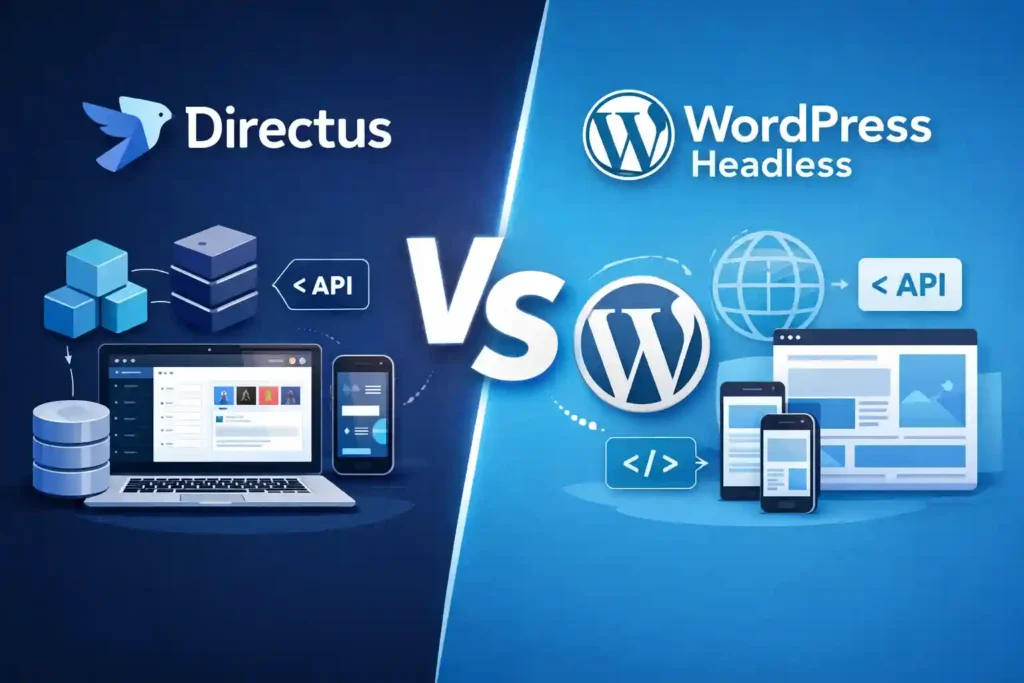
Speed and Load Time
Directus delivers faster raw API response times by connecting directly to your database without heavy processing layers. It skips unnecessary abstraction, so data moves faster from the database to your frontend.
WordPress Headless adds an extra layer between your database and API output. This can slow things slightly, especially if you use multiple plugins or complex queries. However, frontend frameworks like Next.js can offset this with optimized rendering.
Verdict: Directus keeps backend response time lean and predictable, while WordPress relies more on frontend optimization to achieve similar speed.
Scalability and Traffic Handling
Directus scales horizontally with ease because it runs as a lightweight API layer. You can distribute load across multiple servers without worrying about CMS limitations. This makes it strong for high-traffic apps and enterprise use cases.
WordPress Headless can also scale, but it needs more effort. You must optimize hosting, caching, and database queries to handle high traffic efficiently. Without proper setup, performance can drop under load.
Verdict: Directus gives you a cleaner scaling path with fewer bottlenecks, while WordPress requires careful infrastructure planning. Both can handle traffic well, but Directus does it with less complexity. Directus has fewer dependencies and a smaller attack surface, while WordPress requires ongoing updates and plugin management to stay secure.
Database Performance
Directus runs directly on your database, giving you faster queries and better control. There is no abstraction layer slowing things down, so performance stays consistent even with complex data structures.
WordPress uses an abstraction layer through its core system and plugins. This can create overhead, especially when dealing with custom post types, meta fields, or large datasets.
Verdict: With Directus, you control indexing, relationships, and queries at the database level. WordPress simplifies database handling, but that convenience often comes at the cost of performance.
API Performance
Directus provides both REST and GraphQL APIs with high efficiency because they are auto-generated from your database schema. You get flexible queries with minimal overhead, improving speed and reducing server load.
WordPress APIs work well, but they depend on additional layers such as the WP REST API or WPGraphQL. These layers can introduce extra processing, especially when handling complex queries or multiple endpoints.
Verdict: Directus gives you cleaner and more flexible querying out of the box. WordPress can match it, but only with proper configuration and optimization.
Frontend Performance
Directus depends entirely on your frontend setup, which gives you full control over performance. You can use static rendering, server-side rendering, or hybrid approaches based on your needs.
WordPress Headless shines here because modern frameworks like Next.js can deliver fast, optimized frontends. Static generation and edge rendering can significantly improve load times and user experience.
Verdict: In both cases, frontend performance depends on your stack. Directus gives you more freedom, while WordPress offers a familiar backend with powerful frontend possibilities if built correctly.
SEO Performance: Which One Ranks Better?
WordPress Headless performs better for SEO out of the box, while Directus needs more custom setup to reach the same level. The difference is not about capability, but how much effort it takes to get there.
WordPress Headless SEO Performance
WordPress gives you a ready-made SEO system that works from day one. You can manage metadata, sitemaps, schema, and indexing without needing custom development, which makes it easier to rank faster.
Plugins handle most of the heavy lifting. You get full control over titles, descriptions, canonical tags, redirects, and structured data directly in the dashboard, reducing technical friction and speeding up execution.
Directus SEO Performance
Directus gives you complete control over SEO, but nothing comes pre-built. You need to define metadata fields, handle sitemap generation, and ensure proper rendering through your frontend setup.
This flexibility is powerful, but it depends entirely on your implementation. If you set up SSR or static generation correctly and structure your SEO data well, Directus can match or outperform WordPress in the long run.
Verdict: When it comes to SEO, WordPress is a clear winner.
Development Experience: Which One Gives You More Flexibility?
Directus offers more development freedom, while WordPress Headless is easier to implement for content-focused projects.
Directus or WordPress Headless development comes down to control versus convenience. One gives you full freedom to build exactly what you want, while the other speeds things up with a familiar ecosystem and ready-made tools.
WordPress Headless Development Experience
WordPress makes development easier if you already know the ecosystem. You get a structured backend, plugin support, and a large developer community, all of which reduce setup time and speed up delivery.
You can quickly connect a frontend using REST API or GraphQL and start building with frameworks like Next.js. However, you still work within WordPress limitations, especially when handling custom data structures or complex logic.
Directus Development Experience
Directus gives you a developer-first environment where you control everything from the database to the API layer. You are not restricted by predefined content models, which makes it ideal for custom applications.
You design your schema, workflows, and permissions exactly how you need. This flexibility makes Directus powerful, but it also requires stronger technical expertise and more planning during development.
Verdict: If you want faster development with less setup, WordPress feels easier to use. If you want complete control over architecture, data, and workflows, Directus offers greater flexibility.
Plugin Ecosystem vs Custom Development: Which Approach Works Better?
Your choice depends on whether you want speed and convenience or flexibility and precision.
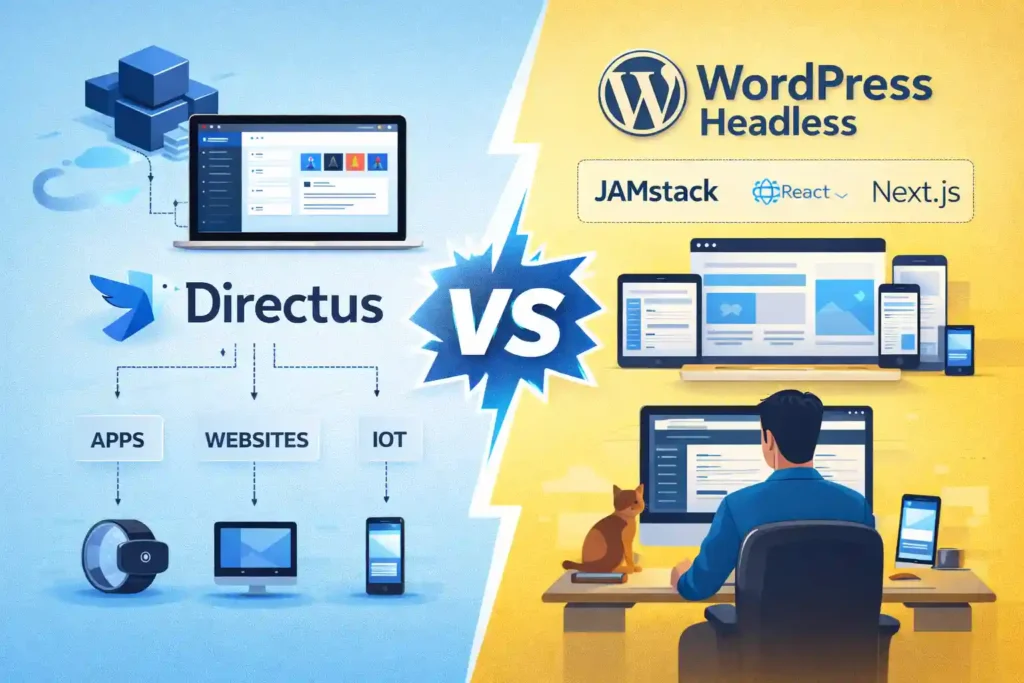
WordPress gives you access to a massive plugin ecosystem that covers almost every use case. From SEO and security to eCommerce and performance, you can install and configure features without building them from scratch.
This speeds up development and reduces technical effort. You can launch faster and iterate quickly, but too many plugins can create performance issues and dependency risks if not managed properly.
Directus does not rely on plugins. Instead, you build features based on your exact requirements using APIs and custom logic. This gives you complete control over how your system behaves.
Additionally, Directus allows for custom CSS to tailor the admin interface’s appearance, making it easy to support whitelabeling and client branding for a more polished, professional presentation.
You are not limited by third-party tools or plugin compatibility. This makes Directus more scalable and cleaner from an architecture perspective, but it requires more development time and technical expertise to implement features properly.
Verdict: This choice comes down to speed versus control. WordPress Headless helps teams ship faster with plugins, while Directus gives teams deeper control through custom development.
Conclusion
Directus performs better for data-heavy systems, custom backend workflows, and API-first development. WordPress Headless performs better for content-driven websites that need faster SEO execution, easier publishing, and quicker time-to-market.
Choose Directus when backend control, scalability, and schema flexibility matter most. Choose WordPress Headless when your priority is content operations, search visibility, and faster project delivery.
FAQs About Directus and Headless WP
Which is better for SEO, Directus or WordPress Headless?
WordPress Headless is better for SEO out of the box because it offers built-in tools, plugins, and easier metadata management. Directus can match or exceed it, but only with proper frontend setup and custom SEO implementation.
Can Directus rank as well as WordPress on Google?
Yes, Directus can rank just as well as WordPress if SEO is implemented correctly. Rankings depend on your frontend performance, metadata structure, and indexing setup, not just the CMS.
Is Directus harder to use than WordPress Headless?
Yes, Directus is generally harder to use because it requires more technical knowledge and setup. WordPress Headless is easier for most teams due to its familiar dashboard and ready-made tools.
When should you avoid using WordPress Headless?
You should avoid WordPress Headless when your project requires complex data structures, custom backend logic, or full control over your database. It can become limiting for highly customized applications.
Is Directus good for beginners?
No, Directus is not ideal for beginners. It is better suited for developers or technical teams who understand databases, APIs, and custom backend architecture.
Which one is more scalable, Directus or WordPress Headless?
Directus is more scalable for complex and data-heavy systems because it uses a database-first, API-driven architecture. WordPress Headless can scale well, but it requires more optimization and infrastructure planning.