If you are trying to grow a brand online today, the biggest question is no longer just how to get traffic. The real question is where that visibility actually lives and who controls it.
Many brands are feeling stuck. Paid campaigns are getting more expensive. Organic reach inside social platforms feels unpredictable. Data access is shrinking. At the same time, users are becoming more cautious about how their information is tracked and used.
This has pushed founders, marketers, and agencies to rethink a long standing assumption. Should growth live inside large platforms that control access and data, or should it be built on the open internet where brands own the relationship?
That is where the discussion around the Open Web vs Walled Gardens really begins. It is not a theoretical debate. It directly impacts cost, trust, long term visibility, and how resilient a business is when algorithms change.
In this guide, we will break down what each model really means, how they work in practice, and why many brands are quietly shifting their strategy without making noise about it.
TL;DR: The Short Answer Before We Go Deep
- Walled Gardens offer speed, convenience, and predictable short term reach, making them useful for fast campaigns and quick visibility.
- They limit ownership, restrict access to audience data, and provide little long term visibility once spending stops.
- The Open Web requires more effort upfront through content, SEO, and consistency.
- In return, it gives brands control, compounding search value, and direct relationships with their audience.
- Most successful brands do not commit to only one model forever.
- They use Walled Gardens strategically for reach and testing.
- They build their foundation on the Open Web for ownership and resilience.
- The difference is simple: one rents attention and the other helps you own it.
What is the Open Web
Open Web refers to the part of the internet that is accessible without being locked inside a single platform. It includes websites, blogs, publishers, ecommerce stores, forums, and content hubs that anyone can access through a browser or search engine.
This is where most people still go when they want answers, comparisons, tutorials, or deeper information.
How the Open Web Works in Practice
Users discover Open Web content through search engines, links, newsletters, bookmarks, and recommendations. There is no single gatekeeper deciding who sees what. Visibility is influenced by relevance, content quality, authority, and technical performance rather than paid reach alone.
A well structured article can continue attracting traffic for years without ongoing spend.
Examples of Open Web Properties
The Open Web includes WordPress websites, independent blogs, online magazines, ecommerce stores, documentation hubs, and educational platforms. It also includes apps and tools that do not lock content behind mandatory accounts.
If a user can discover it through search and share it freely, it belongs to the Open Web.
Who Controls Content and Distribution
On the Open Web, the brand controls hosting, publishing, updates, and distribution. You decide how content is structured, how data is collected, and how users engage with your site.
There is no platform limiting reach because a policy changed overnight.
Why Search Engines Matter in the Open Web
Search engines act as discovery engines for the Open Web. They reward clarity, relevance, and authority. Increasingly, AI powered tools also rely on Open Web content to generate answers.
This makes the Open Web a long term visibility asset rather than a temporary campaign channel.
Build Visibility You Actually Own
Long term growth comes from owning your content, your audience, and your platform. Seahawk helps brands build, optimize, and scale WordPress websites that perform well in search, adapt to change, and support sustainable growth beyond paid channels.
What are Walled Gardens
Walled Gardens are closed platforms that control user access, content distribution, and data flow. Brands can advertise and publish content inside these platforms, but they do not own the audience or the underlying data.
Visibility exists as long as the platform allows it.
What Makes a Platform a Walled Garden
A platform becomes a Walled Garden when users must log in, data cannot be exported freely, and distribution is governed by internal algorithms. Brands operate within rules they do not control.
Most social networks and large marketplaces fall into this category.
Common Walled Garden Platforms Brands Use
Popular examples include Meta platforms, Google Ads, Amazon, LinkedIn, and YouTube. These platforms offer sophisticated targeting tools, but they keep user relationships inside their ecosystem.
You can reach people, but you cannot take them with you.
How Visibility is Controlled Inside These Platforms
Reach is shaped by algorithms, bidding systems, and engagement metrics. Even organic visibility depends on what the platform chooses to prioritize at that moment.
A post that performs well today may disappear tomorrow without explanation.
What Data Brands Can and Cannot Access
Brands typically receive aggregated performance data. You can see impressions, clicks, and conversions, but you do not own the audience data itself.
This limits how much long term insight you can build independently.
Open Web vs Walled Gardens at a Strategic Level
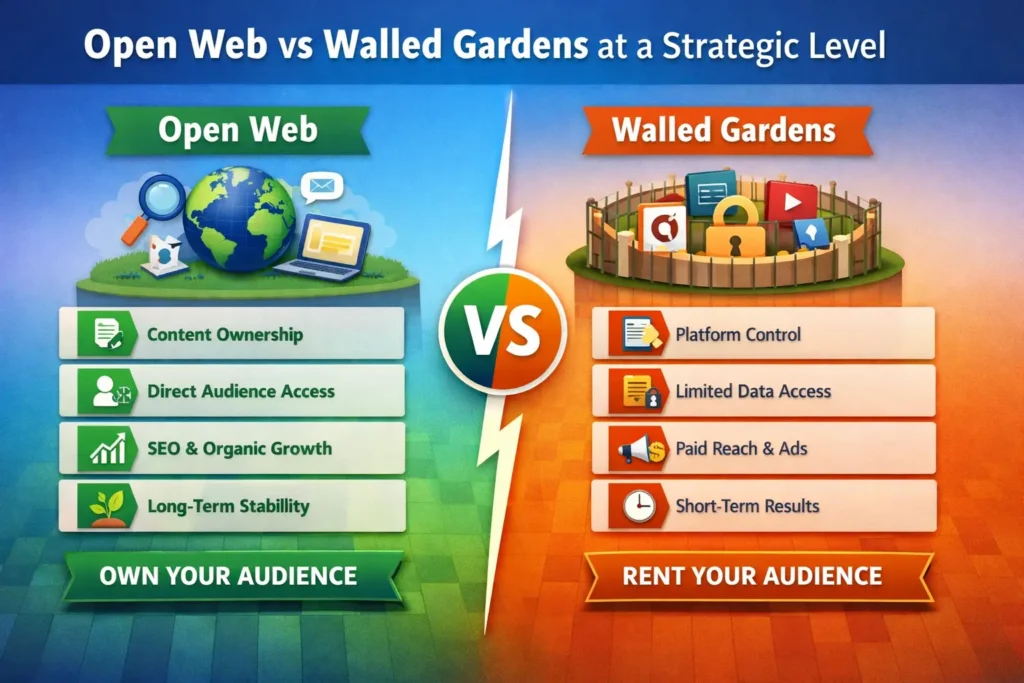
The difference between these two models becomes clearer when you look beyond tactics and focus on strategy.
Content Ownership and Control
On the Open Web, content remains yours. It can be updated, repurposed, and improved over time. Inside Walled Gardens, content exists at the mercy of platform rules.
Once distribution stops, visibility often stops with it.
Audience Relationship and Retention
The Open Web allows direct relationships through email, subscriptions, and repeat visits. Walled Gardens keep that relationship mediated.
You are always one algorithm update away from losing reach.
Longevity of Content and Campaigns
Open Web content compounds. Walled Garden campaigns expire. This single difference shapes how brands grow over years rather than months.
Why Brands Gravitate Toward Walled Gardens
Despite the limitations, Walled Gardens remain attractive, especially for teams under pressure to deliver fast results.
Speed of Launch and Setup
Launching an ad campaign can take hours instead of weeks. This immediacy feels reassuring when targets are tight.
Familiar Dashboards and Reporting
Platforms provide polished reporting interfaces that make performance easy to present internally. This creates a sense of control, even when visibility is rented.
Short Term Performance Pressure
Quarterly goals often reward fast spikes over sustainable growth. Paid reach fits that model well.
Perceived Predictability of Results
Even when costs rise, paid platforms feel predictable. That familiarity keeps budgets flowing in the same direction.
The Real Cost of Relying on Walled Gardens
Over time, the tradeoffs become harder to ignore.
Rising Cost of Reach Over Time
As more brands compete for the same audience, costs increase. Efficiency declines, but spend continues to rise.
Limited Portability of Audiences
When campaigns stop, traffic drops. There is no residual value unless users were moved into owned channels.
Algorithm Changes and Sudden Drops
Platforms change rules without warning. Visibility can vanish overnight, even for established brands.
Trust and Fatigue From Repetitive Ads
Users grow numb to constant interruptions. Trust erodes faster when brands rely only on paid exposure.
Why the Open Web is Gaining Momentum Again
After years of platform dominated growth, brands are slowly rediscovering the value of the Open Web. This shift is not driven by trends. It is driven by necessity.
Growing Privacy Awareness Among Users
Users are more aware of how their data is collected and used. Many are actively limiting tracking, blocking ads, or avoiding platforms that feel invasive. This changes how brands earn attention.
On the Open Web, trust is built through transparency, helpful content, and relevance rather than aggressive targeting.
Decline of Third Party Cookies
The removal of third party cookies has reshaped digital marketing. Strategies that relied heavily on cross site tracking are becoming less reliable.
The Open Web adapts better to this shift because it focuses on contextual relevance, intent, and first party relationships instead of surveillance based targeting.
Search Intent vs Interruption Marketing
When users search, they signal intent. They are open to learning, comparing, and deciding. This mindset is very different from scrolling through a feed.
Content discovered through search feels helpful instead of intrusive. That difference impacts conversion quality and long term brand perception.
Credibility Through Content and Authority
Publishing useful content consistently builds authority. Over time, brands become trusted sources rather than just advertisers.
This credibility is difficult to achieve inside closed platforms where content competes with entertainment and distraction.
How Growth Looks Different on the Open Web
Open Web growth rarely feels explosive at the start. It feels steady, cumulative, and increasingly reliable.
Content as a Long Term Asset
Every article, guide, or landing page adds to a growing library. Instead of expiring, these assets improve with updates, internal links, and authority signals.
A single well performing page can drive traffic and leads for years.
SEO Visibility Builds Over Time
Search visibility compounds. Rankings strengthen. Click through rates improve. AI powered search tools increasingly surface high quality Open Web content in answers and summaries.
This creates multiple discovery paths without additional spend.
Brand Recall Without Paid Exposure
When users repeatedly encounter a brand through helpful content, recognition builds naturally. The brand becomes familiar before any sales conversation begins.
This lowers friction later in the funnel.
Role of Consistency and Publishing Discipline
The Open Web rewards consistency. Brands that publish regularly and improve existing content tend to outperform those chasing one off wins.
There are no shortcuts, but the rules are clear and stable.
When Walled Gardens Still Play a Role
Walled Gardens are not useless. They are simply incomplete on their own.
Product Launches and Time Sensitive Campaigns
Paid platforms work well for launches, promotions, and limited time offers. Speed matters here more than longevity.
Retargeting Existing Audiences
When used responsibly, retargeting can support Open Web content and bring users back to owned platforms.
The key is using ads to reinforce, not replace, organic discovery.
Testing Messaging and Offers
Ads are effective testing tools. They help validate messaging before investing heavily in content and long term assets.
How Smart Brands Combine Open Web and Walled Gardens
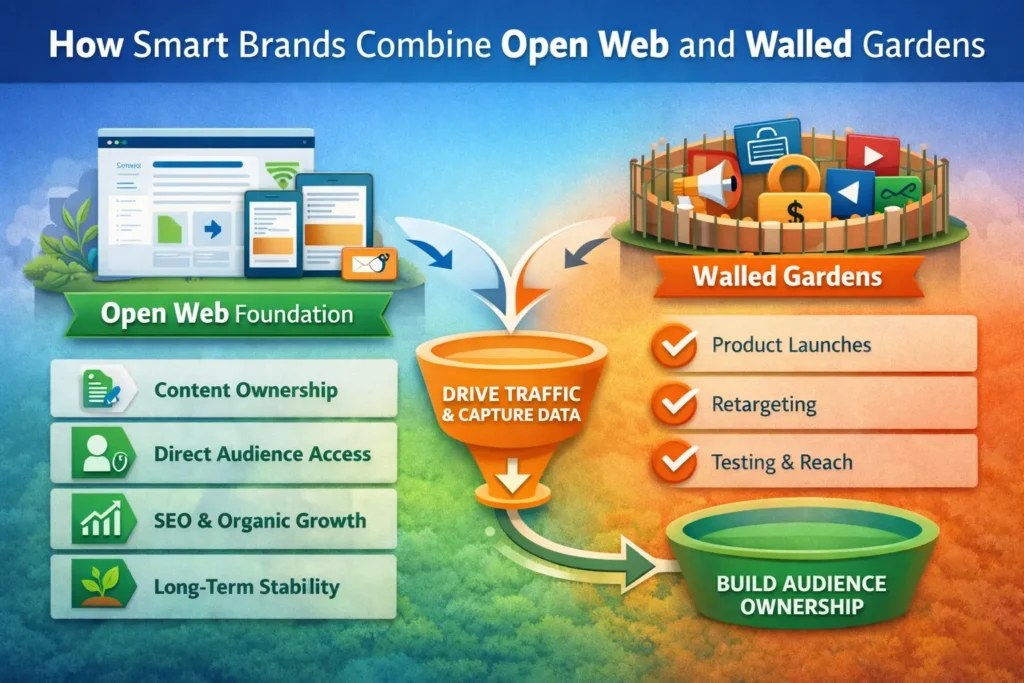
The strongest strategies treat the Open Web as the foundation, not an afterthought.
Open Web as the Foundation Layer
A fast, well structured website becomes the center of gravity. Content lives there. SEO builds there. Trust accumulates there.
Everything else points back to it.
Paid Channels as Distribution Boosters
Ads amplify reach, but they drive users to owned assets instead of trapping them inside platforms.
This shifts spend from rent to investment.
Capturing First Party Data
Email signups, subscriptions, and repeat visits turn anonymous traffic into long term relationships.
This data remains usable regardless of platform changes.
Reducing Dependency Over Time
As owned visibility grows, reliance on paid platforms decreases. Budgets become more flexible. Risk drops.
What This Means for WordPress Led Brands
WordPress.org plays a quiet but powerful role in Open Web growth.
WordPress as an Open Web Engine
WordPress gives brands full control over content, structure, performance, and integrations. It adapts easily to SEO, AI discovery, and evolving standards.
This flexibility is difficult to match inside closed systems.
SEO and Performance Control
Technical SEO, page speed, structured data, and content optimization matter more than ever. WordPress allows teams to fine tune all of it.
Performance improvements directly impact visibility and conversions.
Scaling Content Without Platform Lock In
As content libraries grow, WordPress scales without forcing brands into restrictive ecosystems.
Ownership remains intact.
Where Agencies Like Seahawk Fit In
Building and maintaining an Open Web presence requires consistency, technical expertise, and strategic oversight. This is where experienced WordPress agencies help brands move faster without cutting corners.
Final Thoughts: Choosing Visibility You Actually Own
The debate between the Open Web and Walled Gardens is not about choosing sides. It is about understanding tradeoffs.
Walled Gardens offer speed and convenience, but they come with dependency. The Open Web requires patience, but it rewards ownership, trust, and compounding growth.
Brands that build on the Open Web while using paid platforms strategically are better positioned for long term stability. They control their narrative, own their audience, and remain less vulnerable to sudden shifts in algorithms or platform policies.
In a digital landscape defined by change, ownership is the real advantage.
FAQs About Open Web vs Walled Gardens
What is the main difference between the Open Web and Walled Gardens?
The main difference is ownership. The Open Web allows brands to own their content, data, and audience relationships. Walled Gardens control distribution, visibility, and user data, meaning brands rent access instead of owning it.
Are Walled Gardens bad for brand growth?
Walled Gardens are not bad, but they are limited. They work well for short term campaigns, launches, and retargeting. Problems arise when brands rely on them as the primary growth channel without building owned assets alongside.
Why is the Open Web better for long term SEO and visibility?
The Open Web supports search driven discovery, content longevity, and compounding traffic. Well optimized content can rank, attract users, and build authority for years, unlike paid campaigns that stop delivering once spending ends.
Can brands use both Open Web and Walled Gardens together?
Yes. The most effective strategies combine both. Smart brands use Walled Gardens for reach and testing, while using the Open Web as the foundation for content, SEO, and audience ownership.
Why is WordPress often recommended for Open Web growth?
WordPress gives brands full control over content structure, SEO, performance, and integrations. It supports scalable publishing and long term visibility without locking brands into a single platform’s ecosystem.