If you have been publishing content consistently and still watching competitors outrank you, the problem likely has nothing to do with how many times you use your target keyword. Google stopped rewarding keyword repetition a long time ago. Today, it rewards pages that genuinely answer users’ queries. That shift is driven by semantic search.
Understanding how it works is one of the most important things you can do for your SEO strategy.
It applies whether you manage a WordPress website, run content for a growing brand, or work with clients on organic visibility. This guide breaks it all down in plain language.
TL;DR: Semantic Search at a Glance
- Semantic search focuses on the meaning and intent behind a query, rather than just the words.
- Three major Google algorithm updates, Hummingbird, RankBrain, and BERT, drove the shift toward semantic understanding.
- Search engines now use NLP, knowledge graphs, and vector search to interpret what users actually want.
- Keyword stuffing no longer works. Topical authority and search intent alignment now drive rankings.
- Optimizing for semantic search means writing around topics, using structured data, and building logical internal links.
- AI-powered search tools like Google AI Overviews and Perplexity rely entirely on semantic understanding, making this more important than ever.
What is Semantic Search?
Semantic search is the ability of a search engine to understand the intent and contextual meaning behind a query rather than simply matching the words a user typed.
Instead of looking for literal keyword matches, a semantic search engine asks a deeper question: what does this person actually want to find?
Think about a user searching for “best laptops for graphic design.” A traditional keyword-based search engine would scan indexed pages for those exact words.
A semantic search engine goes further. It understands that the user wants a machine with a powerful GPU, a color-accurate display, and sufficient RAM for design software.
It then returns results that match those underlying needs. This happens even if some of those pages never use the exact phrase verbatim.
That is semantic search in action. It connects meaning to meaning rather than word to word.
Build Content That Actually Ranks.
Semantic search is changing how content gets discovered. Seahawk Media helps you create SEO-driven WordPress websites that align with how modern search engines understand intent.
Semantic Search vs Keyword Search
Keyword search works by matching the words in a query to the same words on a webpage. It is straightforward and fast, but it misses context entirely.
A page that repeats a keyword twenty times looks relevant to a keyword-based system, regardless of whether it actually helps the reader.
Semantic search evaluates meaning, word relationships, user intent, and context. It understands that “how do I speed up my site” and WordPress performance optimization tips are asking essentially the same thing.
Keywords still play a role, but they work alongside meaning rather than in place of it.
How Did We Get Here? The Google Algorithm Updates That Made Semantic Search Mainstream
Semantic search did not arrive overnight. Google introduced it gradually through a series of major algorithm updates over the past decade.
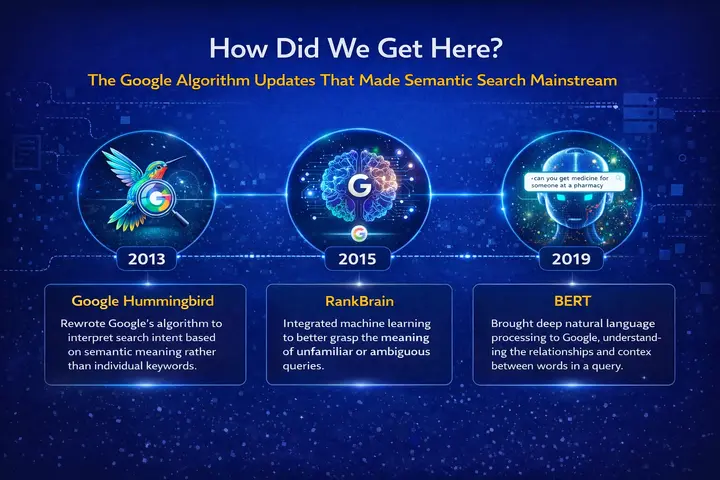
Each one moved the engine further away from keyword matching and closer to genuine language understanding.
Google Hummingbird (2013)
Hummingbird was the first significant rewrite of Google’s core algorithm with semantic search at its center.
It shifted the focus from individual keywords to the full meaning of an entire query. When it launched, it affected up to 90% of all searches.
For the first time, Google began reading queries the way a human would, rather than treating each word as a separate signal.
RankBrain (2015)
RankBrain brought machine learning into Google’s ranking process. It allowed Google to interpret unfamiliar queries by connecting them to related concepts it already understood.
In practice, this meant Google could handle unusual or ambiguous searches more accurately without relying on exact keyword matches.
BERT (2019)
BERT introduced deep natural language understanding at scale. It allowed Google to analyze the role of every word in a sentence rather than focusing solely on main keywords.
This was particularly impactful for longer, conversational queries, where word order can significantly change the meaning.
A search for “can you get medicine for someone at a pharmacy” now reads as a specific real-world scenario. It is no longer treated as a loose collection of medical-related keywords.
How Semantic Search Actually Works?
Understanding the process behind semantic search helps you make smarter decisions about how you create and structure content. Here is how a modern search engine moves from a user query to a set of ranked results.
Query Analysis and Intent Detection
The first thing a semantic search engine does is analyze what the user actually wants. This goes beyond reading the words. It classifies the query by intent type.
Informational intent means the user wants to learn something. Navigational intent means they are looking for a specific website.
Transactional intent means they are ready to take action, such as making a purchase. Commercial investigation means they are researching before making a decision.
The same keyword can carry very different intent depending on how it is phrased. “WordPress hosting” could be informational. “Buy WordPress hosting” is clearly a transactional offer.
Semantic search detects this difference and returns results that match the intent, not just the words.
The Role of Natural Language Processing (NLP)
Natural language processing is the technology that allows search engines to interpret human language the way humans do. It handles synonyms, sentence structure, and context.
This means a search engine understands that “how to fix a slow website” and “improve WordPress page speed” are asking the same question.
NLP also allows search engines to understand negation, comparison, and nuance. A query like “WordPress plugins that do not slow down your site” conveys a specific idea.
NLP ensures the search engine captures that specificity rather than just returning results for WordPress plugins in general.
Knowledge Graphs and Entity Recognition
A knowledge graph is a vast database of entities and their relationships. Google’s Knowledge Graph now contains over 8 billion entities, including people, places, brands, products, and concepts.
Entity recognition allows Google to understand what a word refers to in context. When someone searches for “Apple event,” Google knows whether the user means a technology product launch or a farming fair.
It makes that distinction based on surrounding signals, search history, and the relationships stored in the Knowledge Graph.
That is why content that clearly establishes its subject matter and connects related concepts tends to perform better in semantic search. Google can place it accurately within a broader topic.
Vector Search and Semantic Embeddings
Modern semantic search converts text into numerical representations called vector embeddings. These vectors capture the meaning of words and phrases mathematically.
This allows the search engine to measure how similar two pieces of content are based on meaning rather than exact wording.
In practical terms, this means a page about “site speed optimization” can rank for “how to make my WordPress site faster” even if it never uses that exact phrase.
The vector representations of both queries are close enough in meaning for the search engine to treat them as equivalent.
Why Semantic Search Matters for Your SEO Strategy?
Understanding semantic search is one thing. Knowing what it means for your content strategy is another.

Here is where the practical impact becomes clear.
Keyword Stuffing No Longer Works
Repeating a target keyword throughout a page used to be a reliable way to signal relevance to Google. Today, that approach signals low-quality content.
Semantic search rewards pages that cover a topic thoroughly and naturally. It penalizes pages that force a keyword into every paragraph at the expense of readability and depth.
As a result, the goal shifts from keyword density to topical completeness. A page that answers the main question and addresses the related questions a reader is likely to ask next will consistently outperform a page built around a single phrase.
Topical Authority Matters More Than Individual Keywords
Semantic search evaluates the depth and breadth of a site’s coverage on a given subject.
A website that publishes twenty well-connected pieces of content on WordPress security will carry far more topical authority than a site with one highly optimized page targeting a single keyword.
This is the concept behind topic clusters. A pillar page covers the main subject broadly. Supporting pages go deep on individual subtopics and link back to the pillar.
Together, they signal to Google that the site is a genuinely authoritative resource on the subject rather than a single-page keyword target.
Search Intent Alignment is Now Non-Negotiable
A page that targets the wrong intent will struggle to rank, regardless of how well it is written or optimized.
If a user’s query carries informational intent and your page is built as a product landing page, semantic search will identify that mismatch. It will rank your page below content that actually serves what the user needs.
Before creating any piece of content, identify the intent behind the target query. Build the page to fully match that intent. Informational queries need clear, helpful explanations.
Transactional queries need pages that facilitate action. Getting this right is now one of the highest-leverage ways you can improve organic visibility.
How to Optimize Your WordPress Content for Semantic Search?
Knowing how semantic search works is only useful if you can translate it into content decisions. Here are four practical ways to align your WordPress site with how search engines evaluate content today.
Write Around Topics, Not Just Keywords
Start each piece of content by mapping out the full topic rather than building around a single phrase.
Think about the main question, the related questions a reader is likely to have, and the subtopics that provide meaningful context. Cover them all within a single, well-structured piece.
This approach naturally produces content that performs well in semantic search because it mirrors the depth and comprehensiveness that Google’s algorithm rewards.
Tools like Google’s People Also Ask section and Google Search Console are useful starting points for identifying related subtopics and questions to address.
Use NLP and Semantically Related Terms Throughout Your Content
Semantic search responds to the presence of contextually relevant terms, not just the repetition of a single keyword. These are words and phrases that naturally appear in well-written content on a given subject.
For example, a page about WordPress security should naturally include terms like malware, two-factor authentication, login protection, SSL, and regular backups.
Their presence signals topical depth. Tools like Surfer SEO and Google’s Natural Language API can help you identify which semantically related terms to include.
Implement Schema Markup for Structured Data
Schema markup tells search engines exactly what your content means, not just what it says. It is one of the clearest signals you can send to a semantic search engine about the subject matter, structure, and purpose of a page.
On WordPress, Rank Math offers built-in schema implementation tools that are straightforward to use without touching code.
Both plugins are actively maintained and regularly updated. Beyond semantic relevance, schema markup also increases the likelihood that your content will appear as a rich snippet, which significantly improves click-through rates.
Build Internal Links That Reflect Topic Relationships
A well-structured internal linking strategy reinforces topical authority by showing Google how the pages on your site relate to each other. Pages that link to each other around a shared topic form a semantic cluster that signals expertise on that subject.
Link from broad topic pages to more specific subtopic pages and back again. Use descriptive anchor text that reflects the destination page’s content rather than generic phrases.
Over time, this structure helps search engines build an accurate picture of your site’s depth of coverage on each subject you publish about.
Semantic Search and the Rise of AI-Powered Search Tools
Semantic search has become even more important as AI-powered search tools have grown. Google AI Overviews now appear in nearly 19% of all search queries in the US.
Tools like Perplexity, ChatGPT Search, and Gemini generate answers directly from indexed content rather than simply listing links.
All of these systems rely entirely on semantic understanding to select the sources they cite. They are not looking for pages that repeat a keyword.
They are looking for pages that genuinely and comprehensively answer a question. Content that performs well in semantic search is also the content most likely to be surfaced and cited by AI-driven answer engines.
This means the investment you make in semantic SEO today compounds over time. As AI-powered search continues to grow its share of how people find information, the content that aligns with semantic principles will become more visible, not less.
Final Thoughts
Semantic search is not an emerging trend to monitor from a distance. It is the current reality of how Google and every major AI-powered search tool evaluate and rank content.
Pages built around keyword repetition are losing ground to pages built around genuine topical depth and intent alignment.
The practical shift is straightforward. Write for the topic, not the keyword. Match the intent behind every query you target.
Use structured data to help search engines better understand your content. Build internal links that reflect how your content connects.
At Seahawk Media, every content and SEO strategy we build for clients is grounded in these principles.
If your WordPress site is not getting the organic visibility it should, we can help you identify exactly where the gaps are and build a content strategy that aligns with how search actually works today.
FAQs About Semantic Search
Is semantic search the same as semantic SEO?
They are closely related but not identical. Semantic search refers to how search engines understand and process queries.
Semantic SEO is the practice of optimizing your content to align with that understanding. In short, semantic search is what Google does. Semantic SEO is what you do in response.
Does semantic search replace traditional keyword research?
No, keyword research still matters. However, the way you use it changes. Rather than targeting a single keyword per page and optimizing around repetition, you use keyword research to understand the topics and intent clusters worth covering. Keywords inform your strategy. They no longer dictate your entire structure.
How does Google use semantic search to rank content?
Google analyzes the intent behind a query, identifies the entities and concepts relevant to that intent, and evaluates how well each indexed page addresses the user’s underlying need. It factors in topical authority, content depth, structured data, and user behavior signals to determine which pages best serve the query.
What is the difference between semantic search and vector search?
Semantic search is the broader goal: understanding meaning and intent. Vector search is one of the technologies that enable it. Vector search converts text into numerical representations and measures their similarity mathematically. It is the mechanism that allows semantic search to find relevant content even when exact keywords do not match.