Choosing the wrong type of agency partnership does not just slow you down. It drains your margins, creates rework, and erodes client trust.
Most agencies make the same mistake: they call a vendor a partner, mismatch the role, and spend months cleaning up the damage. The good news is the fix is not complicated. It starts with understanding that not all partnerships are designed for the same purpose.
This guide breaks down the three types of agency partnerships, how each one works across WordPress service delivery, and a simple diagnostic to help you find the right fit for where your agency stands today.
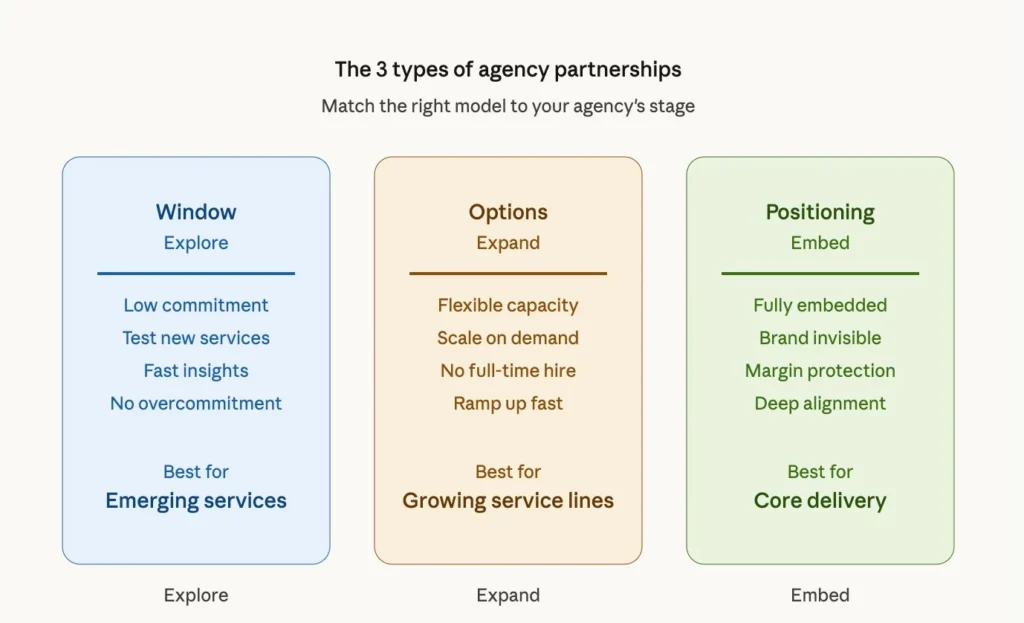
Agencies typically choose between three partnership models depending on growth stage and delivery needs.
Window partnerships help explore new services with minimal commitment. Options partnerships provide scalable delivery capacity without hiring. Positioning partnerships act as a fully embedded white-label team aligned with your workflows and brand standards.
Why Partnership Type Determines Agency Success?
Most agencies focus on finding the right partner. Fewer focus on defining the right role for that partner. That distinction is where the margin gets protected or lost.
When a partner is misclassified, the problems are predictable. Margin erodes because work requires constant rework. Clients feel the inconsistency. Your internal team burns time cleaning up misfit deliverables.
The three-type framework below, adapted from research by Wharton professor Harbir Singh on strategic alliances, solves this problem by forcing agencies to define intent before choosing a partner. His research shows that partnerships succeed not just when the partner is capable, but when the partnership type matches the agency’s goals and the market’s uncertainty.
For WordPress agencies specifically, getting this right separates agencies that scale cleanly from those that grow messy.
The 3 Types of Agency Partnerships Explained
Every agency partnership falls into one of three categories. Here is how each one works, when to use it, and what can go wrong.
Window Partnership: Explore without Overcommitting
A Window Partnership is your agency’s way to test a new service area without betting on it. You gain visibility into emerging territory, insight into how it works, and a low-risk path to understanding whether it fits your agency’s offer.
Think of it as reconnaissance. You are not executing at scale. You are learning.
When to use a Window Partnership:
- You are evaluating a new service like AI SEO, headless WordPress, or Gutenberg block development
- Demand is unproven, and the speed of learning matters more than polish
- You want to explore before committing to the budget or hiring capacity
WordPress-specific examples:
- A WordPress agency is testing AI-assisted content workflows before adding them as a service line
- An agency piloting WooCommerce headless builds with a specialist partner before scoping a dedicated offering
- A web shop is running its first accessibility audit partnership to gauge client demand
Benefits:
- Low cost and fast to start
- Keeps your agency current without disrupting core operations
- Generates insight that informs your next strategic decision
Risks:
- IP leakage or brand exposure without proper confidentiality agreements
- Window partners are not built to scale. They are built to help you learn. Expecting delivery volume from a Window partner is a setup for disappointment.
Agency takeaway: A Window Partnership is a smart investment in clarity. Use it to validate before you build.
Options Partnership: Scale Fast without Hiring
An Options Partnership is a step beyond exploration. You have validated that a service has demand, but you are not ready to build a full in-house team for it. An Options partner gives you scalable capacity that you can ramp up or pull back based on pipeline volume.
This is the most underused partnership type. Agencies either test without committing (Window) or go straight to full embedding (Positioning). The Options model is the bridge that lets you grow a service line intelligently.
When to use an Options Partnership:
- You are scaling a service that is growing, but not yet mature enough to justify a full team
- You need flexible delivery capacity for high-potential, lower-volume work
- You want to say yes to more opportunities without overloading your core team
WordPress-specific examples:
- Partnering for WooCommerce development on a per-project basis while demand grows
- Using a white-label SEO partner for a new content and optimization service before building internal capacity
- Adding WordPress speed optimization as a service through a specialist while you evaluate whether to train your existing developers
Benefits:
- Moderate investment with an expandable structure
- Let your agency respond to opportunities faster than hiring allows
- Preserves internal focus on strategy and account management
Risks:
- Can create delivery drag if ROI expectations are not clearly defined upfront
- Vulnerable to inertia when priorities shift, and the partnership does not evolve with your agency
Agency takeaway: An Options Partnership gives your agency the right to expand without the obligation to fully commit. It is your hedge against uncertainty.
Positioning Partnership: Embed for Margin Protection
A Positioning Partnership is where the stakes are highest, and the payoff is most significant. This partner does not just fill capacity. They operate as an invisible extension of your agency, embedded in your workflows, onboarded to your QA standards, and aligned to your delivery culture.
This is the model that protects your most important client relationships and your highest-margin service lines.
When to use a Positioning Partnership:
- Core service delivery where brand consistency is non-negotiable
- Client relationships that cannot absorb delivery inconsistency
- Mature service lines where you need reliability and depth, not experimentation
WordPress-specific examples:
- A white-label WordPress development partner trained on your coding standards, design systems, and delivery timelines
- A white-label maintenance provider managing client sites under your agency’s brand with zero client-visible involvement
- A WooCommerce partner embedded in your project management workflow, attending planning calls under your direction, and delivering to your acceptance criteria
Benefits:
- Deep alignment means fewer revisions, faster turnaround, and consistent client experience
- Protects your brand, your bandwidth, and your bottom line
- Scales with your agency without adding headcount or fixed costs
Risks:
- Breaks down if treated like overflow. A Positioning partner disengages when excluded from planning. Bring them in early or expect friction later.
Agency takeaway: A Positioning Partnership is not just a delivery resource. It is your execution infrastructure. Treat it that way, and it compounds in value over time.
Window vs Options vs Positioning: Quick Comparison
| Type | Role | Best For | Risk | WordPress Example |
| Window | Explore and learn | Emerging or unproven services | IP leakage, brand exposure | AI SEO pilot program |
| Options | Expand quickly | High-potential, growing service lines | Inertia, unclear ROI | Per-project WooCommerce builds |
| Positioning | Embed and protect | Core delivery, margin protection | Disengagement if excluded from planning | White-label WordPress dev team |
The costliest mistake is not choosing the wrong partner. It is slotting the right partner into the wrong type. Use this table as a sanity check before every new partnership conversation.
How to Choose the Right Partnership Type for Your WordPress Agency?
Before you classify a new partner or audit an existing one, work through this three-question diagnostic.
Question 1: Are you testing something new? If yes, use a Window Partnership. You want low cost, fast insight, and the flexibility to walk away without sunk costs.
Question 2: Are you scaling a service that has proven demand but not yet full internal capacity? If yes, use an Options Partnership. You need flexible delivery that can ramp quickly without locking you into fixed overhead.
Question 3: Are you protecting a core service line where brand consistency, delivery reliability, and margin protection are non-negotiable? If yes, use a Positioning Partnership. You need a partner who embeds in your workflows, stays invisible to your clients, and delivers to your exact standards every time.
Work through your current partnerships against these three questions. If you find a partner sitting in the wrong slot, that misclassification is likely the source of your delivery friction.
What a Strong Positioning Partnership Looks Like with Seahawk Media?
For WordPress agencies whose core delivery depends on consistent, high-quality execution, a Positioning Partnership with Seahawk Media serves as your invisible delivery team.
Here is what that looks like in practice:
- Full invisibility: No Seahawk Media branding in code, documentation, or client-facing materials. Your clients see only your agency.
- NDA as standard: Confidentiality agreements are signed before any engagement begins, covering all project data and client information.
- Workflow integration: We adapt to your project management tools, communication channels, and approval processes, not the other way around.
- Dedicated project management: A named project manager owns communication, tracks deliverables, and ensures nothing slips between the cracks.
- QA before every handoff: WordPress projects go through code review, functionality testing, and performance checks before delivery.
- No long-term lock-in: Month-to-month flexibility with no retainers or contracts, so you scale up or adjust as your pipeline changes.
Seahawk Media’s white-label WordPress team has supported over 1,000 agency partnerships since 2016 across development, WooCommerce, migrations, maintenance, and SEO, all under agency brands with zero client-visible involvement.
Scale Your Agency Without Hiring
White-label WordPress services delivered under your brand. No contracts. No retainers.
Signs Your Current Partnership is Misclassified
Before committing to a new partner type, audit what you already have. These are the signals that a partnership has been slotted into the wrong role.
Signs a Positioning partner is being treated like a Window:
- You are not including them in project planning conversations
- Work requires significant rework before it meets your standards
- The partner feels like a vendor, not an extension of your team
Signs a Window partner is being treated like a Positioning partner:
- You are routing critical client deliverables through a partner who is still in a learning mode with your agency
- Client satisfaction is inconsistent because delivery standards are not fully aligned
- You are absorbing risk on work that should have been piloted first
Signs an Options partner has outgrown their classification:
- Volume has increased enough that a dedicated, embedded relationship would reduce overhead and improve consistency
- The service line is now core to your revenue, not experimental
- You are managing more coordination overhead than the partnership is worth at its current structure
If any of these match your current situation, reclassifying the partnership before the next project cycle is the right move.
Final Thoughts: Choose the Right Agency Partnership Model
The agencies that scale cleanly are not the ones with the most partners. They are the ones who know exactly what each partner is there to do.
A Window partner who helps you validate AI SEO today might become an Options partner next quarter as demand grows. An Options partner delivering WooCommerce builds might graduate into a Positioning partner once volume and consistency justify a fully embedded relationship. The model is not static. Your partnerships should evolve as your agency does.
The practical starting point is a simple audit. List your current partners. Map each one to Window, Options, or Positioning. Spot the ones sitting in the wrong slot. Fix those first before adding new relationships.
Growth does not require more partners. It requires the right partners in the right roles. Get that alignment in place, and your agency gains leverage without adding chaos to your operations or your margins.
Frequently Asked Questions About Types of Agency Partnerships
What are the three types of agency partnerships?
The three types of agency partnerships are Window (Explore), Options (Expand), and Positioning (Embed). Window partnerships are used to test new services with minimal commitment. Options partnerships provide scalable delivery capacity for growing service lines. Positioning partnerships embed a partner fully into your agency’s workflows for core service delivery and margin protection.
What is a Positioning Partnership in an agency context?
A Positioning Partnership is a fully embedded delivery model where a partner operates as an invisible extension of your agency. They align with your QA standards, project management workflows, and delivery culture. This model is used for core service lines where brand consistency and reliability are non-negotiable.
What is the difference between a Window and an Options Partnership?
A Window Partnership is designed for exploration. You gain visibility into a new service area with minimal commitment. An Options Partnership is designed for scaling. You have validated demand and need flexible capacity that can ramp up quickly without the commitment of hiring a full in-house team. The window is for learning; options are for growing.
How do I know which partnership type my agency needs?
Ask three questions. Are you testing something unproven? Choose a Window partner. Are you scaling a service with validated demand but without full internal capacity? Choose an Options partner. Are you protecting a core service line where brand consistency and margin protection matter most? Choose a Positioning partner.
Can a white-label WordPress agency be a Positioning partner?
Yes. A mature white-label WordPress agency that embeds in your workflows, signs NDAs, stays invisible to your clients, and delivers to your exact standards is operating as a Positioning partner. This is the model used for core delivery relationships where consistency and trust are essential.
What happens when an agency misclassifies a partner?
Misclassifying a partner creates predictable problems. Margin erodes from rework. Clients experience inconsistent delivery. Internal teams burn time managing a partner who is not well-suited to the role they have been given. Auditing and reclassifying partnerships early in a project cycle prevent these outcomes.
How does Seahawk function as an agency partnership?
Seahawk operates as a Positioning partner for WordPress agencies. The team embeds in your workflow, signs NDAs before engagement, stays fully invisible to your clients, and delivers development, WooCommerce, maintenance, and SEO under your agency’s brand with dedicated project management and pre-delivery QA.