If you have ever built or managed a site online, you have probably used the words “website” and “webpage” interchangeably. But these two terms are not the same, and understanding the difference between a website vs webpage is one of those foundational concepts that shapes how you plan your content, structure your SEO, and build a meaningful online presence.
This guide breaks it all down in plain language so you can stop guessing and start building smarter.
TL;DR: Website vs Webpage
- A webpage is a single document with its own URL. A website is the full collection of those documents under a single domain.
- Search engines rank individual web pages, not entire websites, so every page needs its own SEO strategy.
- A well-structured website with purposeful internal links builds topical authority and drives consistent organic growth.
- Your website is never truly finished; pages need regular updates, fresh content, and ongoing optimization to keep performing.
- Quality always beats quantity, as ten focused, well-optimized pages consistently outperform a hundred thin, poorly structured ones.
What is a Website?
A website is a collection of related web pages that all live under a single domain name and are connected through a navigation structure.
The domain is the root address, something like yoursite.com, and every web page on that site branches out from that central address.
A website is more than just a folder of pages, though. It is a system. It has a hierarchy, consistent design, and a shared purpose that ties every page together, whether the site has five pages or five hundred.
What Makes Up a Typical Website?
Most websites, regardless of industry, are built from a recognizable set of dedicated pages:
- Homepage: The front door of your website. It introduces who you are and what you do at a glance.
- About Us Page: Tells your story, your team, and your mission.
- Services or Product Pages: Dedicated pages for what you offer, each targeting a specific audience need.
- Blog or Resources Section: Where you publish articles, guides, and educational content.
- Landing Pages: Campaign-specific pages built for a single conversion goal.
- Contact Page: Where visitors reach out, book a call, or find your location.
Each of these serves a distinct user need. A well-structured website connects these pages through internal links and logical navigation so that users can find what they need without confusion.
What is a Webpage?
A webpage is a single document on the World Wide Web that is displayed in a web browser such as Chrome, Firefox, or Safari.
Each webpage has its own unique address, known as a URL, and that URL often includes an extension or a subdirectory path that identifies exactly where the page lives within a website structure.
Every webpage is written primarily in HTML, which defines the content and structure of what you see on screen.
CSS then controls how that content looks visually, handling things like fonts, colors, and layout. JavaScript adds interactivity and dynamic content on top of that foundation.
What a Webpage Actually Contains?
A single webpage can contain a wide variety of elements depending on its purpose. You might find:
- Blocks of text and written content
- Images, infographics, and visual elements
- Embedded videos and multimedia
- Hyperlinks that connect to other pages
- Contact forms and call-to-action buttons
- Product listings or service descriptions
Each of these elements serves a function related to the specific purpose of that individual page.
Real-World Examples of Web Pages
You interact with individual webpages every single day without thinking about it. When you read a blog post on a marketing site, that is a webpage.
- When you land on a product page for a pair of shoes while shopping online, that is a webpage.
- An about us page, a landing page for a promotional campaign, a contact form, or a pricing breakdown: each is a separate webpage with its own URL and role.
- A landing page, for instance, serves one single purpose: to convert visitors. Designers strip it down to the essentials and build it around a single offer or call to action.
That is a great example of how even a single webpage can carry enormous business value when designed with intent.
How Seahawk Media Helps You Build Websites That Actually Work?
At Seahawk Media, we approach every website project as a strategic exercise, not just a design task.
Before we write a single line of code, we map out the entire site architecture, identify which pages you need, define the purpose of each one, and plan exactly how they connect through internal links and navigation.

WordPress Development Built for Real Results
We specialize in WordPress websites, and for good reason. WordPress is one of the most flexible, SEO-friendly, and scalable platforms for managing a website with multiple web pages.
Whether you need dedicated pages for services, product pages for an ecommerce store, landing pages for campaigns, or a content-rich blog section, WordPress handles all of it with the right structure and the right plugins to support strong search performance.
Each webpage we build is independently optimized, meaning it targets specific keywords, follows proper on-page optimization practices, and is set up to serve a clearly defined user intent.
Web Management That Keeps Your Site Performing
Building a website is the starting point, not the finish line. Seahawk Media provides ongoing web management to ensure your web pages stay updated, technically sound, and ranking well as search engine algorithms evolve.
From refreshing existing pages to creating new ones that capture emerging search demand, our team ensures your website remains a growth engine for your business online.
Build a Website That’s Structured to Convert
It’s not just about creating pages. It’s about how everything connects, guides users, and drives results.
Website vs Webpage: The Core Differences
Now that you understand what each term means individually, it helps to see the contrast side by side. The difference is not just semantic. It has real implications for how you build, manage, and optimize your online presence.
Structure and Scope
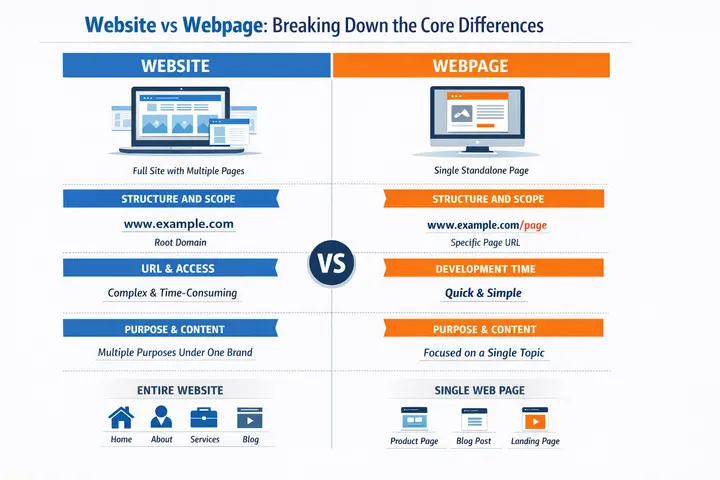
A webpage is one unit within a larger system. A website is the entire system. When someone visits your homepage, they are landing on a specific page, but they are still on your website.
The structure of that website, meaning how pages are organized, how they link to each other, and how the navigation guides users through the content, determines whether visitors stay, explore, and convert.
URL and Access
Every website has a root domain that serves as its address on the internet. A webpage, on the other hand, has a specific URL that includes a path pointing to that individual document.
For example, seahawkmedia.com is a domain name, but seahawkmedia.com/services/wordpress-development is a specific webpage within it.
That distinction matters significantly for how search engines understand and index your content.
Development Time and Complexity
Building a full website requires considerably more time, strategy, and resources than creating a single webpage.
A website involves:
- Planning the overall architecture
- Determining how many pages are needed
- Building a consistent navigation structure
- Ensuring design cohesion across the entire site
- Setting up the technical infrastructure on a web server.
Creating an individual webpage within an existing website is far simpler once that foundation is in place.
Purpose and Content Depth
A webpage is built around a specific purpose. A product page exists to sell products. A blog post exists to educate or inform. A landing page exists to capture a lead or drive a single action.
A website, by contrast, brings all these individual purposes together under a single brand identity and digital presence.
Why This Difference Matters for Your SEO and Content Strategy?
Here is where things get genuinely important for anyone building or managing a business online.
The distinction between a website and a webpage is not just a matter of terminology. It shapes how you rank on search engines, how you create content, and how users experience your brand.
Search Engines Rank Individual Web Pages, Not Entire Websites
This is one of the most misunderstood points in SEO. When your site shows up in search engine results for a keyword, it is a specific webpage that earned that position, not your website as a whole.
- Your homepage might rank for your brand name. A dedicated service page might rank for a competitive keyword.
- A blog post might rank for an informational query. Each individual webpage competes on its own merits in the search results.
This is why on-page optimization matters so much at the page level. You need to treat every webpage you publish as its own strategic asset, with a clear focus keyword, a defined audience, and a specific purpose.
Thinking of every new page you create as a new ranking opportunity is one of the most effective mindset shifts in content strategy.
Internal Linking Connects the Whole System
Because search engines crawl individual web pages and follow hyperlinks between them, how you connect your pages internally has a direct impact on how well your entire website performs.
Strong internal linking passes authority from high-performing pages to newer ones, helps search engines understand your site structure, and keeps users navigating deeper into your content rather than bouncing after a single visit.
A well-planned website with purposeful internal links across several pages builds topical authority over time. That topical authority is what separates high-ranking websites from those that struggle to consistently appear in search results.
User Experience Depends on Clear Page Structure
Every webpage should have a clear purpose tied to a specific user intent. When users land on a page that does not clearly match what they were looking for, they leave.
That increases your bounce rate and sends negative signals to other search engines. When each individual page on your website answers a specific question, solves a specific problem, or serves a specific user goal, visitors stay longer and convert more often.
Website vs Webpage: Common Misconceptions
The confusion between a website and a webpage runs deeper than most people realize, and it quietly affects decisions around content, structure, and search performance every single day.
These are the most common misconceptions worth understanding before you build or grow your next site.
A Webpage Cannot Exist Without a Website
You cannot publish a standalone webpage floating somewhere on the internet without any website infrastructure behind it.
Every webpage must be hosted on a web server, accessible via a domain, and part of a minimal website structure. Even a single-page website is technically a website, just one with only one page.
More Pages Do Not Always Mean a Better Website
A focused website with ten carefully optimized, high-quality pages consistently outperforms a bloated website with hundreds of thin, poorly structured pages.
Google and other search engines have made it increasingly clear that content quality and relevance matter far more than sheer volume.
Publishing new web pages for the sake of it, without a clear purpose or solid content, adds noise rather than value.
Your Website is Never Truly Finished
A website is a living digital asset. Individual web pages need to be updated as information changes, as keywords shift, and as user behavior evolves.
Adding new pages, refreshing older content, improving internal links, and updating on-page optimization are ongoing tasks for any site that wants to maintain or improve its search ranking.
Final Thoughts
The difference between a website and a webpage is simple once you see it, but the implications of that difference run deep through every part of your digital strategy.
- A webpage is a single document with a specific purpose and a unique URL.
- A website is the entire collection of those documents, connected through structure, navigation, and a shared domain. Search engines rank individual web pages.
Users navigate entire websites. And the businesses that understand both levels, the individual page and the overall site structure, are the ones that build online presences that actually grow over time.
If you are ready to build a website that is structured to rank, designed to convert, and managed to last, the team at Seahawk Media is here to help. Reach out today and let us build something that works.
FAQs About Website vs Webpage
What is the difference between a webpage URL and a website address?
A website address is the root domain, such as example.com. A webpage URL includes a specific path that points to an individual document within that site, such as example.com/services/seo. The path or extension in the URL is what identifies a specific webpage within the broader website structure.
How many webpages does a website need?
There is no fixed number. A focused website with five to ten high-quality, well-optimized pages can outperform a site with hundreds of thin, poorly structured ones. What matters most is that each page serves a clear purpose and targets a specific user intent.
Can a webpage exist without a website?
No. Every webpage needs to be hosted within a website infrastructure. Even if you only have one page published online, it still technically lives inside a website. A single-page site is still a website, just one with only one webpage.
What is the main difference between a website and a webpage?
A webpage is a single document displayed in a web browser with its own unique URL. A website is a collection of individual pages connected under a single domain name. Think of a webpage as one page in a book, and the website as the entire book itself.