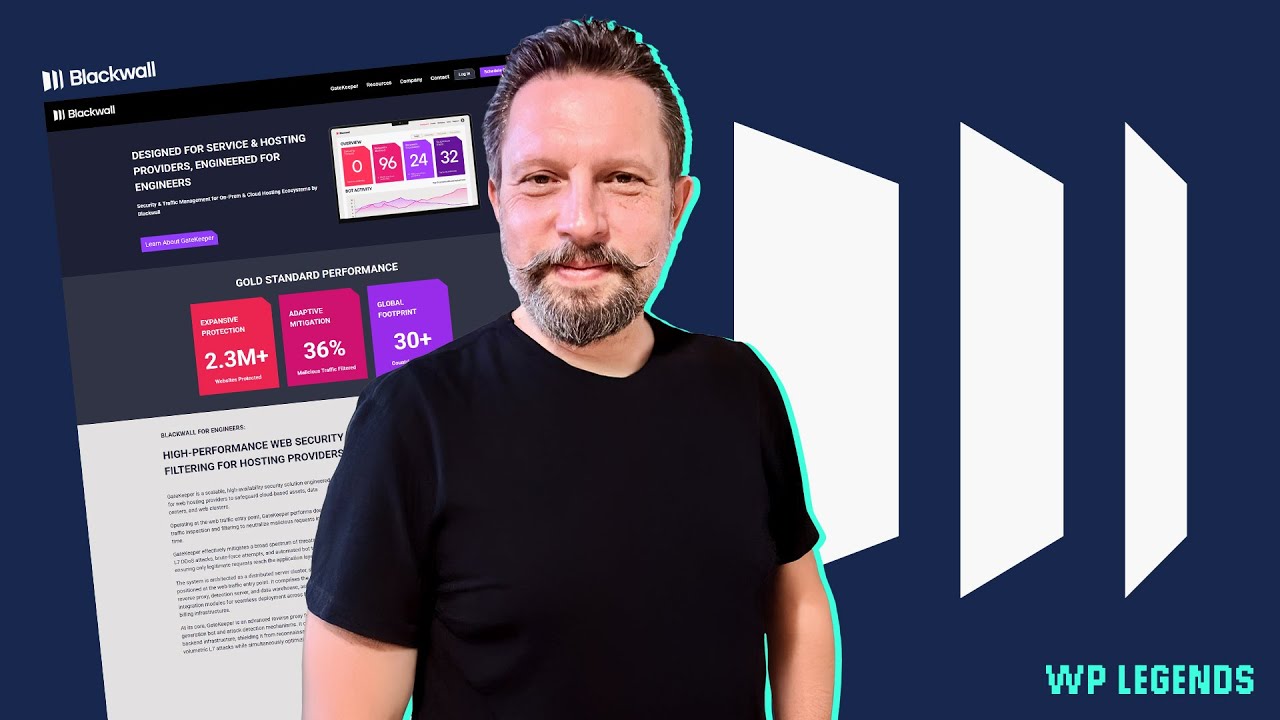
In this episode of WP Legends, we sit down with Robert Jacobi, Chief Experience Officer at Blackwall, a global web security provider serving hosting companies, managed service providers, and agencies around the world.
Robert’s career spans more than two decades across open source, hosting, and WordPress leadership. From his early days as president of Open Source Matters, the legal entity behind Joomla, to running the WordPress business unit at Cloudways, he has helped shape how the web scales securely and collaboratively. Now at Blackwall, he is focused on making the modern web safer, faster, and more resilient by protecting hosting providers, agencies, and end users from malicious bots and evolving AI-driven threats.
In this conversation, Gautam and Robert dig into the future of web security, the evolving relationship between open source and SaaS, the trouble with cheap hosting, and how the WordPress community creates room for anyone to meet anyone.
Watch the Episode
What Blackwall Does
Robert keeps the explanation simple. Blackwall provides a platform that lets partner hosting providers, MSPs, and agencies build their own web traffic management products. Partners can embed the solution in the cloud or on-premises and then sell those capabilities to their own customers, primarily on the security side through bot mitigation, deterrence, and management.
That management piece matters because not every bot is bad. Over half of all internet traffic is now bot-related rather than human, so the job is twofold: making sure real people reach where they are meant to go, and making sure the good bots, from search engine crawlers to pricing tools to AI agents, land in the right places. As the agentic wave builds, Robert expects the balance to become even more important over the next year.
His own role shifts with the calendar. From September through November, it is heavily an evangelist and influencer role, getting the Blackwall name in front of the right people. Outside conference season, it moves toward government relations, investor relations, and translating everything he hears in face-to-face conversations back to the engineering and sales teams. As he points out, the nuance of traffic management rarely comes through clearly in email or Slack.
From Joomla to the Front Line of Web Security
Robert’s path to Blackwall runs through the open-source world. Based in Chicago, he spent years in the Joomla and Mambo communities, eventually becoming president of Open Source Matters. Joomla is marking its twentieth anniversary this year, and that long grounding in community and open source has shaped how it leads today.
He did not step into an active WordPress community role until around 2017, and his most recent chapter before Blackwall was running the WordPress business unit at Cloudways, through its acquisition by DigitalOcean. After that, he took time to figure out his next move, kept speaking at events, and was approached by the company that would later become BotGuard at WordCamp Europe in Athens. A few months later, at the kickoff for MSP Global, he came on board. He has now been at Blackwall for two years.
The Biggest Threat to Hosting Companies
Asked to name the single biggest threat facing hosting companies, Robert did not hesitate: laziness.
In his framing, security is an onion. It has multiple layers, and each one needs to be protected as an attack vector in its own right. For a WordPress hosting stack, he sees three components that must be in place. There is a DNS and traffic management layer at the top, a WordPress layer in the middle, and a PHP and operating system layer at the base. No single platform is perfect, so all three need coverage. Threats are arriving faster, smarter, and more broadly, and skipping the homework of building a fully thought-out mitigation strategy is exactly how providers get into trouble.
He described what he only half jokingly called the golden triad of best-of-breed tools for each level: Blackwall at the traffic layer, Patchstack at the WordPress layer, and Monarx at the PHP and operating system layer. Pieces can be swapped in and out, but the principle is layered defense rather than a single point of protection. That layered approach is the same thinking behind serious WordPress maintenance and care, where security is treated as ongoing work rather than a one-time setup.
Why Hosting Should Stop Racing to the Bottom
The conversation turned to pricing, and Robert was blunt about the industry’s long race to the bottom. The model of giving hosting away for a dollar a year and hoping customers renew at fifty is, in his words, nonsense. If you are running a million-dollar e-commerce business, quibbling over a few dollars a month for reliable hosting makes no sense. As he put it, that is a cup of coffee a month, and how many times have you spilled coffee?
He reached for a car analogy that recurs throughout the episode. You can buy a broken-down old car for a few dollars, but it will not get you to the end of the block. You do not need a luxury car either. What you need is something solid, reliable, tested, and equipped with real safety features. Hosting deserves the same lens.
The providers he admires never settled on cheap. He pointed to Rocket.net, now part of hosting.com, which built its business on premium pricing and used that headroom to focus on the partnerships and value its customers actually need, recently extending into e-commerce through an acquisition. The lesson for founders is to offer something competitors are not, and to charge accordingly.
Shared Hosting, AI Builders, and the Future of WordPress
Does shared hosting have a future? Robert’s view is that it is quietly getting rebranded. Proprietary platforms like Wix and Squarespace are, in effect, shared hosting at a SaaS level, repackaged and made pretty, and GoDaddy’s Airo push sits in a similar space. The term itself means nothing to most end users. Outside of tech, people do not think about shared hosting; they just want a website that works.
On the rise of AI site builders like Lovable and Base44, with hundreds of thousands of sites reportedly being spun up daily, Robert stayed measured. Whatever you build still has to be hosted somewhere, so that market is not fully baked yet. He gives those platforms real credit for ease of use, but comes back to ownership. Leave your content on a closed platform, and you are in the same position as leaving it on Facebook or a proprietary store, where the platform wants your attention and, to some degree, your content. WordPress offers the opposite through its open source nature, freedom to move, and genuine ownership.
He is bullish on WordPress precisely because of that freedom and its enormous market share, and expects third-party providers, including Extendify, to keep building experiences that use WordPress as the foundation. Gautam added the Elementor angle, noting that a striking share of the web, somewhere around ten to twelve percent, now runs on Elementor, a figure Miriam Schwab had shared with him in a recent episode. Tools that make launching faster, Robert agreed, lift the whole ecosystem. A rising tide raises all boats, and as long as everyone keeps investing resources into WordPress, everyone benefits. For agencies serving other agencies, that same logic underpins white-label WordPress work.
Leadership and the Open Nature of the WordPress Community
After so many roles, from founder to advisor to executive, Robert’s leadership philosophy has stayed consistent: listen more than you speak. He genuinely likes people, believes in the range of choices humans are capable of, and wants to understand what someone actually needs and on what timeline before jumping to solutions. His closing thought on it was pointed. The more technology promises to fix things quickly, the more we actually need to talk to each other.
That belief connects to what he loves most about this ecosystem. Open source, especially WordPress, creates the opportunity for anyone to meet anyone. He recalled meeting the CEO of Newfold Digital at a WordCamp, and stressed that WordCamps, particularly the major ones, open that door to everyone, not just people with a C in their title. When he started out, his titles were forgettable, and it made no difference. Show up, take the opportunity, and your horizons expand.
Making the Most of WordCamps and CloudFest
Robert is one of the most seasoned event attendees in the space, and he has practical advice for anyone starting out. WordCamp Europe is a favorite across industries, more business-oriented than most, and the place where real deals get done. In fact, his move to Blackwall traces directly back to a business conversation there. WordCamp US is his favorite for its local, community-first feel and the chance for one-on-one conversations with some of the most important people in the ecosystem.
On the hosting and infrastructure side, CloudFest is his standout. The US edition in Miami impressed him with its crowd and networking, but the original CloudFest in Germany, with more than ten thousand people spanning hosting, infrastructure, security, WordPress, and hardware, is on another level. He encourages people stuck in the WordPress bubble to attend and see the wider world of ideas and opportunities. He also praised the CloudFest networking app, including a new recommendation engine this year that surfaced strong matches based on attendee profiles.
His tips for first-timers are hard-won. Book roughly 70% of your meetings in advance, because at a 10,000-person event, back-to-back half-hour meetings from morning to evening turn into a marathon run at sprint speed. Sneak in fifteen-minute naps wherever you can, favor water over heavy meals, and give honest feedback afterward. His one recurring complaint across events is the coffee, and true to form, Blackwall brings its own espresso machine to its booths.
Fun Rapid Fire Round
To close, Robert took on the rapid-fire round.
On where he truly learned leadership and built his network, WordPress or Joomla, he gave it to his Joomla years without much hesitation, crediting a decade in that community before stepping into an active WordPress role.
On how much of the web still runs on Joomla, he estimated around 2%, making it the largest open-source CMS after WordPress, ahead of Drupal and others, with a long history as a genuinely multilingual and multicultural platform.
When asked what people still misunderstand about web security in 2025, his answer became a classic. The old line was that humans are the problem. The new one is that humans are still the problem, but now AI actors are behaving like humans, too. He singled out SSL as the great misconception, stressing that SSL is encryption in transit, not security in itself, and that end-to-end encryption of stored data is what really protects people when everything else fails. AI, he warned, only sharpens the threat, compressing attacks that once took weeks into seconds at a massive scale.
And for an underrated WordPress memory, he offered one that anyone can replicate. The first time he direct messaged Matt Mullenweg on the WordPress Slack and got a reply. The fact that a co-founder running such a huge share of the internet still reads and responds captures, for Robert, exactly what makes this community special. His advice to viewers: do not hesitate to reach out to founders and CEOs at WordCamps and CloudFest, because they want to meet you.
Get Featured on WP Legends
Are you a plugin creator, WordPress entrepreneur, or someone building something cool in the WP space? We’d love to share your story on WP Legends.
Powered by hosting.com