AI in ecommerce is no longer a competitive advantage reserved for large retailers. In 2026, it is the operating layer that separates stores that are growing consistently from those losing ground to competitors who show customers what they want before they even search for it.
This guide breaks down exactly how AI improves shopping experiences, drives more sales, and what each use case means for your store.
AI in ecommerce refers to the use of machine learning, natural language processing, and generative AI to personalise shopping experiences, automate customer interactions, optimise pricing, predict inventory demand, and drive measurable revenue growth for online stores. It covers product recommendation engines, AI-powered search, conversational shopping assistants, dynamic pricing, and fraud detection running automatically in the background.
How Rapidly is AI Changing Ecommerce in 2026?
The AI in ecommerce market has grown past $9 billion in 2025 and is projected to reach $64 billion by 2034. Over half of online shoppers now use AI tools during their shopping journey, and more than a third start product searches with an AI assistant rather than a traditional search engine.

Nine in ten retail executives expect AI to be used more than traditional search engines by their customers before the end of 2026. The shift is not coming. It is already happening.
How AI Personalizes the Shopping Experience?
AI helps ecommerce websites create more personalized shopping experiences by analyzing customer behavior, browsing patterns, purchase history, and product preferences in real time. This allows online stores to recommend more relevant products and improve customer engagement across the shopping journey.
AI-powered personalization also improves product discovery, upselling, and customer retention by showing shoppers products they are more likely to buy. Features like personalized recommendations, dynamic search results, recently viewed products, and AI-driven product suggestions help ecommerce businesses increase conversions and create smoother shopping experiences.
Want Your Ecommerce Store to Keep Performing Smarter?
Support better shopping experiences, faster performance, and long-term sales growth with expert ecommerce website care built for online stores.
Key Ways AI in Ecommerce Drives Better Shopping and More Sales
AI helps ecommerce businesses personalize shopping, improve product recommendations, automate tasks, and create faster, more relevant customer experiences that increase conversions and sales.

AI-Powered Product Recommendations
AI recommendation engines analyze browsing behavior, purchase history, and real-time session signals to surface products each visitor is genuinely likely to buy. The technology has moved well beyond simple collaborative filtering into predictive purchase modeling that adapts to each visitor in the moment.
Stores that treat recommendations as a core revenue driver rather than a sidebar widget consistently outperform those that do not, and the gap widens as the AI model accumulates more behavioral data to work from.
Conversational AI and Shopping Assistants
AI shopping assistants guide customers through product discovery using natural language. A customer searching for “comfortable shoes for standing all day at work” gets a curated result based on understood intent rather than a keyword match. These tools interpret context, ask clarifying questions, and surface options that fit the customer’s actual situation.
AI chat increases conversion rates by up to four times compared to unaided browsing. It catches customers at the point of hesitation, answers questions in real time, and re-engages those about to leave with relevant suggestions. Businesses using AI chat report significantly lower cart abandonment rates as a direct result.
AI-Powered Search and Visual Discovery
Visual search lets customers upload an image and find matching products instantly without needing to describe them in words. This removes one of the biggest friction points in mobile commerce, where typing a detailed description is cumbersome and often inaccurate. Visual search users spend significantly more per session than text search users because intent is stronger and match quality is higher.
Voice search adds another discovery layer for hands-free moments. Conversational search interfaces handle queries that do not fit neatly into a keyword box and feed those signals back into the personalization engine. Together, visual and voice search give your store more ways to connect with customers when they are ready to buy.
Dynamic Pricing and Margin Optimization
AI pricing tools monitor competitor prices, demand signals, and inventory levels in real time and adjust your prices automatically based on the rules you define. When a competitor goes out of stock, your system identifies the opportunity and responds within minutes without manual review.
The key advantage over manual pricing is continuous optimization. A human team reviews pricing periodically. An AI pricing system optimizes around the clock, responding to market changes that happen overnight or over a weekend when no one is watching. Retailers using AI pricing consistently report margin improvements and measurable increases in average order value.
AI Customer Service and Support Automation
AI customer support handles order status queries, return requests, product questions, and shipping updates instantly, 24/7, without adding headcount. Your human team focuses on complex or high-value conversations where judgment and empathy matter. Businesses that use AI consistently report lower support costs and faster resolution times.
A customer who gets an instant, accurate answer during the purchase decision is far more likely to complete their order. AI chat tools that engage customers proactively during browsing sessions, not just reactively after a ticket is raised, reduce the uncertainty that causes hesitation before checkout and drive measurable conversion lifts.
Predictive Inventory and Demand Forecasting
Predictive inventory tools analyze historical sales data, seasonal patterns, and external signals to forecast demand at the product and variant level. You stock what you need before demand peaks rather than reacting after you run out and miss sales.
AI forecasting significantly reduces supply chain errors, cutting lost sales from stockouts and warehousing costs from overstock. Stores using predictive inventory management reduce lost sales by up to 30 percent compared to those using manual reorder processes. The model becomes more accurate over time as it accumulates more data about your specific catalog and customers.
Fraud Detection and Security
AI fraud detection analyses every transaction in real time against thousands of signals, including device fingerprinting, behavioral patterns, transaction velocity, and IP reputation. Legitimate orders clear instantly. High-risk ones are flagged or blocked without the manual review overhead that slows fulfillment.
Unlike rule-based systems that require manual updates when fraudsters adapt, AI fraud systems learn continuously from new patterns across the broader transaction network. Your protection improves over time rather than degrading as attackers develop new approaches. For stores processing significant volumes, AI fraud detection reduces chargeback rates meaningfully while keeping checkout smooth for genuine customers.
How AI Changes Ecommerce Discovery and Search
AI is changing how customers discover products online by shifting ecommerce from traditional keyword-based search toward conversational, visual, and AI-assisted shopping experiences. Search engines, AI assistants, and recommendation systems now play a major role in deciding which products customers see first and which brands gain visibility online.
What is Agentic Commerce and Why Does it Matter?
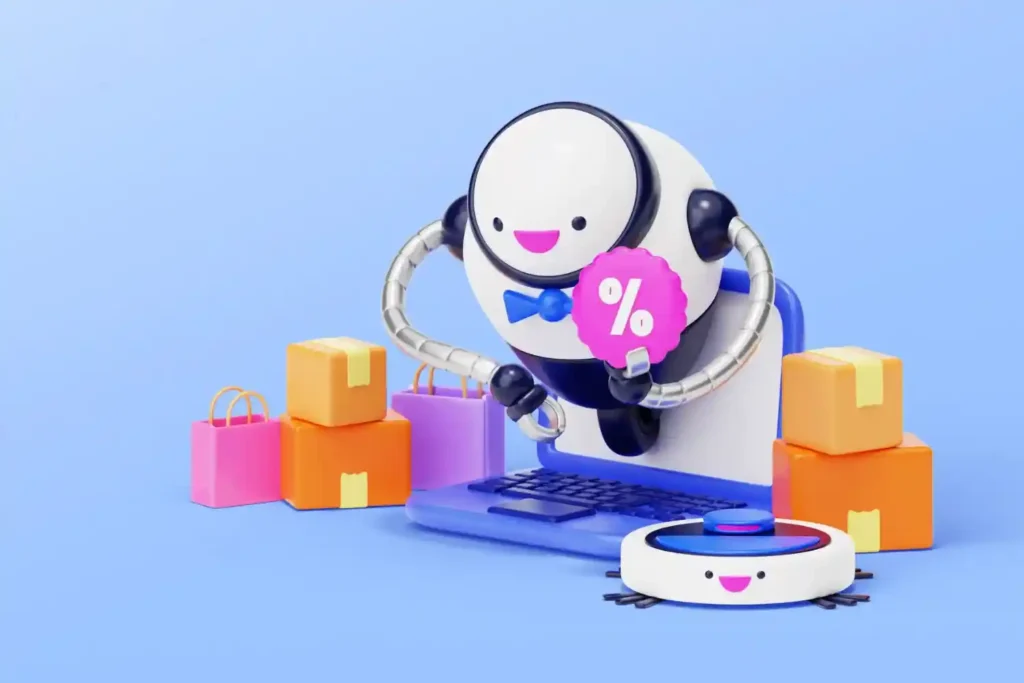
Agentic commerce is the next stage beyond AI-assisted shopping. Rather than helping customers find and choose products, AI agents take actions on their behalf. A user instructs an AI agent to find the best-priced hiking boots within a given budget, and the agent handles discovery, comparison, and checkout across multiple stores without the user having to click through pages.
McKinsey projects that agentic commerce could generate up to $1 trillion in US B2C retail revenue by 2030. Stores with AI-ready product data, structured checkout flows, and strong schema markup will appear in AI agent recommendations as this channel scales.
Stores with poor product data, missing schema, or confusing URL structures will be invisible to a growing share of purchasing decisions being made by AI on behalf of human shoppers.
How AI in Ecommerce Affects SEO and Product Discoverability?
Consumers increasingly ask AI assistants for product recommendations rather than searching Google. They receive curated answers rather than a list of links. Being one of the few products an AI assistant recommends is the new version of ranking on page one, and the criteria for earning that position are different from traditional SEO.
Ecommerce stores are now marketing to AI algorithms as much as to human shoppers. Those algorithms evaluate product data quality, brand authority, review sentiment, and structured content signals to decide what to recommend. Answer engine optimization, product schema markup, FAQ content, and structured product attributes are now as important as keyword optimization for maintaining long-term discoverability.
How to Start Using AI in Your Ecommerce Store?
You do not need a complex infrastructure project to get started. These are the highest-impact entry points for most stores.
- Start With Product Recommendations: The fastest return on AI investment. Even basic recommendation engines significantly outperform no recommendations and improve as your data grows.
- Add AI-Powered Customer Support: Deploy a conversational AI tool for order tracking, returns, and product FAQs before expanding to guided discovery.
- Implement AI-Powered Site Search: Replace the default search with an NLP-powered tool that understands conversational queries and returns results based on intent.
- Use Predictive Analytics for Inventory: Connect your sales history to a demand forecasting tool before your next peak season to reduce stockouts on high-demand products.
- Add Structured Data and Schema Markup: Product, FAQ, and review schema make your store more visible to both traditional search engines and AI-powered discovery tools.
- Clean Up Your Product Data: AI systems are only as accurate as the data they run on. Complete and consistent product titles, descriptions, attributes, and images are the foundation on which every AI application depends.
Conclusion: AI and Ecommerce
Artificial intelligence in ecommerce is a present competitive advantage for stores that implement it and a growing disadvantage for those that do not.
Start with product recommendations and AI-powered support, clean up your product data, and add structured markup for AI discoverability. Each improvement compounds the next. The stores building this foundation now will be significantly better positioned as agentic commerce scales over the next two to three years.
FAQs About Using AI for Ecommerce Stores
What is AI in ecommerce?
Artificial intelligence in ecommerce is the use of machine learning, natural language processing, and generative AI to personalize shopping experiences, automate customer interactions, optimize pricing, predict demand, detect fraud, and drive measurable revenue growth for online stores.
How does AI improve the shopping experience?
AI surfaces relevant products in real time, enables conversational and visual product discovery, provides instant customer support at any hour, and personalizes every touchpoint based on individual behavior and intent rather than broad segments.
What is agentic commerce?
Agentic commerce refers to AI systems that autonomously complete purchasing actions on behalf of users, including discovery, comparison, and checkout with minimal human input. It is already generating measurable ecommerce revenue in 2026.
How does AI increase ecommerce sales?
AI increases sales by boosting conversion rates with personalized recommendations, boosting average order value with AI-powered upselling, reducing cart abandonment through real-time engagement, and improving inventory availability through demand forecasting.
What AI tools are best for small ecommerce stores?
The highest-impact starting points are a product recommendation plugin, an AI chatbot for customer support, an NLP-powered search tool, and product schema markup for AI and search visibility. Each delivers measurable returns without requiring enterprise infrastructure.