WordCamp Asia 2026 in Mumbai was our most memorable event of the year. Ankur Gandhi and Abhay Shah from our team attended all three days at the Jio World Convention Center, and we left with far more than notes from sessions. We left with a completely fresh perspective on what the WordPress community is, what it stands for, and where we fit inside it.
From Contributor Day on April 9 to the closing keynote on April 11, the energy was consistent, the sessions were sharp, and the connections were real. Here is our full recap of everything that made WordCamp Asia 2026 unforgettable.
What Was WordCamp Asia 2026 in Mumbai?
WordCamp Asia 2026 in Mumbai brought together thousands of WordPress professionals, contributors, businesses, and creators for three days of learning, collaboration, networking, and innovation.
A Quick Overview of WordCamp Asia 2026
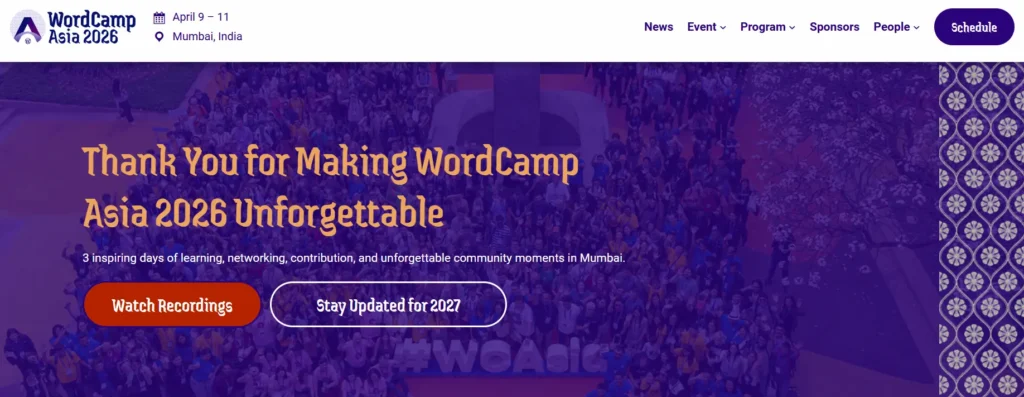
WordCamp Asia 2026 was the fourth edition of Asia’s flagship WordPress conference. It was hosted at the Jio World Convention Center in Bandra Kurla Complex, one of Mumbai’s most well-connected business districts. The event ran over three days, April 9 to 11, 2026, and welcomed professionals from across the globe.
The conference featured multiple session tracks: Foundation, Growth, and Enterprise. These ran simultaneously across dedicated rooms, giving attendees the flexibility to follow topics most relevant to them. Workshops ran in parallel and offered hands-on, practical learning separate from the main stage sessions.
Key Statistics and Highlights From WCAsia 2026
The numbers from this year’s event speak for themselves:
- 2,400+ attendees across all three days
- 70+ speakers from around the world
- 40+ sponsors powering the event
- 50 countries represented in the crowd
- 1,500+ contributors on Contributor Day
- 300+ first-time contributors
- 19+ Make Teams with 38 table leads
- 60+ Open Source Library conversations held
These numbers confirm what we felt on the ground. This was a large, diverse, and deeply engaged community gathering.
Why WordCamp Asia Matters for the Global WordPress Community?
WordCamp Asia is more than a regional event. It represents the broader open-source values that WordPress was built on. If you want to understand what WordCamps truly stand for, community-driven learning, open collaboration, and the spirit of building together, attending this event makes it instantly clear.
India has one of the most active WordPress ecosystems in the world. With over 20 active community groups and 15+ major events in 2025 alone, it was a natural fit to host this edition. The choice of Mumbai as the host city also added cultural richness, giving the event a unique energy.
Contributor Day at WordCamp Asia 2026 Mumbai
Contributor Day on April 9 was our first full day at the event, and it set the right tone right away. Over 1,500 contributors gathered across 19+ Make Teams. Table leads guided participants, many of whom were first-timers, through real tasks that directly impact the WordPress project.
Key teams like Polyglots saw 70+ contributors suggest more than 7,000 strings on-site. The Photos table saw 76 photos uploaded, primarily by 31 first-time contributors. The Support team addressed 15+ new topics and cleared 25+ unresolved ones. Even smaller tables, like WPCS, onboarded 15 new contributors, all focused on learning.
What struck us immediately was how welcoming every table felt. Experienced contributors did not guard their knowledge; they actively shared it. There is a culture of giving here that you simply do not find in most other tech circles. The Contributor Buddy initiative, which paired new attendees with experienced contributors, made this even more visible and effective.
The Open-Source Library ran alongside the main sessions, hosting 60+ conversations and 18 “Books” experienced contributors who shared personal stories from their open-source journeys. These were not lectures. They were genuine, one-on-one exchanges that helped new contributors, including us, understand where we could contribute and grow.
Best Workshops and Learning Sessions at WordCamp Asia 2026
The workshops across all three days were, without question, among the most valuable parts of the event. Every session we attended was full. And unlike some workshops that stay surface-level, these went deep.
On Contributor Day, four workshops ran with a combined 320+ participants:
- WordPress Core Development Setup helped 60+ participants get their local environments ready
- Beginner’s Guide to WordPress introduced 80+ newcomers to platform fundamentals
- Building a Block Theme from Scratch guided 85+ attendees through modern theme development, and this session connected directly to what is happening with full site editing in WordPress today
- Beginner’s Guide to SEO drew 100+ participants and left each one with a clear action plan
On conference days, workshops tackled advanced topics. Sessions on WP-CLI automation, AI-assisted agent building, and cloud-based WordPress installations gave developers concrete tools to bring back to their workflows.
Abhay and Ankur walked out of multiple sessions with pages of notes. But more than the notes, we walked out with a roadmap. The speakers did not provide how-to guides. They provided a clear picture of where the web is heading and what we need to do to stay ahead.
AI, Automation, and the Future of WordPress at WCAsia 2026
If there was one theme that cut across every track, it was artificial intelligence. And for us, attending these sessions was nothing short of a masterclass in where the web is headed.
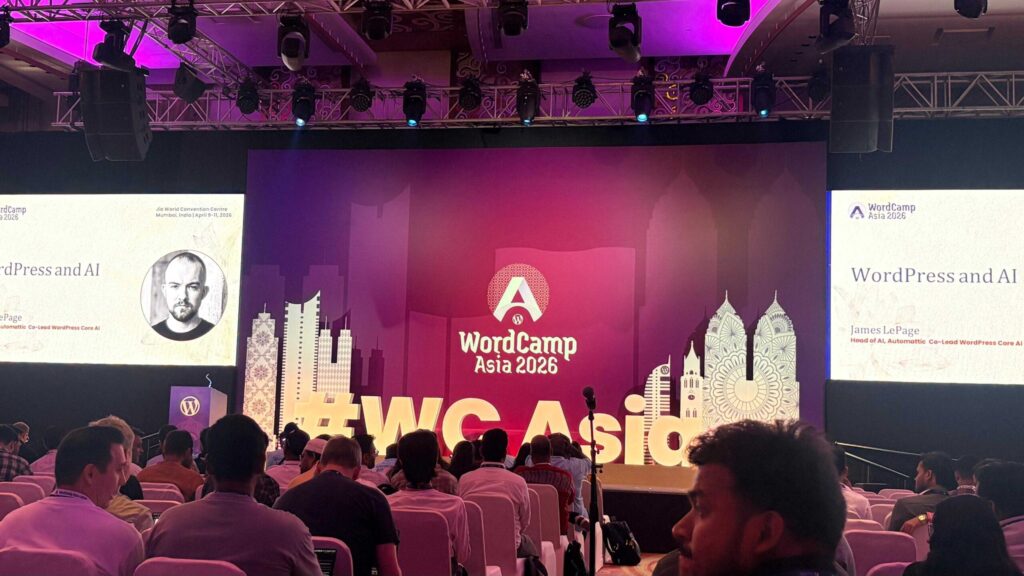
James LePage, Head of AI at Automattic, opened Conference Day 1 with a session on how content and publishing are changing in the age of AI. His core point: while AI is transforming creation, distribution remains the real differentiator. Content alone no longer drives impact. Reach does.
Fellyph Cintra’s session on WordPress Playground and AI showed how developers can build autonomous testing pipelines moving from reactive, manual testing to intelligent, self-running systems. This shifted how we think about quality assurance in our own work.
One of the most thought-provoking sessions came from Miriam Schwab, who framed MCPs (Model Context Protocols) as “the hooks of the AI era” a way to give AI models the context they need to work intelligently with WordPress. If you’re interested in how these workflows are evolving, understanding MCP for web creators is worth exploring in depth.
Nirav Mehta’s session stayed with us long after it ended. He described an “honest journey” through AI, the hype, the headaches, and the real wins. His closing line, “Stay curious, stay grounded,” became an unofficial theme for Day 1.
The AI panel on marketing, moderated by Alexander Ando-Michaelson and featuring voices from BlogVault, Missive Digital, and Thrivemattic, was candid and specific.
It addressed what is actually changing in content strategy and SEO, not just the theory. For agencies and marketers, this was one of the most practically useful sessions of the event.
Keynote Speakers and Top Sessions at WordCamp Asia 2026
Mary Hubbard, Executive Director of WordPress, delivered one of the conference’s most impactful talks. She positioned WordPress as a trust-first platform, one where open-source principles and community scrutiny actively strengthen security. She also introduced a forward-looking concept: WordPress as an agentic platform, where AI-driven plugins are making workflows increasingly autonomous.
Matt Mullenweg, co-founder of WordPress, was scheduled to deliver the closing keynote but was unable to attend due to a health issue. The community’s warmth and concern were visible immediately. In his place, a Q&A panel featuring Mary Hubbard, Chenda Ngak, Peter Wilson, and Sergey Biryukov stepped in with depth and authenticity.
The panel covered the open-source philosophy powering WordPress, the platform’s evolving direction in the AI era, and the responsibilities of those who maintain the web’s most widely used CMS. It was the kind of conversation that doesn’t happen often in public, and the room gave it the attention it deserved.
Anirban Mukherji of miniOrange spoke directly to startup founders, sharing how he built his company from WordPress, the platform powering 43% of the web. His message was clear: the platform gives you access to a massive customer base from day one.
Rahul Bansal’s rtCamp session on starting an enterprise WordPress agency in 2026 was one of the most referenced talks of the event. It was grounded in experience and didn’t shy away from the hard realities of scaling.
Career Corner and Networking Opportunities at WordCamp Asia 2026
The Career Corner was a consistent draw throughout both conference days. It gave attendees a structured space to discuss career pivots, freelancing, and professional growth within the WordPress ecosystem.
One standout talk, “From Mumbai to WordPress: How Community Shaped My Career Change,” hit close to home for us. It illustrated exactly how the WordPress ecosystem can serve as a career pathway for anyone willing to show up and contribute, not just developers, but people from all kinds of professional backgrounds.
Beyond the formal sessions, the hallways, lunch breaks, and shuttle rides were where much of the real networking happened. As this was our first WordCamp at this scale, we were honestly blown away by what we found.
Every person we spoke with, from independent developers to business owners running large agencies, was incredibly open to conversation. They shared ideas freely. They asked real questions. And they gave us perspectives that actually shifted our internal thinking and challenged some of our existing business assumptions.
There is an unmatched support culture here. People genuinely want each other to succeed. That is not something you find in most tech circles, and you do not quickly forget it.
We had similar networking experiences at WordCamp Pune 2025, but the scale and diversity of conversations at WCAsia 2026 added a completely new dimension to what community connection feels like.
Sponsor Hall Highlights and WordPress Ecosystem Innovation
The sponsor hall was open across both conference days and remained one of the most energetic spaces in the venue. Super Admin sponsors included Elementor, Hostinger, Jetpack, PayPal, Pressable, Salesforce, and WordPress.com. Google and Woo held Admin-level sponsorships.
For us (Ankur Gandhi and Abhay Shah), the sponsor area was where we spent a significant portion of our time. We met with current partners face-to-face, converting digital relationships into grounded, real-world ones.
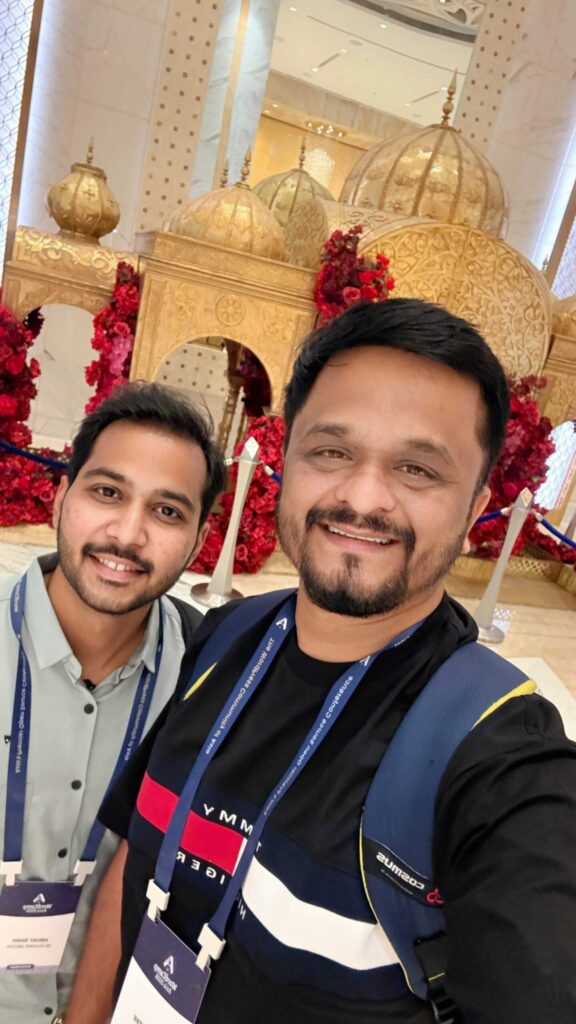
We met with several of our current partners face-to-face, turning existing digital connections into solid, real-world relationships. There is a different quality to in-person conversation. Things get decided faster, trust gets built quicker, and the partnerships that follow feel more grounded.
Beyond our existing partners, we dove deep into conversations with other stalls about possible collaborations. We did not walk by; we sat down, asked questions, and explored what working together could actually look like.
It was inspiring to see how many players in the ecosystem were actively looking for win-win scenarios that benefit the wider community rather than just their own bottom line.
That spirit of openness reflects a deeper reality about how WordPress communities worldwide continue to operate, with shared progress taking precedence over competitive positioning.
YouthCamp and Open Source Community Experiences
YouthCamp ran during Contributor Day and offered 20+ young participants aged 15 and under a guided WordPress build session. This wasn’t a lecture format. Each child worked in a small group, followed a step-by-step flow, and walked away with a live webpage they had built themselves.
The session wrapped with a mini showcase where groups presented their work. Recognitions like “Most Creative” and “Best Teamwork” celebrated effort over perfection. Facilitators Sourabh Matolia and Kishan Jasani kept the session energetic and encouraging throughout.
YouthCamp sits at the intersection of open-source culture and education. Seeing children understand that WordPress is built by a global community of volunteers and contributors, and that they can be part of that story, was genuinely moving.
The Open-Source Library, running parallel on Contributor Day, added a different kind of depth. Experienced contributors served as “Books” available for one-on-one or small-group conversations covering contribution pathways, leadership, open-source culture, and personal journeys. It created the kind of reflective learning space that standard sessions rarely do.
Food, Fun, and Community Moments at WordCamp Asia Mumbai
The food at WCAsia 2026 deserves an honest mention. The menu was thoughtfully curated for a global audience, featuring the best of Indian cuisine alongside options for different dietary preferences.
Lunch breaks were not just breaks; they became social moments. Some of our best conversations of the entire trip happened over food, with people we had never met before and would not have connected with otherwise.
The After Party on April 11 carried the theme “Disco Deewane,” a celebration of unapologetic joy. From 7:00 PM to 10:00 PM in Jasmine Hall 1, the community came together with music, lights, and the kind of spontaneous energy that only happens when the formal schedule is over and everyone is simply present.
The sponsor raffle brought the entire hall together in one shared, joyful moment. It was one of those rare event beats where people who had spent the day in separate rooms all found the same space and the same energy at the same time.
Looking back, we are genuinely glad we committed to all three days. Each day offered a different layer of depth, from the contributions and hands-on learning of Day 1 to the strategic sessions of Day 2 to the celebration and community of Day 3. We left Mumbai not just with more knowledge, but also with renewed inspiration and a clear vision of how we want to grow within this community.
Key Takeaways From WordCamp Asia 2026 for Agencies, Developers, and Marketers
Three days gave us a lot to process. Here is what stood out most clearly:
- For agencies: Enterprise WordPress is no longer just about execution. Sessions like James Giroux’s talk on the “Agentic Future” made it clear that strategic thinking and AI integration are becoming the actual differentiators. Starting with a clear niche matters more than ever.
- For developers: AI is not replacing development skills; it is expanding them. Sessions on autonomous testing pipelines, AI-assisted agent building, and MCP integration showed us that developers who understand these tools will shape what’s next. The future of WordPress is deeply connected to how developers engage with AI infrastructure.
- For marketers: Distribution and discoverability are the real challenges now. AI can generate content at scale, but building the audience and platform to reach people requires a deliberate strategy. The marketing panel made this distinction clearly and practically.
- For everyone: Contributing to open source isn’t just altruistic. It builds skills, builds visibility, and builds relationships. Contributor Day reinforced this at every table.
When we compare this experience to WordCamp Europe 2025, the focus on emerging markets, AI integration, and community-first growth felt more pronounced at WCAsia 2026, reflecting both the host city and the current moment in the WordPress ecosystem.
Looking Ahead to WordCamp Asia 2027
The closing ceremony delivered two announcements that brought the room to its feet.
First, India was officially named the fourth flagship WordCamp host country, a recognition of the scale, energy, and quality of what its community has built over decades.
Second, Penang, Malaysia, was announced as the host city for WordCamp Asia 2027, scheduled for April 9–11, 2027. For a community that travels to connect and contribute, this was the perfect way to close an extraordinary three days.
We will be there. And if WordCamp Asia 2026 is any indication, the next edition will be even bigger.
FAQs About WordCamp Asia 2026 Mumbai Highlights
What was WordCamp Asia 2026, and where did it take place?
WordCamp Asia 2026 was the fourth edition of Asia’s flagship WordPress conference. It took place at the Jio World Convention Center in Mumbai, India, from April 9 to 11, 2026. The event welcomed 2,400+ attendees from 50 countries.
What happened on Contributor Day at WordCamp Asia 2026?
Contributor Day ran on April 9 and brought together 1,500+ contributors across 19+ Make Teams. Participants worked on real WordPress tasks covering translation, documentation, design, testing, and more. The day also featured four workshops, YouthCamp, and the Open-Source Library.
Who were the keynote speakers at WordCamp Asia 2026?
James LePage, Head of AI at Automattic, and Mary Hubbard, Executive Director of WordPress, delivered keynote sessions. Matt Mullenweg was scheduled for the closing keynote but could not attend due to a health issue. A panel featuring Mary Hubbard and other WordPress leaders stepped in and delivered a strong, candid session.
What was the main theme of WordCamp Asia 2026?
Artificial intelligence dominated the conversation across all three days. Sessions covered AI-driven content publishing, autonomous testing pipelines, MCP integration, and AI’s impact on marketing. The broader theme was using AI to build smarter, not just faster.
Where will WordCamp Asia 2027 be held?
WordCamp Asia 2027 will take place in Penang, Malaysia, scheduled for April 9 to 11, 2027. The announcement was made during the closing ceremony of WordCamp Asia 2026 in Mumbai.