In this guide, you will learn how domain flipping works, how to evaluate profitable domains, essential tools for research, common risks to avoid, and proven strategies to maximize your returns in today’s competitive market.
The digital economy is expanding at an unprecedented pace. As more businesses move online and new startups emerge daily, the demand for premium domain names continues to rise.
A strong domain is no longer just a web address; it is a branding asset, a credibility signal, and in many cases, a competitive advantage.
This growing demand has fueled the rise of domain flipping, a practice where investors purchase domain names at a lower price and sell them later for a profit. Similar to real estate investing, success depends on identifying undervalued assets and understanding market trends.
Consequently, domain investing has become increasingly popular among entrepreneurs, SEO professionals, side hustlers, and digital investors seeking scalable online income opportunities.
TL;DR: Domain Flipping Explained in Simple Terms
- Domain flipping involves buying domain names at low prices and selling them later for profit.
- High-value domains are short, brandable, keyword-rich, geo-targeted, or trend-focused.
- .com domains generally have the highest resale demand.
- Research search volume, CPC, backlinks, and trademark risks before buying.
- Use tools like SEMrush and Ahrefs for evaluation.
- Avoid hype purchases, overpricing, and legal risks.
- Success requires patience, negotiation skills, and strategic portfolio management.
What is Domain Flipping?
Domain flipping is the practice of purchasing domain names at a relatively low price and reselling them at a higher price.
Investors typically target undervalued, expired, or trend-driven domains that have strong branding or keyword potential. The objective is straightforward: acquire digital real estate with resale value.
How Domain Flipping Works?
At its core, domain flipping follows a buy-low, sell-high model. Investors identify promising domains, register or acquire them through marketplaces, and then list them for resale.
In some cases, they improve perceived value by adding a landing page or showcasing traffic metrics before negotiating with potential buyers.
Domain Flipping vs Long-Term Domain Investing
Although often used interchangeably, domain flipping and long-term investing differ in strategy. Flipping focuses on short-to-medium holding periods and quicker returns.
In contrast, long-term domain investing involves holding premium domains for years, waiting for significant appreciation or the right buyer.
Watch this podcast of Joseph Alagna, Chief Strategy Officer at it.com, as he sheds light on the exclusive opportunity to own a piece of the internet through top-level domains.
Examples of Successful Domain Sales
High-profile sales demonstrate the profitability of domain investing. For example, Voice.com sold for $30 million, while Business.com was acquired for millions due to its commercial relevance. These transactions highlight the substantial value that premium domains can command.
Why Businesses Pay Premium Prices?
Businesses invest heavily in premium domains because they enhance brand credibility, improve memorability, and often support SEO authority.
A concise, keyword-rich, or brandable domain can reduce marketing costs and strengthen long-term digital positioning, making the upfront investment strategically worthwhile.
Step-by-Step Process on How Domain Flipping Works
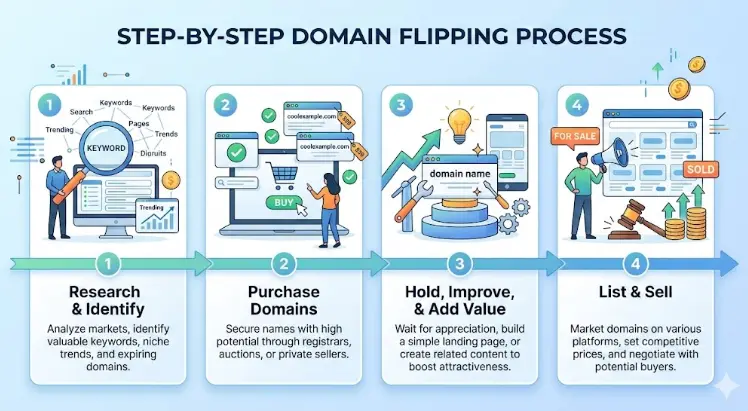
Understanding the mechanics of domain flipping is essential before investing capital. Although the concept is straightforward, profitability depends on disciplined research, strategic acquisition, and effective selling. Below is a structured breakdown of the process.
Step 1: Research and Identify Profitable Domains
The foundation of successful domain flipping begins with research. Investors typically analyze trending industries, high-search keywords, and emerging technologies to identify demand.
Additionally, expired domains with existing backlinks or traffic can offer hidden value. Brandable names, short domains, and geo-targeted combinations (such as city + service) also tend to perform well.
At this stage, data-driven evaluation reduces the risk of speculation.
Step 2: Purchase Domains
Once a promising domain is identified, the next step is acquisition. Domains can be registered at standard rates through registrars like GoDaddy or Namecheap.
Alternatively, investors can bid on premium or expired domains via marketplaces such as GoDaddy Domain Auctions, Atom.com, and Seahawk Domain Marketplace. Strategic buying, not impulsive purchasing, is critical to maintaining profit margins.
Step 3: Hold, Improve, or Add Value
After purchase, investors may choose to hold the domain until demand increases. However, adding value can improve resale potential.
For instance, creating a simple landing page, generating minimal traffic, or demonstrating keyword relevance can enhance perceived worth.
Step 4: List and Sell
Finally, the domain is listed on marketplaces like Sedo or Flippa. Effective pricing, clear positioning, and negotiation skills ultimately determine the return on investment.
Turn Your Domain Into a High-Performing Digital Asset
If you have secured a domain for personal or business use and not for flipping, then now is the time to maximize its value. Partner with Seahawk Media to transform your premium domain into a powerful, revenue-generating website.
Types of Domains That Sell Well
Not all domain names carry equal resale value. In fact, certain categories consistently outperform others due to demand, branding flexibility, and commercial intent. Understanding these high-performing domain types allows investors to make more calculated purchasing decisions.
Short and One-Word Domains
Short, single-word domains are highly desirable because they are easy to remember, type, and brand. For example, domains like “Orbit.com” or “Pulse.com” are versatile and scalable across industries.
Their simplicity increases brand authority and resale potential. Consequently, these domains often command premium prices.
Keyword-Rich Domains
Keyword-based domains contain high-search terms that align with specific services or industries. For instance, “BestMortgageRates.com” or “OnlineTaxConsultant.com” directly target user intent.
Because they support SEO relevance and improve click-through rates, businesses are often willing to invest heavily in such domains.
Brandable Domains
Brandable domains are unique, catchy, and easy to pronounce. Examples include “Zentrox.com” or “Bluvera.com.” Although they may not contain exact-match keywords, their memorability and distinctiveness make them attractive to startups seeking identity-driven branding.
Geo-Targeted Domains
Location-based domains combine a city or region with a service. Examples such as “MiamiPlumbingExperts.com” or “LondonDentalCare.com” appeal to local businesses. Since local SEO remains highly competitive, these domains often convert quickly.
Industry-Specific Niche Domains
Domains tailored to growing industries, such as “AIRecruitmentSolutions.com” or “CryptoPortfolioManager.com”, capitalize on trend-driven demand. As industries expand, so does the value of relevant domain assets.
New TLDs (.io, .link, .tv)
Although .com dominates, newer extensions are gaining traction. For example, tech startups often prefer “Launchpad.io,” while media brands may opt for “StreamHub.tv.”
These extensions can be strategic when aligned with industry positioning, though resale values vary based on adoption trends.
How to Evaluate a Domain’s Profit Potential?
Accurate evaluation is the cornerstone of profitable domain investing. Rather than relying on intuition, investors should assess measurable factors that influence resale value and market demand.
- Domain Length: Shorter domains generally perform better. Ideally, a domain should be under 15 characters, easy to spell, and simple to pronounce. Concise names are more memorable and typically command higher prices in competitive markets.
- Search Volume and CPC: If the domain contains keywords, analyze their monthly search volume and cost-per-click (CPC). High search volume indicates demand, while strong CPC suggests commercial intent. Together, these metrics signal monetization potential.
- Extension Value: Extension significantly impacts value. .com domains remain the gold standard due to global trust and recognition. However, niche extensions such as .ai (popular among tech startups) can also attract premium buyers when strategically aligned.
- Brandability: A domain should sound professional, scalable, and distinctive. Even without exact-match keywords, strong brand appeal increases buyer interest.
- Trademark Risks: Before purchasing, verify that the domain does not infringe on existing trademarks. Legal disputes can eliminate resale value entirely.
- Backlink Profile: For expired domains, analyze backlink quality and domain history. Spammy links or penalties reduce value significantly.
- Tools for Valuation: Platforms like Estibot provide automated price estimates, while SEO tools such as SEMrush and Ahrefs help assess keyword metrics and backlink authority.
Proven Tips for Profiting with Domain Investments
Success in domain investing rarely happens by chance. Instead, it requires disciplined strategy, calculated risk management, and long-term thinking. The following proven practices can significantly improve your return on investment.
- Focus on .com Domains First: Whenever possible, prioritize .com domains. They remain the most trusted and globally recognized extension. Because businesses instinctively prefer .com for credibility and branding authority, these domains are typically easier to resell and command higher prices.
- Follow Emerging Trends: Market demand drives domain value. Therefore, monitor fast-growing sectors such as artificial intelligence, fintech, health tech, remote work solutions, and sustainability. Acquiring relevant domains early, before the market becomes saturated, can position you for substantial upside when demand accelerates.
- Avoid Trademark Infringement: One legal misstep can eliminate potential profits. Always conduct trademark research before purchasing a domain. Avoid names that include established brand terms or protected phrases. This not only protects you legally but also ensures the domain retains legitimate resale value.
- Buy in Bulk Strategically: Diversification reduces risk. Instead of investing heavily in one speculative domain, build a balanced portfolio across industries and domain types. However, purchase selectively, as quality should always outweigh quantity to avoid excessive renewal costs.
- Be Patient: Finally, understand that domain flipping is not always a quick-turn strategy. Some domains sell within weeks, while others may take years. Patience, combined with strategic pricing and negotiation, often determines long-term profitability.
- Learn Negotiation Skills: Strong negotiation skills can significantly increase your profit margins. Rather than accepting the first offer, position your domain strategically by highlighting its brand value, keyword relevance, or traffic data. Also, set a realistic anchor price, remain professional during counter-offers, and avoid emotional decision-making.
Is Domain Flipping Worth it in 2026?
In 2026, domain flipping remains a viable opportunity, particularly as startups, AI-driven businesses, and niche service providers seek strong digital identities. Moreover, global trends in entrepreneurship and personal branding continue to fuel demand for premium domains.
However, profitability is no longer driven by speculation alone. The market has matured, competition has intensified, and buyers are more selective.
Therefore, success depends on strategic acquisition, proper valuation, and disciplined portfolio management. Investors who follow data-backed decisions and focus on high-demand sectors can still generate substantial returns.
Ultimately, domain flipping in 2026 is worth it, but only for those willing to treat it as a calculated investment strategy rather than a quick-profit scheme.
Risks of Domain Flipping
Despite its potential, domain flipping carries measurable risks.
- First, there is no guarantee of a buyer, which can tie up capital for extended periods.
- Additionally, annual renewal fees accumulate, reducing overall margins.
- Market trends can also shift quickly, making once-promising domains less attractive.
- Finally, trademark disputes or purchasing low-quality expired domains with spammy backlink profiles can eliminate resale value entirely.
Careful due diligence is essential to minimize these risks.
Common Mistakes to Avoid During Domain Flipping
Many beginners overpay for hype-driven or trend-based domains without validating demand. Similarly, buying long, complex, or hard-to-spell names reduces resale potential.
Another frequent mistake is neglecting trademark checks, which can create legal complications. Investors also underestimate holding timelines and renewal costs, leading to poor cash flow management.
Furthermore, emotional pricing, either setting unrealistic expectations or accepting low offers too quickly, can erode profits. To succeed, focus on research, discipline, and portfolio quality rather than impulse-driven purchases.
Conclusion
Domain flipping remains a strategic opportunity for investors who approach it with research, patience, and disciplined execution. While the concept is simple, buy low and sell high, sustainable profits depend on selecting high-demand domains, evaluating real market data, and managing risk effectively.
Moreover, understanding branding trends, keyword value, and buyer psychology can significantly improve outcomes. Although not every domain will sell quickly, a well-curated portfolio increases the likelihood of strong returns over time.
Ultimately, domain investing rewards informed decision-making and long-term thinking, making it a viable digital asset strategy in today’s competitive online marketplace.
FAQs on Domain Flipping
How much money do you need to start domain flipping?
You can start domain flipping with as little as the cost of registering a standard domain, typically $10–$15 per year. However, having a larger budget allows you to acquire higher-quality or expired domains with stronger resale potential.
How long does it take to sell a domain name?
There is no fixed timeline for selling a domain. Some domains sell within weeks, while others may take months or even years, depending on demand, pricing strategy, and market trends.
Are expired domains profitable for flipping?
Expired domains can be profitable if they have a clean history, quality backlinks, and relevant keyword value. However, proper due diligence is essential to avoid domains with spammy profiles or penalties.
Is domain flipping legal?
Yes, domain flipping is legal as long as you do not infringe on trademarks or engage in cybersquatting. Conducting trademark checks before purchasing helps prevent legal disputes.
Can domain flipping generate a full-time income?
Domain flipping can generate significant income, but it requires experience, strategic investing, and patience. For most beginners, it is advisable to start as a side investment before scaling into a full-time venture.