In a web world dominated by central repositories and marketplaces, the WordPress ecosystem, built on plugins, themes, and extensions, remains surprisingly centralized. Most plugin updates, theme distributions, translations, and even health checks rely on WordPress.org’s infrastructure. That centralization introduces risk: what if that infrastructure becomes a bottleneck or is manipulated? This is where FAIR Package Manager comes in.
FAIR (Federated and Independent Repositories), built on the principles of decentralization and proudly powered by WordPress, envisions a future where no single entity dominates the supply chain. At the same time, it ensures site owners continue to enjoy the convenience of seamless updates and installations.
In this post, we’ll explore what FAIR is, how it works, why it matters, the challenges ahead, and how you (whether developer, site owner, or enthusiast) can begin experimenting with it.
The Current WordPress Ecosystem
WordPress plugins and themes are largely distributed via WordPress.org, a centralized repository maintained by Automattic and the WordPress project.

Developers submit their code, and updates, reviews, and discovery all happen under this centralized umbrella.
Risks and limitations of that model:
- Single point of failure: If WordPress.org’s services go down or are compromised, plugin/theme updates or installations may break.
- Supply chain vulnerability: A malicious or hijacked plugin can propagate across many sites through the centralized network.
- Control & gatekeeping: The platform owner can change policies or interfere with plugin authors, limiting flexibility or introducing bias.
- Scalability & cost: Maintaining a global infrastructure of plugin/theme hosting, versioning, and distribution is expensive and complex.
Meanwhile, decentralization is gaining traction across tech communities. The Web3, Fediverse, and cryptographic identity spaces all push for systems where no single authority has undue control. FAIR is a convergence of these decentralization ideals applied to WordPress’s plugin/theme ecosystem.
What is FAIR Package Manager?
FAIR stands for Federated and Independent Repositories. It is a protocol and ecosystem for distributing WordPress “packages” (plugins, themes, translations, etc.) via a federated and decentralized network of repositories rather than relying solely on the WordPress.org monolith.
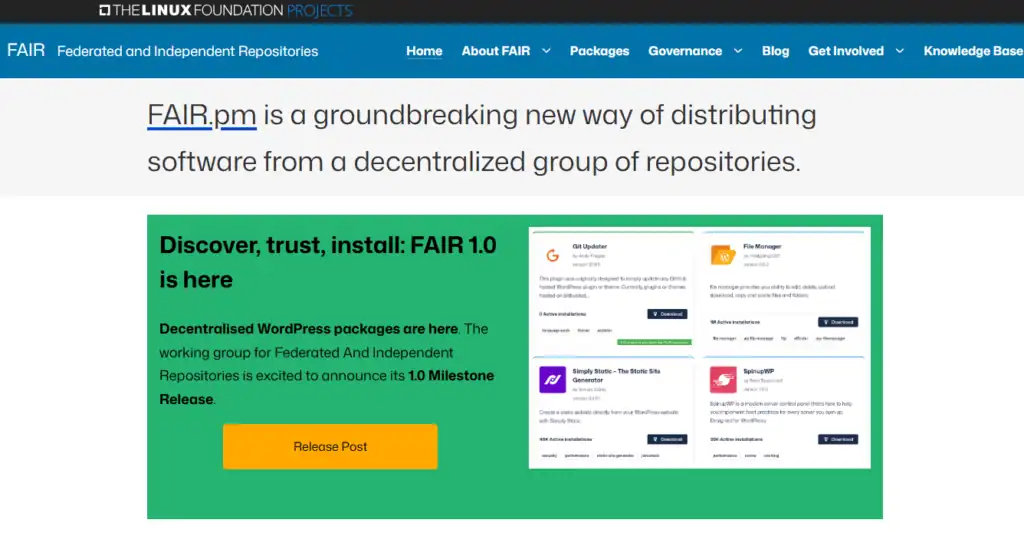
Key points of FAIR include:
- Protocol basis: FAIR is built using ATProto and W3C DID (Decentralized Identifiers) frameworks. These give FAIR the cryptographic, identity, and federation foundations it needs.
- Governance: FAIR is hosted under the Linux Foundation as a neutral, vendor-agnostic project.
- Mission: To improve security in the WordPress supply chain, reduce reliance on any single service, and empower the community via transparent governance.
- FAIR 1.0: The first major release of the system, announced publicly as live.
In short, FAIR is an alternative (not a fork) that works alongside existing WordPress infrastructure but gradually offers a more distributed path forward.
How FAIR Works: Architecture and Mechanics
Understanding FAIR requires grasping how its components interact under the hood and how it integrates (or replaces) existing WordPress services.
Federated and Independent Repositories
Instead of a single monolithic repository, FAIR enables multiple repositories (or “mirrors”) operated by various trusted entities (hosts, plugin shops, open source projects). Sites can fetch updates from one or more repositories in the FAIR federation.
Workflow: Publishing, Discovery, Trust, and Verification
Here’s what the workflow looks like:
- Publishing: Plugin/theme authors can opt in to FAIR by publishing packages to a FAIR-compatible repository (or mirror).
- Discovery: WordPress sites with the FAIR plugin or integration can fetch the list of available packages across multiple repositories.
- Trust & Verification: FAIR uses cryptographic signing, identity (DID), and provenance metadata to ensure packages are authentic and haven’t been tampered with.
- Updates & Installation: From the site’s perspective, it behaves like WordPress does now (install, update, rollback), but the backend fetches from federated sources.
WordPress Integration
FAIR provides a drop-in plugin for WordPress. This plugin replaces or intercepts many of the core calls that would normally go to WordPress.org (update checks, translation fetches, news/events feeds, etc.).
Some features include:
- Version checks and updates for core, plugins, and themes via FAIR instead of WordPress.org.
- Language packs and translations are managed through federated sources.
- Event/news feeds replaced or augmented via FAIR sources.
- Optional local replacement of Gravatar (avatar) calls, media sources, etc., to reduce external dependencies.
For hosts or agencies, FAIR can be bundled into a WordPress distribution with FAIR preinstalled. Repositories can be set up by hosts to serve their customers. Compared to traditional WordPress distribution, FAIR gives more modularity, resilience, and control.
Benefits and Opportunities with FAIR Package Manager
FAIR aims to bring many advantages, some immediate and others long-term, to the WordPress ecosystem.
- Enhanced Security and Supply Chain Integrity: By decentralizing distribution and relying on cryptographic verification, FAIR reduces the risk of a single compromised server propagating malicious code across many sites.
- Reduced Central Control and Vendor Lock-In: FAIR offers an escape hatch: plugin authors and hosts have more freedom in where to publish, and site owners aren’t fully dependent on WordPress.org for all updates or assets.
- Community Governance and Transparency: With FAIR under the Linux Foundation and multiple stakeholders, no single party can unilaterally take over the ecosystem. Governance is designed to be open, consensus-driven, and public.
- Better Trust Models: Provenance metadata, cryptographic signatures, identity validation, and federated reputation systems can make plugin discovery more trustworthy than “whoever uploaded to .org last.”
- Incentives for Developers, Hosts & Agencies: Developers may publish to FAIR alongside .org to reach new audiences. Hosts can run their own repositories, offering curated plugin sets or private forks. Likewise, agencies can ensure consistent plugin versions across client sites via trusted mirrors.
- Resilience and Redundancy: If one repository goes down, sites can fallback to alternate mirrors. No more dependency on a single global infrastructure.
Challenges and Risks with FAIR
No new architecture is without hurdles. FAIR faces some meaningful obstacles.
- Adoption & Network Effects: FAIR’s value depends on widespread adoption. A few scattered installs won’t deliver the resilience the project intends. Getting web hosts, plugin authors, and agencies on board early is crucial.
- Governance & Coordination: Open governance is idealistic, but coordinating across diverse interests, commercial plugin vendors, independent authors, and large hosts can be tough.
- Technical Scalability: It can be tricky to manage large numbers of packages, mirrors, verification, caching, versioning, and conflict resolution across a federated network.
- Tooling & UX Maturity: Early versions may have bugs, limited compatibility, or lack polish. The user experience should remain mostly invisible to site owners, or risk friction.
- Transition & Coexistence: FAIR must coexist with WordPress.org until mass adoption. To ease migration, hybrid systems, fallbacks, and backward compatibility will be needed.
Implications for the WordPress Ecosystem
As FAIR gains traction, its influence is likely to ripple across the entire WordPress ecosystem.
From developers to site owners, marketplaces, and even the broader web, decentralization introduces both opportunities and adjustments. Let’s explore what this shift could mean for different stakeholders.
- For WordPress.org and Core: FAIR is not designed to replace WordPress.org. Instead, it will likely complement and gradually reduce its load. Over time, .org itself may participate as one of many federated mirrors.
- For Developers: Developers can gain greater flexibility. They can decide which repositories to publish to, leverage cryptographic metadata, and manage versioning across multiple mirrors. As a result, trust in distribution becomes less centralized and more community-driven.
- For Site Owners and Administrators: Site owners benefit from added resilience. With FAIR, they face fewer risks of downtime and gain access to a wider range of plugin sources. Yet, their day-to-day update process still feels familiar.
- For Marketplaces and Plugin Shops: Marketplaces could experience a shift. By hosting their own FAIR mirrors, they can reduce reliance on centralized platforms. Consequently, the plugin economy may evolve into a more competitive and modular environment.
- For the Broader Web and Decentralization Movement: Finally, FAIR’s model demonstrates how decentralization can strengthen web infrastructure. Beyond WordPress, it offers a potential blueprint for other CMSs and digital ecosystems.
Use Cases of FAIR and Early Examples
Although FAIR is still in its early stages, practical scenarios already highlight its potential. From hosting providers to enterprises and plugin vendors, different groups can benefit by experimenting with FAIR in distinct ways.
- Hosts with Curated Plugin Portfolios: Managed WordPress hosts could operate their own FAIR mirrors, offering clients only vetted plugins and stable versions.
- Enterprise and Internal Networks: Large organizations can host private FAIR repositories behind firewalls, ensuring consistent and secure plugin updates across all internal sites.
- Niche Plugin Markets: Plugin vendors, especially premium ones, may publish through FAIR alongside existing sales channels, giving users added trust and update reliability.
- Hybrid Coexistence Models: Some sites might adopt a hybrid approach, using WordPress.org for most updates while relying on FAIR for specific needs. Gradually, this could lead to wider adoption.
How to Get Involved and Experiment with FAIR?
Getting started with FAIR is straightforward, and there are multiple ways to participate depending on your role in the WordPress ecosystem.
Whether you’re a developer, host, or site owner, gradual experimentation can help you embrace decentralization with confidence.
- Visit the FAIR Website: Explore fair.pm for an overview of the project’s mission, goals, and updates.
- Explore the GitHub Repository: Head to GitHub to review the source code, documentation, and active development.
- Download the FAIR Plugin: Try the FAIR plugin on a staging site to see how it integrates with WordPress.
- Join the Community: You can also contribute by joining governance groups like the Technical Steering Committee or community working groups.
- Run a Mirror or Share Feedback: Finally, hosts and agencies can set up mirrors, while all users are encouraged to suggest features, report issues, and provide feedback. Starting small makes it easier to transition to production later.
Final Thoughts
FAIR is an ambitious step forward. At its core, it’s not about breaking WordPress; it’s about extending it with a more resilient, distributed infrastructure for plugin and theme distribution.
FAIR offers a path toward a future where no single point of failure can cripple the WordPress ecosystem, while still preserving the update and discovery experience users are familiar with.
If you care about security, autonomy, or the longevity of WordPress, FAIR is well worth your attention. Try it, experiment with it, and join the community pushing WordPress toward a more decentralized, dependable future.
FAQs About FAIR Package Manager
Will FAIR replace WordPress.org?
Not immediately. FAIR is designed to complement WordPress.org and may coexist alongside it until adoption grows.
What is FAIR in the context of WordPress?
FAIR is a decentralized system for distributing WordPress plugins, themes, and other packages without relying solely on WordPress.org.
How does FAIR improve WordPress security?
FAIR uses cryptographic verification and federated repositories, making it harder for malicious code to spread through a single point of failure.
Do I need technical knowledge to use FAIR?
No. Site owners can install the FAIR plugin like any other WordPress plugin, while developers and hosts can explore advanced features such as running mirrors.