
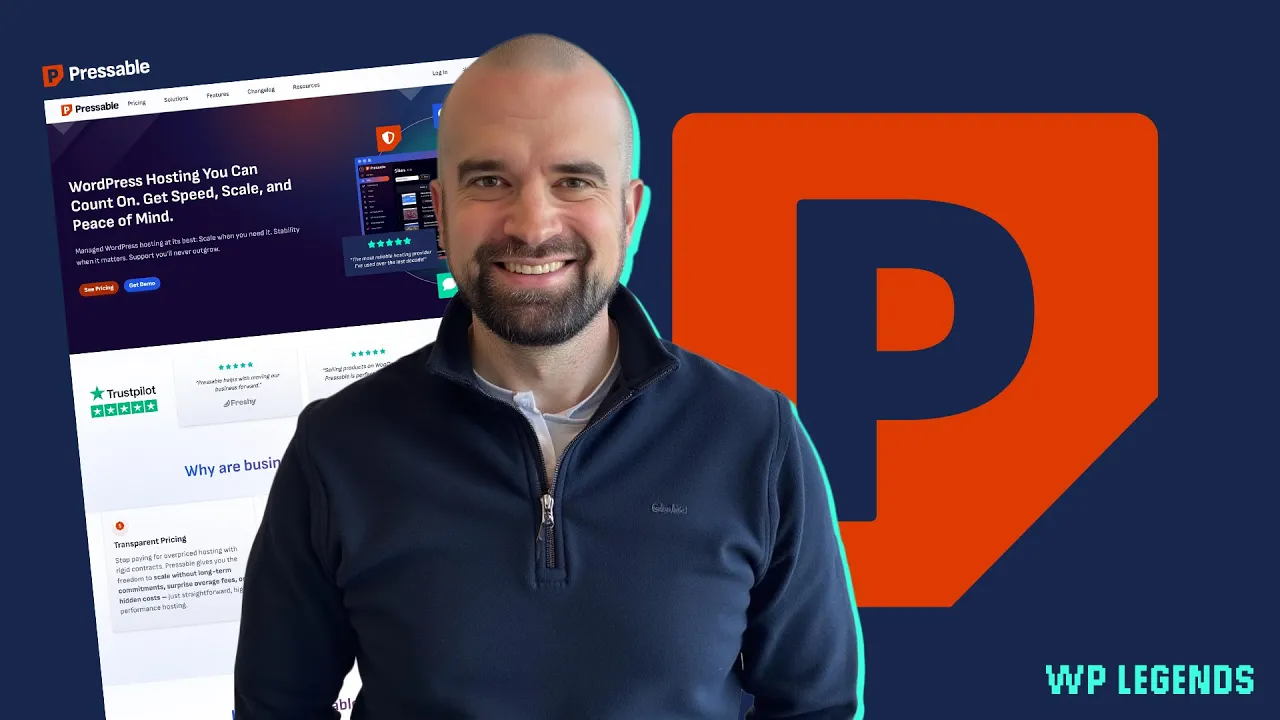
In this episode of WP Legends, we sit down with Kevin MacGillivray, Chief Marketing Officer at Pressable, Automattic’s high-performance managed WordPress hosting platform built for agencies, developers, and digital businesses that need reliability at scale.
Before joining Pressable, Kevin spent nearly six years at Shopify, leading product marketing and revenue strategy across point of sale, payments, shipping, and the wider merchant services stack. Now he brings that e-commerce background into the WordPress world, where relationships, trust, and community shape how business actually gets done.
Gautam and Kevin cover a lot of ground in this conversation: what it takes to grow a hosting brand in a crowded market, why Shopify still dominates small store launches, how automation and AI are changing the way sites get built and maintained, and where WooCommerce fits into the next phase of the open web.
Watch the Episode
From Shopify to the Open Web
Kevin’s route into WordPress ran straight through six years at Shopify. He started out leading product marketing for the point-of-sale product, helping businesses sell in person, then moved to merchant services, the part of the business covering payments, shipping, taxes, financial services, and advertising. In other words, all the tools that help a business succeed once it is already on the platform.
Over those years, a steady stream of colleagues moved from Shopify into the Automattic family, landing in WooCommerce and WordPress VIP. Those relationships slowly sold Kevin on the wider Automattic world, and when the Pressable opportunity came up, the timing was right. Pressable sits in a fast-growing part of the market and is moving from a smaller, agile product and team into a phase that requires real marketing infrastructure to support how it goes to market.
His first proper immersion in the community was WordCamp US in Portland, where he met his own team for the first time alongside partners, agencies, and a wide slice of the ecosystem. As he puts it, it was a great first experience, and a busy one.
The Biggest Mindset Shift From SaaS Commerce to WordPress
Moving from a company the size of Shopify into the WordPress ecosystem is a genuine shift, though Kevin is quick to point out the shared DNA underneath.
At Shopify’s scale, automation is mission-critical. When you are serving that many businesses, you simply cannot operate hands-on, so the company has become very good at doing things efficiently at scale. The WordPress world pulls in a different direction. Here, trust, reputation, and community standing are how partners get chosen and how business gets done. That relationship-led approach is present everywhere, in every conversation, event, and transaction.
What stays constant across both worlds is mission. Shopify built everything around making commerce better for everybody and getting tools into as many hands as possible. Automattic and Pressable are not far off, focused on putting products, tools, and opportunities in front of people so they can build what they want with minimal barriers. The two missions are not identical, but they are adjacent, and both come from an open, founder-led mentality.
Why Shopify Still Wins the Small Store Launch
Gautam brought a real-world experiment to the table. Working with a friend launching a clothing store in the UK, he reviewed around 400 stores and found that roughly 95 percent were built on Shopify rather than WooCommerce. The question that follows is obvious. If WordPress powers 43 percent of the web and gives owners full ownership of their site, why does Shopify dominate the storefront?
Kevin reached for a Lego analogy to explain it. Shopify hands you the set already built. You do not do any assembly, you cannot change much, but the castle is there and ready. The middle option is an opinionated WordPress setup, where the pieces come with an instruction manual and a recommended way to solve your needs. The third bucket is the open, build-anything version, a box of pieces you can turn into whatever you like.
Most people fall into the Shopify model because it is an out-of-the-box solution, but it has cracks. Cost adds up, flexibility is limited, theme setup is not always easy, and Shopify developers are in short supply and expensive to hire when you do find them. Kevin’s takeaway is that the WordPress and WooCommerce communities need to do a better job of telling the stories of the other models, showing what success looks like in each, and highlighting the benefits businesses can achieve by choosing them. With news of tighter integration between Shopify and WordPress on the horizon, that story is only going to get more interesting. For agencies weighing the options, Seahawk’s WooCommerce development work sits right in the middle of this conversation.
Making Site Setup Simpler With Automation and AI
Launching a WordPress site has become far easier thanks to page builders like Elementor and hosts like Pressable that make spinning up and staging a site quick and painless. Even so, moving parts remain. Owners still have to handle things like SSL and a handful of setup steps, and people without a team or a developer budget can get stuck along the way.
This is where Kevin sees AI and ongoing WordPress advances closing the gap fast. People already have access to more guidance than ever, whether inside a product or through an AI tool. Automation is excellent at handling the predictable and the common. What Pressable adds on top is the contextual. When someone hits a problem, they can quickly reach a real person who is often a WordPress developer or contributor and knows exactly what is going on. Gautam vouched for this from experience, noting that his team gets near-instant answers via live chat and that his clients on Pressable have not run into bandwidth or hosting issues.
Positioning Pressable Alongside WordPress.com and WP Cloud
Growing a hosting brand also means positioning it clearly against neighbors, including WordPress.com. Kevin MacGillivray actually leans into the shared foundation as a strength. Pressable is built on WP Cloud infrastructure, so it benefits from that base directly. Since WordPress.com sits in the same Automattic family and shares that infrastructure, the marketing challenge becomes telling distinct stories for products that serve different audiences.
The distinction he draws is practical. WordPress.com does a strong job for agencies that build a site and hand it off to the end user with no ongoing relationship. Pressable thrives in the opposite scenario, supporting agencies that stay involved and manage the site for their client over time. The two are not mutually exclusive, and they are not built to compete with each other. Pressable is also growing in the mid-sized business segment, serving in-house teams running a single high-performance site that need the speed, security, and reliability the platform is known for. Managed relationships like these are also the backbone of Seahawk’s WordPress maintenance and care services.
Storytelling, SEO, and Building an Organic Brand
A large part of Kevin’s day is spent talking to agencies, learning what is working, what is not, and what their clients are struggling with. Those conversations feed directly into marketing. Through the back half of the year, Pressable is releasing an agency case study, a filmed fireside chat, roughly once a week, each telling one agency’s story alongside the collective one.
For Kevin, this is the most rewarding part of the role. In a marketing landscape where authenticity is increasingly hard to find, real people telling real stories cut through the noise, much the same way live events and in-person connections do. Gautam echoed the point, noting that his own channel leans on being unbiased, unscripted, and authentic, because audiences can see straight through anything that is not.
SEO carries real weight at this stage too. Kevin cares about organic discovery and about people finding Pressable in the right contextual moments, and he is watching closely as search evolves toward citations. Building the organic brand, whether through blog articles or by ensuring the site covers the topics users are actually searching for, is a priority he takes personally.
The Tools and Trends Kevin is Watching
Asked what he is most excited about, Kevin pointed to the growing wave of MCP tools and plugins. The ability to work in plain language, find things, and get tasks done without needing to be a technical expert could be a game-changer for many WordPress users. He painted a picture of a broken contact form in wp-admin, where, instead of heading to an AI chatbot or hiring a developer, you simply ask what is wrong and learn you are missing an SMTP setup. If most routine tasks get solved inside the admin like that, the experience shifts dramatically. It ties back to a theme running through his whole career as a product marketer: making the complex simple.
On WooCommerce, Pressable works closely with the team, and Kevin is candid about wanting to see product and category setup simplified further to drive adoption. The plugin ecosystem is already vast, with everything from Stripe, Square, and PayPal to FunnelKit, MemberPress, LifterLMS, Tutor LMS, and LearnDash available to anyone building a store. The remaining friction is set up, and lowering it so more people can launch without a developer would grow adoption across the board.
The conversation also turned to the rise of AI site builders like Lovable, Base44, Framer, Wix, and Squarespace. Kevin sees these companies pushing the boundaries of what is possible, which the whole space needs, but he frames them as adjacent rather than direct competitors. Many people building on tools like Lovable get stuck at the 80 to 90 percent mark and then have to work out how to finish. Where these tools shine is prototyping and MVPs, spinning something up fast to show a client or an investor before committing full resources. The trust and ecosystem built around WordPress still matter deeply to many people, and as more of this technology is built into WordPress itself, that feels like the more likely path forward.
Fun Rapid Fire Round
To close, Kevin took on the rapid-fire round.
Among the metrics he loves seeing most, he skipped pure dollars and went to user metrics: how many new businesses and agencies are joining, how many sites are being added, and how few customers are leaving. Stickiness and true product engagement are what get him excited.
On whether WordPress or WooCommerce holds the bigger opportunity right now, he admitted that six months ago, his Shopify background would have pushed him toward e-commerce. After going deeper into WordPress, he has a newfound appreciation for just how huge the non-commerce market is, and he refused to crown one over the other.
And on the fun hypothetical of hosting in space, would he market a thousand dollar a month space hosting plan, he figured there are always buyers who love a good novelty. Gautam upped the ante, betting people would pay ten thousand for it, because there is a customer for just about anything.
Kevin is planning to attend some of the big WordCamps in 2026, with Europe and Asia on the radar, including Mumbai. He also gave a warm shout-out to Pressable’s swag, including the Portland t-shirt.
Get Featured on WP Legends
Are you a plugin creator, WordPress entrepreneur, or someone building something cool in the WP space? We’d love to share your story on WP Legends.
Powered by hosting.com


